The Z-Score: Why Your Weakest Subject Decides Your University Seat
The short answer: Your marks in each subject are standardised against everyone who sat that subject's paper — how far above or below that cohort you stand is your subject Z-score — and university selection ranks you on the average of your three. Each subject holds exactly one third of that average, which is why one weak subject drags down two excellent ones.
A chapter of the free book Learn to Learn
Published 2026-08-31 · updated 2026-08-31
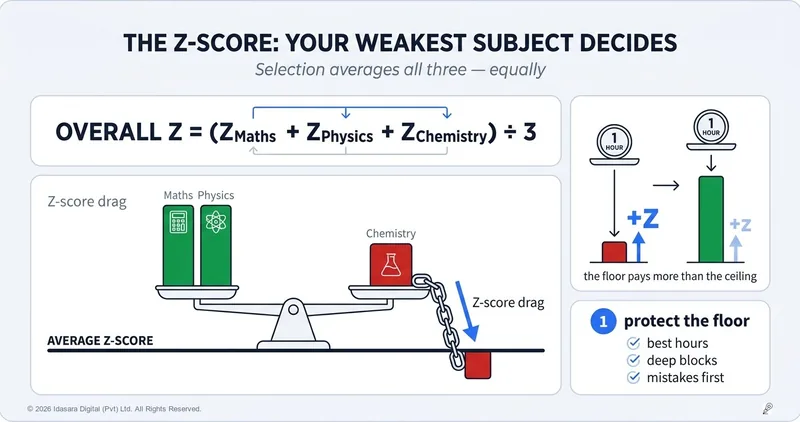
University entrance in Sri Lanka is decided not by your marks but by your Z-score — a relative measure averaged across your three subjects, which gives your weakest subject the same vote as your strongest. This chapter of Learn to Learn explains how the Z-score actually works, why one neglected subject drags down two excellent ones, and the strategy that follows: protect the floor, don't just raise the ceiling.
Every A/L science student knows a version of this story, because every batch produces one.
A brilliant student — genuinely brilliant at Combined Maths, strong in Physics. Their Chemistry, though, was the subject they "never liked," studied grudgingly, last on every list. Results day: excellent, good… and weak. And the university list, when it comes, carries a shock that seems mathematically unfair: students visibly less brilliant at maths are holding the engineering seat.
Nothing unfair happened. The selection system did exactly what it is designed to do — and the student, like most students, had spent two years optimising the wrong quantity. Understanding this before your two years are spent is worth more than almost any single piece of subject knowledge in this book.
What is a Z-score, actually?
University selection can't compare raw marks across subjects and years — a 72 in one subject in one year is not the same achievement as a 72 in another (papers differ in difficulty; cohorts differ in strength). So selection uses a statistical standardisation: your Z-score in a subject expresses where you stand relative to everyone who sat that paper — how far above or below the cohort's average you performed, in units of the cohort's spread. Score at the average, and your Z is around zero; comfortably above the pack, positive; below, negative.
Two properties follow immediately, and both matter strategically:
It's a relative race. Your Z rises not by your marks being good, but by your marks being better than the cohort's — the national cohort, including every tuition-drilled competitor. This is why the ladder's honest instruments (marked papers, real schemes) matter so much at A/L: you are being measured against the field, so your practice must be measured the same way.
Then the three subjects are averaged. Your overall Z — the number that ranks you for selection — is, in essence, the mean of your three subject Z-scores. One third each. Your weakest subject holds exactly as much of your future as your strongest.
The tyranny of the average
Sit with that arithmetic, because its consequences run against every instinct.
Instinct says: be excellent at what you're best at. The average says: excellence in one subject and weakness in another cancel — a strongly positive Maths Z and a negative Chemistry Z can net out to the overall Z of a merely average student, which is precisely how the batch's "less brilliant" candidate takes the seat: three solid positives beat two stars and a hole, reliably.
Worse, the exchange rate is asymmetric in exactly the wrong direction. At the top of a subject you're already beating most of the cohort, and pushing higher means outcompeting the strongest — hard-won, small Z-gains. Near the bottom, marks are cheap: a neglected subject brought from weak to solid gains raw marks fastest — foundations, baseline questions, method marks (marks earned for correct working) — and the Z follows the marks. In plain terms: an hour invested in your weakest subject buys more Z than the same hour polishing your strongest. The brilliant student's tragedy was an allocation error: two years of hours flowing to where study felt rewarding, away from where the arithmetic paid.
This is Z-score drag, and the strategy it dictates is the opposite of instinct: protect the floor first. Your overall Z is hostage to your worst subject; the highest-yield project on your desk is almost always the subject you like least.
How do you protect the floor?
Nothing new is needed — every tool is already in your kit; the Z merely re-aims them:
- Find the true floor with instruments, not feelings — marked papers and the mistake bank's per-subject balance — how many logged errors each subject carries (the readiness chapter's signals, read per subject). The disliked subject and the weakest subject are usually, but not always, the same one.
- Give the floor the structural advantages: it leads the deep-work rotation more often, it gets the peak-energy hours, its mistake-bank entries get eliminated first — the hardest-subject rules from this whole time layer, now with a selection-arithmetic justification.
- Hold the ceiling with maintenance, not neglect — your strong subjects still get their rotation-guard slots and paper volume; the guard exists precisely so floor-repair doesn't create a new hole elsewhere.
- Watch the balance monthly: per-subject paper scores trending — floor rising, ceilings holding — is what a rising overall Z looks like from inside the year. If the floor subject's trend stays flat for a month, escalate its share; the drag is compounding while you wait.
And a reframe for the feelings, because two years is long: you don't have to love your floor subject. You have to respect what it holds — one third of the number that opens the door. Students who internalise the arithmetic report the resentment easing; the subject stops being a dislike and becomes a project with the best exchange rate on the desk.
Do this tonight
- Rank your three subjects by evidence — most recent marked-paper performance, not affection. Name your floor.
- Audit last week's hours across the three, honestly. Most students find the floor got the least and the worst hours — instinct's allocation.
- Re-cut next week: the floor takes tomorrow's deep block and the peak hour, its oldest mistake-bank entries scheduled first. One week of floor-first allocation, then look at what the marked work says. The arithmetic has been waiting two years for you to use it.
At a glance
- The Z-score standardises your performance relative to the national cohort, per subject; selection ranks the average of your three — each subject holds one third of your future.
- Excellence and weakness cancel: two stars and a hole lose to three solids, reliably.
- The exchange rate favours the floor: an hour on your weakest subject buys more Z than an hour polishing your strongest.
- Strategy: protect the floor — deep-block leadership, peak hours, mistake-elimination priority — while the rotation guard holds the ceilings.
- Track per-subject trends monthly; a flat floor trend is compounding drag.
One step further with Idasara Academy
Z-score drag is invisible from inside a busy week, which is why the A/L engine watches it for you: on the exam plan, Idasara Academy's Z-score tool estimates your standing from your actual marked performance, flags when one subject is dragging your aggregate, and reallocates your daily plan's weight toward the floor before the drag compounds — while the rotation guard keeps the strong subjects held. The tyranny of the average, turned into a screen you act on monthly instead of a shock you receive on selection day.

Start Free — Create Your Account →
FAQ
Is the averaging really that blunt — doesn't my best subject count extra for my chosen course? Selection runs on the overall Z through the UGC's published process — the UGC (ugc.ac.lk) is the authority on how; the ranking number itself averages your subjects. Course-specific nuances exist downstream, but the headline arithmetic — weakest subject, equal vote — is the planning reality, and it's the one allocation decisions must respect.
My weakest subject feels beyond repair. Should I just maximise the other two? The arithmetic says that's the one strategy guaranteed to underperform: the two strong subjects are already near their expensive Z-territory, while the weak one sits on the cheap gains. "Beyond repair" is almost always the debt chapter's compound interest talking — walk it back to ground that holds, and take the thick-of-the-crowd gains that are waiting.
Does this mean equal hours for all three subjects? No — it means evidence-weighted hours with a floor bias, held inside the rotation guard. Equal hours is instinct's other error; the right split follows the marked-paper trends, re-read monthly.
How do I even estimate my Z during the year? You can't compute the real one — it depends on the cohort's exam. What you can do is track its inputs: performance on marked official past papers against real schemes, per subject, over time. Relative standing follows performance; the instruments you already run are the best forecast available to any student.
Further reading
Z-score drag, deep-work allocation, and the A/L engine are written up in the Idasara Method: Part 4 — Time Management & Flipped Learning and Part 3 — The Grade Progression Ladder & Paper Marking (rank models).
Sources
- The Idasara Method: Part 4 — Time Management & Flipped Learning (Z-score drag protection)
- The Idasara Method: Part 3 — The Grade Progression Ladder & Paper Marking (Z-score & rank models)
- National Institute of Education, Sri Lanka — nie.ac.lk (A/L syllabi the papers standardise over)