No Quiet Room: How to Study in a Full House
The short answer: Quiet is made, not found — three ways: claim the half-hour before your morning chores begin (earned by an earlier bed, never stolen from your duties), move deep work to reachable quiet places like the school library, and negotiate one small, specific quiet arrangement with the family. Noise-tolerant work — card reps, drills, audits — stays home for the loud hours.
A chapter of the free book Learn to Learn
Published 2026-08-31 · updated 2026-08-31
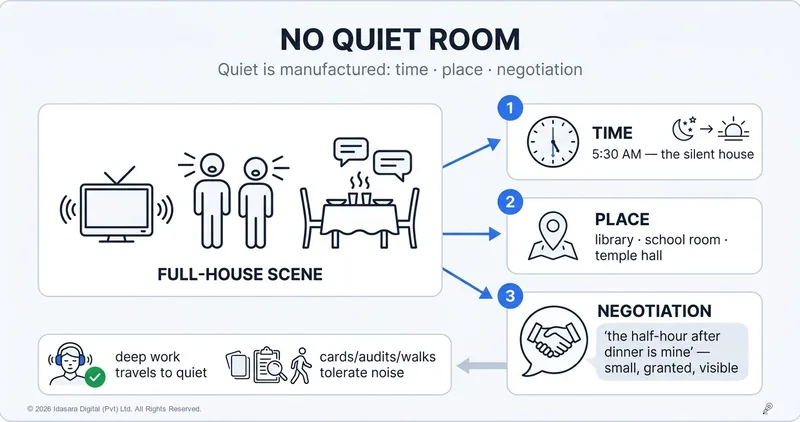
Study advice is written by people with doors: "find a quiet space, remove distractions" — as if half the country's students don't share one room with a television, siblings, and the whole evening life of a family. This chapter of Learn to Learn is for the doorless: the three moves that manufacture quiet where none exists — shifting time, shifting place, and negotiating openly — plus the honest science of studying through noise you cannot switch off.
Every study guide in the world contains the same serene sentence: "Choose a quiet, comfortable study space."
Now here is an ordinary Sri Lankan evening: one main room, the TV on because grandmother watches her teledrama, a younger sibling doing homework loudly, dinner being made, neighbours visiting, the light shared. There is no quiet space to "choose."
So let's solve the real problem. For the student without a door, quiet is not a room you find. It is something you make — from time, from place, and from asking. Three moves, in order of power.
Move 1 — Shift time: claim the quiet edge of the morning
The most reliable quiet in a full house is not a place. It is an hour — the early morning, before the household's day starts. But let's be honest about it, because in many homes the early morning is not free: the fire gets lit, water gets carried, and in farm and shop households — especially for daughters — dawn already belongs to chores.
So the honest claim is smaller and more real: the half-hour before your chores begin. If the household's work starts at 6:00, your quiet study window is 5:30 — earned by an earlier bed, not stolen from your duties. And where the morning's chores are genuinely movable, negotiate one shift openly (Move 3 below shows how): "if the water is carried the evening before, my mornings are free until six." Even thirty pre-chore minutes at the day's quietest hour, on the science's best window, outperforms an hour fought for in the loud evening. The price is paid the night before: early bed, evening kept light — the sleep chapters' rules become non-negotiable.
Move 2 — Shift place: the geography audit
The second move: stop assuming study happens at home. Run a one-week audit of your actual geography: the school library or an empty classroom in the after-school hour (teachers grant this more readily than students ask — asking is the whole trick), the public library, the temple or church hall on quiet days, a relative's calmer house on a schedule, even the right bench at the right hour. The working question: where, within my reachable world, do thirty quiet minutes reliably exist?
Then match work to place, deliberately: deep work travels to the quiet places; noise-tolerant work stays home. The blank-page test — writing a topic from memory — first-contact reading, past-paper sittings: these go where the quiet is. And a whole layer of this book's method is surprisingly noise-tolerant: flash-card reps, the figure walk — retelling a chapter's diagrams from memory — copying-out the mistake list, red-ink audits, even exercise-drilling once a skill is warm. The full house doesn't stop your studying; it just claims the shallow half — if you sort the halves on purpose.
Move 3 — Negotiate: the family is not the enemy
The move most students never make out loud: ask the household for structured quiet, small and specific. Not "everyone be silent always" (impossible, and resented) — but a named, bounded, visible arrangement: "the half hour after dinner, TV volume down and the small table is mine" or "Sunday morning until ten."
Two rules make the negotiation land. Make it small enough to grant — thirty protected minutes honoured beats three theoretical hours resented; you can grow a working arrangement, never a failed one. And make the studying visible in return — this is the blame-cycle chapter's economics running in reverse: a family that can see the tracker on the wall — the term's progress, charted — and the marked papers accumulating defends the quiet half-hour as its project. In many houses, the sibling becomes an ally ("quiz me from these cards" turns the loud little brother into a retrieval machine), and the parent who once talked through your studying becomes the one shushing visitors. Families protect what they're included in.
What about the noise that remains?
Some noise survives all three moves. The honest science: attention can work through steady background noise far better than through speech-and-TV (words hook the language mind); so for home hours, prefer the corner away from the screen, use simple earplugs or steady sound if you have any means to (even a fan's hum masks voices), and give noisy-hour work the noise-tolerant tasks from Move 2's sorting. And drop the guilt: focus lost to a full house is a condition, not a character flaw — the comeback chapters' rule applies here too. You are not a worse student than the room-owners. You are running the same engine on a harder track, and the engine still wins.
Do this week
- Claim one pre-chore morning window — just one — and run a real study block in it. Judge the half-hour by what it produced, not by the alarm's pain.
- Run the geography audit: list every reachable place where thirty quiet minutes exist, and assign next week's deep work to them.
- Make one small, specific, grantable quiet-request to the family — with the wall-tracker offered in return. Start the arrangement this book can grow.
At a glance
- "Find a quiet room" is advice for people with doors. Quiet is made: from time, place, and asking.
- Time-shift: claim the half-hour before the morning chores begin — the day's quietest window, earned by an earlier bed (and where chores can move, negotiate the shift openly).
- Place-shift: audit your real geography (school rooms, libraries, halls, relatives) — deep work travels to quiet; noise-tolerant work (cards, walks, audits, drills) stays home.
- Negotiate small and visible: thirty granted minutes beat three resented hours; a family shown the instruments defends the arrangement as its own.
- Remaining noise: sit away from speech, mask with steady sound, assign it the tolerant tasks — and carry no guilt. Harder track, same engine.
FAQ
Getting up even earlier sounds miserable — mornings are already heavy here. Is it really worth it? Try it honestly for one week before judging — most students report the opposite of misery: the first calm studying of their lives, and real pride in the claimed half-hour. The misery lives in late nights plus early mornings together; the trade only works when the evening pays for it with an earlier bed. And if your mornings truly cannot give even thirty minutes, that's what Moves 2 and 3 are for — the method never depends on one clock time.
My family thinks studying anywhere but home means I'm roaming. How do I get permission for libraries and school rooms? Make it verifiable: named place, named hours, work brought home to show (the visibility chapter's machinery again). Start with the most trusted venue — school, with a teacher's knowledge — and let the produced evidence buy the next permission. Families relax when the story checks out repeatedly.
I'm the one who minds the younger children in the evening. The noise IS my job. Then you're carrying the working-and-caring chapter's life, and it has its own machinery — but two pieces land now: the noise-tolerant task-sorting turns minding-hours into card-rep hours, and the sibling-as-quizzer trick genuinely works from about age seven. Your deep work moves to the mornings the household grants a carer most easily.
Exams are close and the house is impossible. Emergency options? Exam season is when the negotiation goes large — most families will grant real arrangements when the date is named and near — and when the geography audit gets aggressive: schools open study rooms in season, libraries extend, relatives say yes to a bounded month. Ask bigger than feels comfortable; exam season is the one time the whole culture is on your side.
Further reading
The heavier version: Studying While Working or Caring. The hour this chapter claims: Your Hardest Subject Deserves Your Best Hour. The family machinery: "I Never See You Studying".
Sources
- The Idasara Method: Part 4 — Time Management & Flipped Learning (energy windows; block architecture)
- NHS — supporting study routines (family environment and calm)
- Francesco Cirillo — the Pomodoro Technique (bounded blocks — the negotiable unit)