Your Hardest Subject Deserves Your Best Hour — Find It and Defend It
The short answer: The best time to study your hardest subject is your personal peak hour — for most students, the first hours after properly waking. Find yours with a one-week audit (rate your sharpness a few times a day), then assign that hour, the night before, to the hardest material — never to copying, organising, or the phone.
A chapter of the free book Learn to Learn
Published 2026-08-31 · updated 2026-08-31
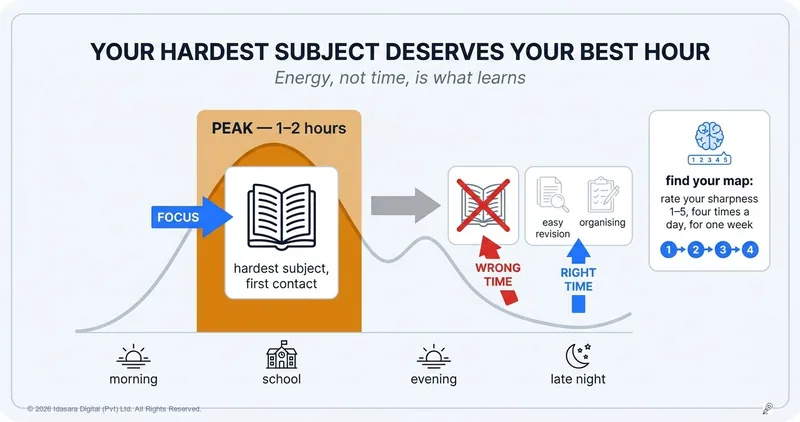
Every student has one or two hours a day when their mind is genuinely sharp — and most spend those hours on anything except the subject that needs them. This chapter of Learn to Learn shows how to find your personal peak window, what belongs inside it, and how to defend it against everything that wants it.
Here is a question you have probably never been asked: at what time of day are you clever?
Not "when do you study" — when are you sharp? Because you aren't equally intelligent all day; nobody is. There are hours when hard material opens under your attention, and hours when the same page might as well be fog. Every student knows this from the inside — and yet almost no student schedules as if it were true. The evening gets planned by subject and by habit, never by energy — which is how the strange, near-universal arrangement happens: the hardest subject ends up with the worst hours.
You saw the mechanism in the time chapter: comfortable subjects colonise the fresh hours because they're pleasant, and the heavy subject gets what's left — eleven o'clock, a drained brain, an open book in front of closing eyes. Then its marks disappoint, and the student concludes the subject is the problem. The subject was never given a fair hour to be learned in.
Energy is the currency; the clock is just the wallet
Recall the book's position from the time chapter: energy, not time, is the resource that learns — sixty fresh minutes outperform three drained hours. This chapter adds the operational half: energy arrives on a schedule, and yours is knowable.
For most people, the sharpest window sits in the first hours after properly waking — before the day's decisions and noise have spent anything. A second, smaller peak often follows real rest — after a meal-and-break, or early evening for students who genuinely revive then. The exact map varies person to person; what doesn't vary is that a map exists, that the peaks are one to two hours at most, and that they are far too valuable to spend by accident.
What belongs in a peak hour is exactly what the rest of the day can't do: first contact with the hardest material. New topics in your weakest subject. The derivation that defeated you last time. Debt repayment — clearing topics you still owe — from the foundations chapter. The full loop — read, note, exercise, mark — on dense chapters. What does not belong there — and what almost universally squats there — is everything easy: copying, organising notes, maintenance revision of strong topics, and the phone. Spending a peak hour on easy work is like paying for gold with diamonds; the easy work would have been fine at a fog hour.
How do you find your peak window — and defend it?
Finding it takes one honest week. Each day, rate your sharpness (1–5) at three or four points — morning before school, after school, early evening, late evening — one number, ten seconds. By Sunday the pattern is unmistakable, and most students are surprised by at least one thing: how good the early morning actually is, or how consistently dead the post-dinner slot they've been relying on turns out to be.
Defending it is the real discipline, because your peak window is valuable to everyone and everything: the household's errands, friends' messages, the comfortable subjects, your own preference for easing into things. Three defences:
- Assign it the night before. A peak hour that opens unassigned gets colonised in minutes. The daily plan's first line: "[peak window]: [hardest subject], [named outcome]" — the energy rule and the named-outcome rule composed.
- Guard its edges. The window dies by nibbling — a ten-minute delay here, a "quick check" there — and a two-hour peak becomes forty usable minutes. Treat its start time like a class you can't be late to; the phone-in-another-room rule matters most at exactly this hour.
- For most students, that means mornings — which are made the night before. For many students the peak is the early morning, and its quality is set by one variable: last night's sleep. A student who trades sleep for late fog-hours is selling tomorrow's gold hour to buy tonight's lead one — the worst exchange rate in studying. (The cramming chapter ahead prices this trade fully.)
School days compress all this, and honesty helps: on a school day you may own only one true peak block — early morning before school, or the first block after coming home and resting (rest first; the post-school hour arrives spent). Weekends are where the map pays fully: two or three peak blocks, every one pre-assigned to the heavy work, is what makes a weekend worth more than its hour-count suggests.
Do this tonight
- Start the one-week energy audit: three or four sharpness ratings a day, ten seconds each, in the back of your planner.
- Meanwhile, run the default bet — it's right for most people: tomorrow's first fresh block goes to your hardest subject, assigned tonight by name and outcome.
- After the block, note what it felt like to meet that subject sharp. Students who make this one swap often report the subject itself starting to feel easier within weeks. It didn't. It's finally being studied by the best version of you.
At a glance
- You are not equally sharp all day: one or two peak hours exist, and by default the hardest subject gets the worst ones.
- Peak hours are for what fog hours can't do: first contact with the hardest material — never copying, organising, or easy revision.
- Find your map with a one-week audit (sharpness ratings, ten seconds each); most peaks are early-morning, made the night before by sleep.
- Defend the window: assign it the night before · guard its edges from nibbling · phone in another room.
- School days own one true peak; weekends own two or three — pre-assign every one.
One step further with Idasara Academy
Knowing what deserves the peak hour is half the discipline, and it's the half Idasara Academy computes for you — free to start: Today's Plan ranks each day's tasks by where your marks currently swing, so the heaviest-yield work is already named and sized when your best hour opens, and the free My Schedule maps your real week (school, tuition, travel) so the plan lands in hours you actually own. You bring the defended window; the plan brings its worthiest occupant.
Start Free — Create Your Account →
FAQ
I'm certain I'm a night person. Should I still force mornings? Trust the audit over the identity — but run the audit honestly, because "night person" is sometimes real chronotype and often just when the house finally goes quiet (a scheduling fact, not an energy one). If your rated peak genuinely sits late, assign the hard subject there — and still protect the sleep that funds it.
My only free time is late night after tuition. What then? Then two moves matter more than perfection: rest before the late block (twenty real minutes, not phone minutes — you'll recover part of a peak), and push the hardest first-contact work to whichever mornings you actually control — a tuition-free weekend slot, a school holiday — keeping weeknights for practice and maintenance. The map you have beats the map you wish you had.
Does the peak hour rule apply during exam season? Doubly. Exam-season mornings are gold bullion: full-paper attempts and elimination sessions belong there, admin and light revision in the troughs. And since many papers are sat in the morning, training your hardest performance at morning peak is also rehearsal for the real thing.
Isn't this just "wake up at 4 a.m." advice in disguise? No — nothing here says wake earlier. It says whatever hours you have, know which are gold, and stop spending them on copper. A student who wakes at 6:30 and gives 6:45–7:30 to their hardest subject has fully obeyed this chapter.
Further reading
Peak energy windows, difficult-subjects-early, and the daily rhythm are written up in the Idasara Method: Part 4 — Time Management & Flipped Learning.
Sources
- Francesco Cirillo — the official Pomodoro Technique site (rest as part of the work rhythm)
- UCLA Bjork Learning and Forgetting Lab — research overview on effortful learning conditions
- The Idasara Method: Part 4 — Time Management & Flipped Learning