Six Months Left: The Honest Rescue
The short answer: Six months is real time if you aim it: spend the first week auditing your true position (syllabus checklists plus cold past papers), then buy marks in order of price — untouched topics in maths and language first, past papers weekly as the engine, exam technique alongside, and the rest written off out loud. Panic re-reads everything; a rescue triages.
A chapter of the free book Learn to Learn
Published 2026-08-31 · updated 2026-08-31
Somewhere between the mock exams and the real ones, thousands of students do the maths on their preparation and feel the floor open. What follows is usually one of two disasters: paralysis, or a panic-plan copied from students who prepared all along. This chapter of Learn to Learn is the third option — triage: the cold arithmetic of what remaining months can and cannot buy, the strict order that maximises marks-per-week, and the honest expectations that keep a rescue from becoming a collapse.
First, the sentence the panicking student needs before any plan:
Six months is real time. Not enough for everything — the chapters that told you consistency beats rescue were true, and this chapter won't unsay them — but six months of aimed work is transformative, and even three months moves grades. The students who waste late months don't waste them by lacking time; they waste them by spending panic on the wrong work: re-reading everything, attending more classes, starting beautiful schedules that assume a year. Rescues fail on aim, not effort.
So this chapter is aim. Triage has one law: buy marks in order of price. Here is the order.
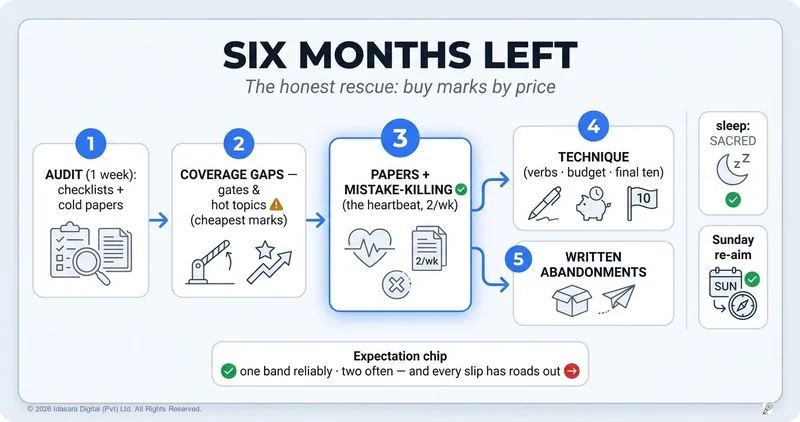
What do I study first? The rescue order (spend your weeks down this list)
1. First week: the audit — you cannot triage blind. Two or three days establishing the true position, using instruments you own: the syllabus checklist per subject (honestly: finished / touched / never), one recent past paper per major subject sat cold and marked ruthlessly (your baseline — painful and priceless), and the error species those papers expose. The audit converts dread (infinite, unactionable) into a list (finite, priced). Every rescue that skips this step buys the wrong things.
2. Coverage gaps in gate subjects — the cheapest marks anywhere. An untouched topic caps your maximum (the contract chapter's arithmetic), and untouched topics yield marks fast: a focused loop-pass — read, produce, check — on a never-studied topic buys its baseline questions in days. Priority within this: the gate subjects (maths, language of instruction) and each subject's heavily-examined topics (past papers reveal which — that's part of what the audit's papers were for). This is also where the comeback protocol plugs in if foundations are the real gap: placement first, gates first.
3. Past papers + mistake elimination — the engine of the remaining months. As soon as coverage is merely decent (not perfect — rescue never waits for perfect), the ladder's Rung-3 machinery takes over as the main diet: papers under conditions, marked, mistakes banked and killed, weekly. In a rescue, papers do triple duty — they train the exam, reveal the next cheapest gaps, and force the syllabus's high-frequency material to the front. Two papers a week per priority subject from month two is the rescue's heartbeat.
4. Format and technique — the marks nobody deserves to lose. The verb habit, method-marks discipline — the marks paid for shown working — the time budget, the final-ten routine: cheap to install (each is a chapter and a week of practice), and in a rescue they matter disproportionately — technique marks are the ones that don't require knowing more.
5. What gets abandoned — say it out loud. Triage means the list has a bottom: the strong subjects drop to maintenance doses (they're already bought), the deep extras go entirely, perfection goes everywhere — and, hardest, some weak-subject ambitions get honestly downgraded from "A somehow" to "solid pass, banked." Write the abandonments down. An unwritten abandonment nags and steals hours; a written one frees them.
The rescue's operating rules
Three rules keep the machine from shaking apart. Consistency still beats intensity — even now: the rescue runs on the launch chapter's engineering (daily blocks, never zero, the bad-day floor) at higher volume — not on 14-hour days, which the cramming chapter priced and which collapse by week three exactly when you need them most. Sleep stays sacred — the rescue's studying must consolidate, and its exam must be sat awake; a rescue that cuts sleep is un-rescuing nightly. And the weekly re-audit steers: every Sunday, twenty minutes — what did papers reveal, what's now the cheapest unbought mark, does the order need reshuffling? A rescue is six months of aiming, re-aimed weekly.
What can six months actually buy? Honest expectations — the part that keeps you sane
What can the months actually buy? No honest number exists — no one has measured rescues at scale, and this book doesn't invent statistics. What can be said mechanically: the cheapest grade movements are the ones nearest a boundary with a nameable leak — F-to-pass and S-to-C are usually coverage-and-technique purchases (the least expensive kind), C-to-B commonly follows real paper volume, and B-to-A depends on how much foundation the audit found already standing. Plan on moving the boundaries your evidence says are close; treat anything more as upside. What the months cannot buy is the outcome a full year would have bought — and making peace with that, early, is a rescue skill: chase the best genuinely-buyable slip, not the fantasy one, and remember what Part 10 proved: every slip has roads leading out of it. The rescue's job is to hand you the best possible starting position on whichever road — not to redeem the wasted months. Those are gone; the next six aren't.
Do this — starting today, because rescues don't start Monday
- Run the audit this week: checklists, one cold paper per major subject, species. Write the true position on one page.
- Draft the rescue order for your case — gates and cheap coverage first, papers as the heartbeat from month two, technique installed alongside, abandonments written.
- Install the engine: daily blocks with the never-zero floor, Sunday re-audits, sleep protected. Then start. Today counts as day one; that's the whole point of today.
At a glance
- Six months is real time — rescues fail on aim, not effort. Triage's law: buy marks in order of price.
- The order: 1) one-week audit (checklists + cold papers + species) → 2) coverage gaps in gates & high-frequency topics (the cheapest marks) → 3) papers + mistake-killing as the heartbeat → 4) technique (the undeserved-loss marks) → 5) written abandonments.
- Operating rules: consistency over heroics (never zero; no 14-hour collapses) · sleep sacred · Sunday re-aim.
- Expectations, honestly: buy the grade-boundaries your evidence says are close (near-boundary + nameable leak = the cheap purchases); treat more as upside — and every real slip has roads out (Part 10).
- Rescues start today. Monday is the vow-cycle talking.
One step further with Idasara Academy
The free Mistake Bank and Today's Plan run the rescue diet's bookkeeping; on the paid tiers, cold papers go through Exam Paper Marking for ruthless baselines, and the exam plan's Readiness Score turns the Sunday re-aim into a glance at a trend. Six months, spent where they buy most.
Start Free — Create Your Account →
FAQ
Should I quit school attendance to rescue full-time? The attendance rules are real (verify your school's), and school still delivers things the rescue needs — teachers for the question log (your saved stuck-questions list), marked mocks, the exam's own administration. The honest version: attend, but flip every attended hour into rescue service (the night-before ritual aims your classes at your gaps), and spend the self-study leave when it officially arrives.
More tuition now, or less? Usually less: the rescue's bottleneck is conversion hours, and month-four is the worst possible time to add delivery (the Me Time arithmetic at its starkest). The exception: a class that marks papers weekly is feedback, not delivery — that one earns its bus fare.
My subjects are all equally behind. How do I pick priorities? Gates first (their failure costs the most doors), then by marks-per-week: the audit's cold papers show where you're closest to the next band — buy the near jumps before the far ones. Equal-behindness never survives an honest audit; something is always cheapest.
What do I tell my parents about what's now realistic? Show them the audit page and the rescue order — the same shared-instruments move as ever (the results-day chapter sets up that conversation fully). Parents panic at vagueness and settle at plans; "here's the true position, here's the order, here's what each month buys" is the calmest sentence a worried house can hear.
Further reading
The engine this rescue runs on: The First 30 Days (ignition) · Why 10 or 20 Past Papers (the heartbeat) · Cramming vs Consistency (why no 14-hour days). The roads after any slip: Part 10's door-map.
Sources
- Murre, J. & Dros, J. (2015) — the forgetting curve (why consistency still wins in a rescue)
- NHS — exam-season basics (sleep as non-negotiable)
- The Idasara Method: Part 3 — The Grade Progression Ladder & Paper Marking (the machinery the rescue borrows)