Results Day at Home: The 24 Hours That Shape the Next Year
The short answer: Plan every outcome out loud a week before the number exists. In the first ten minutes: clean joy if it's good; if it's hard, connection before analysis — "come here. We're fine. This changes plans, not us" — and no comparisons, no autopsies, no relatives' calls until the family is ready.
A chapter of the free book Learn to Learn
Published 2026-08-31 · updated 2026-08-31
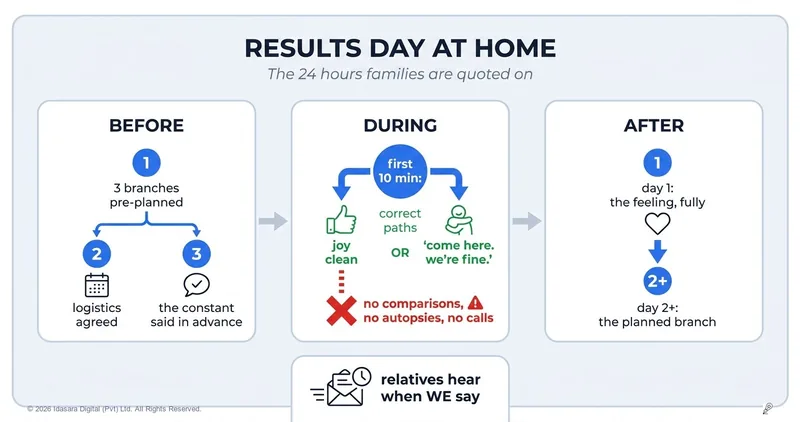
A few times in a school life, a single morning turns a household electric: the results release. Families walk into it unrehearsed — and unrehearsed families say things, in the first ten minutes, that children quote to themselves for decades. This chapter of Learn to Learn is the rehearsal: the before (every outcome pre-planned), the during (what the first ten minutes are for), and the after (when celebration and grief each get their day, and planning gets the next one).
Ask adults what they remember of their own results days and notice what they quote: almost never the numbers — the reactions. The father's face. The aunt who was told first. The sentence said in the doorway. Results arrive as data and land as verdicts-about-me, delivered by the people whose verdicts matter most — which is why an unrehearsed household is dangerous precisely in proportion to how much it cares.
The whole chapter is one principle, applied three ways: decide everything decidable before the number exists — because the ten minutes after it exists are the worst decision-making conditions a family faces all year.
Before: the pre-planning evening
A week or so out, hold the short family conversation that changes the day (the after-A/L chapter assigned it; here is its script):
- Pre-plan every outcome, out loud. Three branches — better than hoped, roughly as expected, worse than feared — and for each, one sentence of what we'll do next (the door-map's routing: apply here, run the repeat-diagnosis, walk the other roads). The branches don't need detail; they need existence — a child who knows the family has a plan for the bad branch walks to the school notice-board with a floor under them, and the readiness chapter's evidence means nobody should be truly ambushed anyway.
- Agree the logistics: who checks (increasingly the student, online, and they get to choose who's beside them), when relatives get told — after the family has had its private hours, on a message the family drafts together — and the phone's role (the group chats will be a storm of everyone's numbers; the comparison chapter's weather, at its worst — agree in advance it can wait a day).
- Say the constant, once more, in advance: the sentence the parents' chapters installed — measurement of preparation, never of worth — lands differently when said before the number, because afterwards it can sound like consolation. Before, it sounds like what it is: the family's actual position.
During: the first ten minutes
The number arrives. The script is short because the moment needs almost nothing — and breaks under almost anything:
If it's good: celebrate cleanly — full joy, no instant escalation ("so now for the scholarship you'll need…" is the pressure-reflex stealing the moment; the next goal can wait a week). If it's mixed or hard: the first sentence is connection, not analysis — "come here. We're fine. This changes plans, not us" — and then, mostly, presence: the repeat-year chapter's grief-rule starts here (feelings first, days-scale; decisions later). What has no place in the ten minutes, any branch: comparisons (any cousin, any classmate), autopsies ("didn't I say more maths?" — there will never be a worse-timed I-told-you-so), and the relatives' phone calls (the drafted message goes out when the family says so). One more scripted mercy: the sibling audience — agree beforehand that the moment is private-ish; a hard number received in front of a smirking or frightened younger sibling doubles its weight.
After: the two days that follow
Day one belongs to the feeling — celebration given its full evening (achievement un-celebrated teaches that goalposts only move), or grief given its honest space (rushed grief resurfaces as the repeat-year's poison; the parents' job is company, not cheer-up). Day two-or-three opens the planning — the pre-planned branch taken out and made real: applications, the diagnosis conversation, the doors walked (Parts 10's machinery, now with data). The sequencing is the message: feelings, then plans, both honoured — a household that runs that order teaches its children how to meet every result life will ever hand them, which is, quietly, the last and largest lesson of the exam years.
And one note for the student, since the day is yours most of all: the pre-planning applies to your inner script too. Write your own three branches before the morning — including the sentence you'll say to yourself on the hard branch (borrow this book's: a result is a position, not a verdict — and I know the roads out). The self-spoken first sentence matters as much as the doorway one.
Do this — the week before results
- Hold the pre-planning evening: three branches routed, logistics agreed, the constant said in advance.
- Draft the relatives' message together and set its release rule.
- Students: write your three-branch inner script, and put this book's Part 10 where you'll find it on day two. Whichever branch arrives, it's a routing step — the family rehearsed it that way.
At a glance
- Results arrive as data and land as verdicts-about-me — and families are quoted, for decades, on the first ten minutes. Rehearse.
- Before: pre-plan all three branches out loud (existence beats detail) · agree logistics (who checks, when relatives hear, the phone's day off) · say the constant in advance, when it can't sound like consolation.
- During: clean joy without instant escalation, or connection before analysis — never comparisons, autopsies, or calls in the first ten minutes.
- After: day one for the feeling (fully), day two-plus for the pre-planned branch. The sequencing is the lesson.
- Students: write your own three-branch script — the sentence you say to yourself matters most.
FAQ
What if the result is genuinely catastrophic — far below every branch we planned? The script holds hardest exactly there: connection first, grief given real days, decisions deferred — then the repeat-year chapter's diagnosis-before-decision machinery, run gently. Catastrophic results almost always have explanations the autopsy will find calmly later (the mined leaks, the sat-papers' story); nothing about finding them belongs in week one.
My child got a great result and I'm terrified of them relaxing. When can I mention next steps? After the celebration has had its full day — then frame forward as invitation, not correction ("when you're ready, let's look at what this opens"). The pressure-reflex that escalates within minutes teaches one lesson only: no achievement will ever be enough. That lesson costs more than any relaxed week.
Relatives will call before we're ready — they always know release day. The drafted message is your shield: send it to the family circle at your chosen hour with a warm closing line that discourages calls ("we're having a quiet family day — we'll ring everyone this weekend"). Unanswered phones on results day are universally understood; the armor-line chapters cover the aunt who arrives in person.
The pressure in our house isn't ours — it's my in-laws'. Every cousin's result is announced like a score update, and my child's number will be read against all of them by people we can't avoid. Name the scoreboard for what it is — a game the extended family runs for its own standing, scored in children — and then decline to field a player. Practically: the drafted message goes to that circle last, the comparison gets one prepared, cheerful, unbudging line ("every child in this family is on their own road — ours is going well"), and it gets said by you, the parent, in front of your child — because the defence they'll remember for decades is not the number, it's watching a parent refuse to trade them. What you cannot do is half-play — proud when the scoreboard favours you, wounded when it doesn't. The scoreboard only loses its power over your child when it visibly has none over you.
Is it wrong that I'm more nervous than my child? It's usual — you've had more years to imagine the branches. The pre-planning evening treats your nerves too: parents report the routing conversation calms them most of all, because dread is mostly unplanned branches. Plan them, and the day shrinks to its true size: one morning, three known roads, a family that rehearsed.
Further reading
The machinery behind each branch: The Repeat Year (the hard branch, fully) · After O/L / After A/L (the routing) · Exam Nerves (the wait's management). The constant's home: Help Without Hovering.
Sources
- What Parents Ask — reacting to results and fear
- NHS — supporting young people through outcomes
- The Idasara Method: Part 3 — evidence over verdicts