After O/L: Choosing Your Stream With Evidence, Not Prestige
The short answer: Choose your stream with three questions, in order: what does your marked work say you're actually strong at, where does each stream really lead, and — only third — what do you want, tested by reading a real A/L textbook chapter for each candidate. Streams aren't ranked; the right one is the strongest bridge between your evidence and a destination you actually want.
A chapter of the free book Learn to Learn
Published 2026-08-31 · updated 2026-08-31
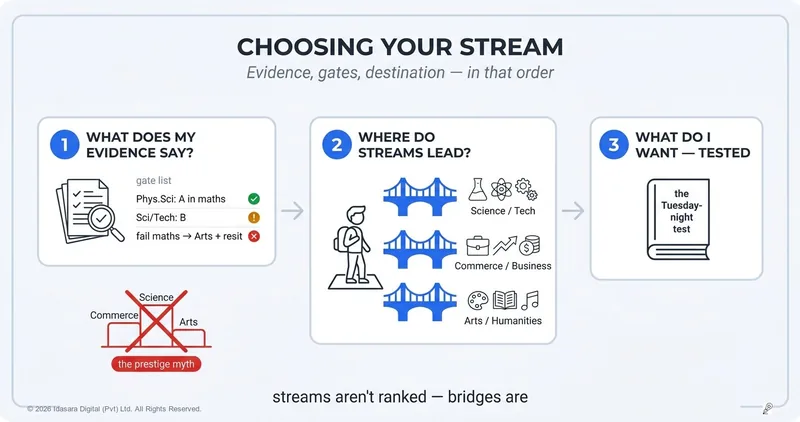
The stream decision is the first big fork of a Sri Lankan life, and most families make it with the worst possible inputs: prestige, pressure, and the neighbours. This chapter of Learn to Learn replaces those with a method: your evidence profile, the real entry gates, and the destination question — asked in the right order.
In the weeks after O/L results, a strange committee assembles around each student: parents, uncles, teachers, neighbours — everyone with a verdict, almost nobody with evidence. And the committee's favourite argument is a ranking nobody says out loud: Science if you possibly can, Commerce if you must, Arts if all else fails.
That ranking has broken more A/L years than any hard syllabus ever has. Students pushed into streams their evidence never supported spend two years drowning to protect a family's idea of prestige — while the stream that matched their actual strengths, and led to destinations they'd have wanted, sat there unchosen. So let's replace the committee with a method. Three questions, in this order.
Question 1: What does my evidence say?
Not "what do I like" (yet), and never "what impresses" — first, what does your marked work say you're strong at? Your O/L results are the headline, but you own richer data: which subjects' papers felt like performance and which like survival; where your mistake patterns were precision (fixable) versus concept-at-depth (a warning at A/L depth); what the maths and science grades actually were.
Because the gates are real and specific. The pattern, as schools publish it (the authority is the Ministry/Department circular your school applies — the pattern below is one school's published guidance, so verify your own school's current rules): Physical Science typically wants a top maths grade; Biological Science leans on the science grade; the Technology streams want strong maths; Commerce wants credit-level maths or accounting-adjacent strength; and a failed maths grade typically means Arts only, plus a compulsory O/L maths re-sit during A/L. The gates aren't insults — they're the system telling you, honestly, where two years of that stream's depth will land on your current foundations. A B-grade-maths student forcing Physical Science isn't ambition; it's signing up for the debt chapter — old gaps compounding under new load — at stream depth.
Question 2: Where do the streams actually lead?
The prestige ranking survives because families argue about streams in the abstract. Walk it forward instead — destinations first: what work do you actually see yourself in? Then walk backwards (the Degree Explorer chapter makes this a full method): which degrees or qualifications reach it, and which streams reach those?
Three truths the committee rarely mentions: every stream carries real destinations — law, management, accountancy, IT, education, media, and the state's own services recruit heavily from Commerce and Arts; the Z-score compares you with the students of your own subjects, not with the whole country (each subject's marks are standardised against everyone who sat that subject — so a strong Commerce performance beats a drowning Science one for almost every purpose, including university entrance, where selection then runs through the handbook's quota system); and the paths beyond university (professional qualifications, NVQ's ladder to degree level, earn-while-learning) connect from every stream — the next chapters map them. The question is never "which stream is best?" It is "which stream is the strongest bridge between my evidence and my destination?"
Question 3: Only now — what do I want?
Interest matters enormously — two years of deep work in subjects you hate is the burnout chapter waiting to happen — but it comes third, because teenage interest is heavily contaminated by exactly the prestige-and-pressure noise this chapter is clearing away, and because interest is partly built by competence (the hated-subjects chapter's finding). Test your interest against reality: read a chapter of the actual A/L textbook for each candidate stream (not the subject's reputation — its Tuesday-night reality). The stream whose Tuesday-nights you can imagine surviving for two years, that your evidence supports, that bridges to destinations you want — that's your stream, whatever the neighbours think.
The family conversation
Parents: the decision needs your wisdom and your restraint at once. Bring the destination knowledge and the honesty about costs; leave the prestige ranking at the door — the repeat-year chapter's rule generalises: decide by diagnosis and destination, never by what will be said at the next family gathering. A child in the right stream with your support outperforms a child in the "better" stream carrying your disappointment. And decide with the evidence on the table — results, the school's gate circular, the destination map — not in a shouting match after dinner.
Do this week
- Build the evidence page: results + your honest per-subject performance notes + the school's actual entry thresholds for each stream.
- Walk two candidate destinations backwards to streams (next chapters help). Note where each stream leads besides its famous destination.
- Read one real A/L textbook chapter per candidate stream. Then hold the family conversation with all three pages on the table.
At a glance
- Kill the prestige ranking: streams aren't ranked; bridges are — evidence → stream → destination.
- Question 1 — evidence: your marked-work profile + the real gates (top maths for Physical Science; fail maths → Arts + re-sit; verify current circulars).
- Question 2 — destinations: walk careers backwards; every stream carries real ones; the Z is relative to who sat each subject — strong-in-Commerce beats drowning-in-Science.
- Question 3 — interest, tested: read the actual A/L textbook's Tuesday-night reality, not the reputation.
- Families decide with three pages on the table, never with the neighbours in the room.
One step further with Idasara Academy
This chapter's method is what the Decision Hub — free to start — runs: path comparison cards put the streams side by side with cited destinations instead of reputations, and path preview lets you sample a stream's actual content before committing — the Tuesday-night test, built in. Your O/L evidence profile plus the comparison cards is the decision, made visible.
Start Free — Create Your Account →
FAQ
My marks qualify me for Science but my evidence says I survived rather than performed. Take the seat anyway? Meeting a gate is permission, not instruction. Two years of stream-depth amplifies whatever your O/L relationship with those subjects was — survival amplifies into drowning more often than into mastery. Read the stream-playbook chapters, run the Tuesday-night test, and choose the bridge, not the badge.
Everyone says Arts has no future. True? It's the prestige ranking talking. Arts carries law-adjacent paths, education, administration, media, languages, and the state services — and the Arts-core playbook chapter shows it's a method-rewarding stream. What Arts punishes is drifting into it without a destination walked backwards; that's true of every stream.
Can I switch streams after starting? Early switches happen and schools have processes — but each costs months of a two-year clock. The three-questions method exists precisely to spend a week now instead of a term later. If you're already mis-streamed, switch early and deliberately, with this chapter re-run.
What if my school doesn't offer the stream my evidence supports? Then the decision includes a school question — a real and common situation with real options (another school, Technology stream availability, the vocational ladder). Ask early, in results week, while transfers are live. The no-tuition-in-my-area chapter's spirit applies: geography is a constraint to plan around, not a verdict.
Further reading
The destination-first tools this chapter leans on: Pick the Career, Then Walk Backwards and The NVQ Road. The stream playbooks: A/L Science · A/L Commerce & Arts.
Sources
- Trinity College Kandy — Guidance on selecting A/L subject streams (entry-gate pattern; verify current circulars)
- StudentLanka — Guide to NVQ in Sri Lanka (the ladder beyond streams)
- The Idasara Method: Part 4 — Time Management & Flipped Learning (what stream depth demands weekly)