How to Study the A/L Science Stream: Three Subjects, One Architecture
The short answer: Give the stream its own architecture: one 90–120 minute deep block daily, the lead subject rotating so nothing sleeps past 48 hours, your weakest subject taking the best hours — and build a derivation deck, every syllabus derivation performed cold on paper and repeated on a spaced schedule. The stream is survived by structure, not by longer nights.
A chapter of the free book Learn to Learn
Published 2026-08-31 · updated 2026-08-31
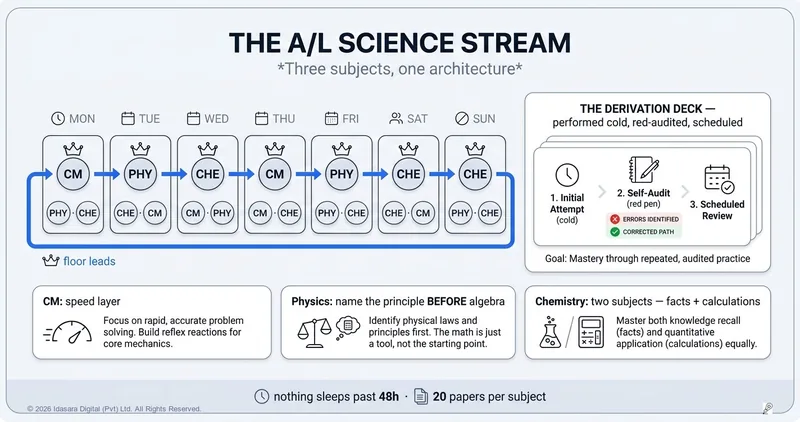
Combined Maths, Physics, Chemistry — the heaviest academic load a Sri Lankan teenager can carry, usually attempted with O/L habits that break in the first term. This chapter of Learn to Learn is the stream playbook: the weekly architecture that keeps three deep subjects alive, the derivation deck (the stream's secret weapon), and what each subject's marks are actually made of.
The A/L science stream breaks students in a predictable way, and it isn't the difficulty. It's that the stream punishes O/L habits precisely because they worked at O/L.
At O/L, nine shallow-ish subjects rewarded broad, bite-sized coverage. The stream inverts everything: three subjects of real depth, where a single question chains six ideas, where "covered the chapter" means nothing until twenty problems are survived, and where the Z-score arithmetic makes your weakest subject the boss of your future. Students who arrive studying "the O/L way, but harder" spend the first year drowning quietly.
The stream needs its own architecture. Most of its parts you now own — deep-work blocks, the rotation guard, Z-protection, paper volume. This chapter assembles them into the stream's week and adds the stream-specific weapons.
How do you structure the stream's week?
The stream's week stands on four beams, all from this book's time layer, now composed:
- One deep block daily (90–120 min) — the stream's fundamental unit; fragmented evenings cannot build six-idea chains (the deep-work chapter's whole argument).
- The 3-way rotation guard: the deep block's lead subject rotates so nothing sleeps past 48 hours — absorption in beloved Combined Maths is a Chemistry Z-drag being manufactured.
- The floor gets the best hours (the Z chapter's allocation law): your evidence-weakest subject leads more blocks and takes the peak slot.
- Paired light slots carry the maintenance layer: derivation-deck reps, fact schedules, marked-paper review — the pairing chapter's structure, stream edition.
That's the frame. Now the weapons.
The derivation deck — the stream's secret weapon
Physics and Chemistry papers are built substantially from derivations and standard results: the equations of motion built from first principles, the lens formula, rate expressions. (Combined Maths is problem-dominant — its deck-equivalent is the standard-method card: the worked pattern for each problem family, performed cold the same way.) Most students read derivations the way weak maths students read worked examples — nodding along, owning nothing.
Treat derivations like O/L Science treated diagrams: as performable units, collected in a deck. Every derivation the syllabus expects goes onto its own page/card: the starting principle on one side, the full derivation performed cold on paper, audited in red, then scheduled — the spaced ladder, exactly like facts, because a derivation is a fact with muscles. A stream student with forty cold-performable derivations owns a startling share of the three papers before question-practice even begins — and owns exactly the material the exam-nerves chapter proved holds up under stress.
What are each subject's marks actually made of?
Combined Maths — pure performance, plus speed. Everything in the O/L maths playbook at double strength: cover-and-attempt, daily volume, mixed sets, method marks — the marks paid per written step — visible. The stream addition is the speed layer: CM papers are long by design, so a fraction of weekly practice runs against the clock deliberately — not to rush understanding, but to automate the standard manipulations until they cost seconds, not thought. Automated basics are what buy thinking time for the question's real idea.
Physics — concept first, then the calculation. Physics' classic trap: grabbing the formula before understanding the situation. Its marks reward the sequence model the situation → choose the principle → then compute — so train that order: for every problem, one sentence naming the principle before any algebra ("energy conservation, because no friction"). Students who annotate the principle stop making physics' signature error — right maths, wrong physics. Diagrams are semi-mandatory: the force diagram or ray sketch is often where the method marks live.
Chemistry — the double subject. Chemistry is two subjects sharing a name: a fact-and-language subject (nomenclature, series, colours, tests — the memorising chapter's spaced machinery, heavily) and a calculation-and-mechanism subject (moles, equilibria, organic pathways — the maths playbook's machinery). Sort every topic into its half and run the right engine; students who treat chemistry as all-memory or all-logic each lose the other half's marks. Organic chemistry's pathways are the pictures chapter's flowcharts, drawn cold, scheduled.
The stream's honest arithmetic
Three facts to plan the two years around: coverage debt compounds fastest here (each topic loads onto the tower — the debt chapter's walk-backwards rule applies within A/L itself, and to O/L foundations under it); the 20-paper volume is non-negotiable per subject (the volume chapter's layers — archetype maps matter most in the stream, where question families are strong); and tuition must pass the conversion test hardest (stream tuition hours are the biggest delivery-pile in Sri Lankan education — the Me Time audit — your self-study hours weighed against delivery hours — decides whether they convert; scripts from paper classes go through your marking loop within a day, per the method's rule).
Do this tonight
- Draw this week's architecture on one page: seven deep-block slots, lead subjects assigned with the floor leading most, light slots paired.
- Start the derivation deck: three derivations from your current topics, performed cold, red-audited, scheduled.
- Run the evidence check from the Z chapter — last marked work per subject — and let it, not affection, pick tomorrow's lead.
At a glance
- The stream punishes O/L habits: three deep subjects need one daily deep block, 3-way rotation, floor-first allocation, paired maintenance slots.
- The derivation deck: every syllabus derivation as a performable unit — cold, red-audited, spaced. Forty cold derivations = a startling share of the papers, stress-proofed.
- CM = performance + a deliberate speed layer · Physics = principle named before algebra + the diagram · Chemistry = two subjects (facts on the schedule, calculations on the maths engine), sorted topic by topic.
- Coverage debt compounds fastest in the stream; 20 papers per subject is the honest volume; tuition hours must pass the conversion test.
- The Z arithmetic runs the allocation: the floor is the boss.
One step further with Idasara Academy
The stream's architecture is bookkeeping-heavy, and the system carries it: Today's Plan schedules the deep blocks with the rotation guard and floor-weighting enforced, the A/L suite runs the derivation-and-problem reps with the Mistake Bank sorting your error species per subject, and the exam plan's past papers in the timed Exam Hall deliver the 20-paper volume with marking that reads your handwritten working — Combined Maths included. Two years is long; the architecture is what makes it one project instead of seven hundred evenings.
Start Free — Create Your Account →
FAQ
Bio stream student here — does this chapter apply? The architecture (deep blocks, rotation, floor-first, volume) transfers whole. Swap the weapons: Biology runs the O/L-Science playbook at depth (diagrams, processes, exact terms — heavier fact machinery), Chemistry stays double, Physics as here. The derivation deck becomes a diagram-and-pathway deck.
My tuition schedule already fills every evening. Where do deep blocks fit? That's the stream's most common real timetable — and the Me Time chapter's warehouse is its diagnosis. Run the audit honestly: if delivery hours exceed double your conversion hours, something must give, and it should be the class whose material you can already reproduce cold (that's the test). One protected daily block beats a fourth repetition of anyone's lecture.
When should the 20-papers-per-subject volume start? Sectional drills as topics complete (Rung 2 style — the ladder's sectional-drill stage — from first year); full papers dominate once coverage substantially closes — for most, the final eight to ten months. Starting full papers over huge coverage holes just re-measures the holes; the ladder's sequencing rules apply unchanged.
Is it normal that I feel permanently behind in the stream? So normal it's practically the stream's weather — depth makes everyone feel slow. Replace the feeling with the instruments: tracker against the two-year map, papers marked, bank balance. The readiness chapter's rule holds: evidence over dread. And if the evidence does show real drift, the six-months-left chapter's triage beats another anxious month.
Further reading
Deep work, Z-protection, and paper volume are this chapter's load-bearing walls: Part 4 — Time Management & Flipped Learning and Part 3 — The Grade Progression Ladder & Paper Marking.
Sources
- UCLA Bjork Lab — research overview (interleaving, spacing, testing at depth)
- Smith, A. et al. (2016) — retrieval under stress, ScienceDaily (why cold-performed derivations survive exam pressure)
- The Idasara Method: Part 4 — Time Management & Flipped Learning
- The Idasara Method: Part 3 — The Grade Progression Ladder & Paper Marking