"Am I Ready?" — What Exam Readiness Actually Means, and How to Measure Yours
The short answer: Read evidence, not feelings: is the syllabus genuinely covered, what do recent marked full papers score, how many mistakes are still unfixed, and are all three moving the right way? Coverage complete, papers scoring in your target band, mistake list shrinking — that is what ready looks like, whatever your nerves say.
A chapter of the free book Learn to Learn
Published 2026-08-31 · updated 2026-08-31
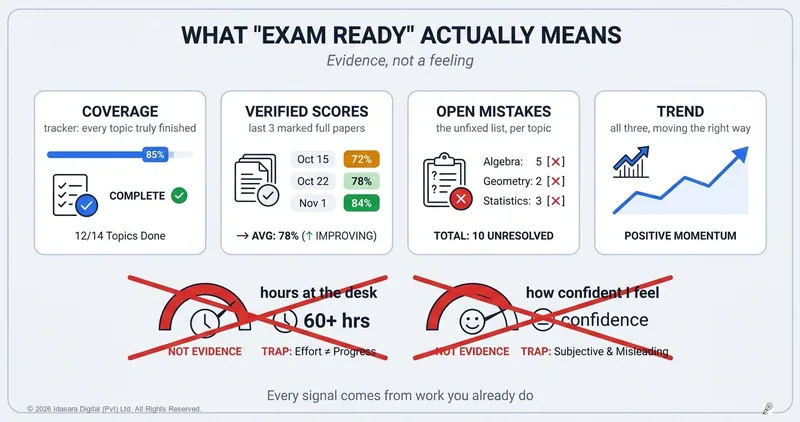
In the final months, every student and every parent asks the same question — and almost everyone answers it with feelings, which measure confidence, not readiness. This chapter of Learn to Learn replaces the feeling with four evidence signals you can read tonight: coverage, verified performance, open mistakes, and trend. Together they answer the question honestly — while there's still time to act on the answer.
Walk into any Sri Lankan home in the months before O/L or A/L and you can hear the question being asked — in two dialects.
The student's version, usually at midnight, to themselves: "Am I ready? It feels like I know things… but is it enough?"
The parent's version, watching from the doorway: "They're at the desk every night — surely that means they're prepared?"
Both are asking the right question with the wrong instruments. The student is reading feelings; the parent is reading hours. And this book has spent thirty chapters showing why both gauges lie: feelings of knowing are manufactured cheaply by re-reading (the illusion has its own chapter), and hours measure fuel burned, not distance travelled (that was the very first chapter). Exam-season anxiety lives exactly here — in the gap between a question that matters enormously and instruments that cannot answer it.
So let's install real gauges. Readiness is not a feeling. It is a state of evidence, and it reads out in four signals.
What are the four signals of readiness?
Signal 1 — Coverage: is the whole syllabus genuinely finished? The foundation signal, because it caps everything: untouched topics cap your maximum mark by arithmetic, before the hall (the contract chapter's brutal maths). The instrument is your term tracker, honestly kept — every topic finished meaning the full loop — read, noted, exercised, marked — not "the class did it." A student cannot be ready at 80% coverage no matter how brilliant the 80% is; the missing fifth is marks pre-surrendered. (And if you're reading this close to the exam with coverage short — don't freeze: every gap you genuinely close from today raises the cap immediately. Bridge oldest-first; the ladder down from panic is in the syllabus-contract chapter.)
Signal 2 — Verified performance: what do marked full papers actually score? The strongest single predictor in existence, because it is the exam, sampled: full papers, strict conditions, honestly marked — the volume chapter's properly-run units. Not what you feel you'd score; what scripts did score, recently, repeatedly. One paper is weather; three or four recent papers are climate, and climate is what the exam delivers. If your last three marked papers sit in the B band, that — not your hopes, not your fears — is your current position.
Signal 3 — Open mistakes: how long is the unfixed list? The forward-looking signal. Two students scoring identical 65s are not equally ready if one's mistake bank holds forty open, recurring errors and the other's holds six: the second student's 65 is nearly a floor; the first's is closer to a ceiling. The bank's open balance per topic — red topics versus green, in the language of topic health — is your repairs-remaining ledger, and it prices exactly what the final weeks should buy.
Signal 4 — Trend: which direction is all of it moving? Readiness is a trajectory, not a photograph. Coverage climbing on schedule, paper scores rising across attempts, the open-mistake balance falling week over week — that pattern, months out, is what "on track for an A" actually looks like, even while the current score still reads B. Flat trends, conversely, are the earliest honest warning that the method needs adjusting — caught while adjusting is still cheap.
Notice what the four signals have in common: every one is already being generated by the system this book built. The tracker, the marked papers, the bank, the weekly rhythm — readiness measurement isn't a new task. It's a dashboard reading of work you're already doing. The student with no system has no signals — which is precisely why they're stuck asking their feelings.
Reading the dashboard — and acting on it
Put the four together monthly (weekly, in the final term) and the vague dread of "am I ready?" resolves into one of a few actionable states:
- Coverage gaps showing? That's the priority regardless of everything else — Signal 1 caps Signals 2–4. Bridge oldest-first, beside current work.
- Coverage solid, papers underscoring? Read the scripts: where do marks leak — knowledge, method, format, time? (The scheme chapter taught you to itemise it.) The leak's species names the fix.
- Papers decent, bank swollen? You're leaving known marks unrepaired — elimination sessions are your highest-yield hours now.
- All rising on trend? Then the honest answer to the midnight question is yes — keep the loop running, and the anxiety can stand down. Not because a feeling improved, but because the evidence did.
And for the parent in the doorway, the four signals transform the conversation. Instead of "were you at your desk?" (hours) or "do you feel prepared?" (feelings), the useful questions become: Is the syllabus tracker complete? What did the last marked paper score? Is the mistake list shrinking? — questions a student can answer with evidence, that surface real problems while they're still fixable, and that replace surveillance with shared instruments. A later chapter of this book, written for parents directly, builds on exactly this.
Do this tonight
- Read your four signals for your most important subject, honestly: coverage % (tracker) · last marked full-paper score · open mistakes (bank) · direction of each over the last month.
- Write the one-line verdict the evidence supports — not the one your mood prefers. "Coverage 90%, papers mid-B, bank heavy in two topics, trend flat."
- The verdict names this week's work — that's the point of gauges. Act on the weakest signal first.
At a glance
- Readiness is a state of evidence, not a feeling — feelings measure confidence (cheaply manufactured); hours measure fuel, not distance.
- Four signals: coverage (tracker-honest, caps everything) · verified performance (recent marked full papers — climate, not weather) · open mistakes (repairs remaining) · trend (direction of all three).
- Every signal is generated by the system you already run — readiness is a dashboard reading, not a new task.
- Each dashboard state names its own fix: bridge coverage → read the leak's species → work the bank → or keep going, it's working.
- For parents: swap "were you at your desk?" for the evidence questions. Shared instruments beat surveillance.
One step further with Idasara Academy
The four signals are exactly what the exam plan's Exam Passport and Readiness Score compute, continuously: past-paper accuracy, mistake-bank health, syllabus coverage pace — and for A/L students, standing models — aggregated into a live 0–100 readout per subject. The parent dashboard is free to open; on the exam plan it shows the child's progress as a simple per-subject traffic light, so the doorway conversation runs on shared evidence instead of anxious guesswork. The score doesn't replace the work; it makes the work's progress visible — which, in exam season, is worth almost as much.
Start Free — Create Your Account →
FAQ
My papers score well but I still feel unready. Which do I trust? The scripts. Pre-exam nerves read as unreadiness but respond to evidence — this is precisely what the closed-mistake pages and marked papers are for the night the doubt hits. Feeling-unready-while-measuring-ready is the most common and most benign mismatch there is.
I feel confident but my papers disagree. Now which? Still the scripts — this is the dangerous mismatch, and it's the illusion of competence graduating to exam scale. Be grateful the papers caught it in October. Read where the marks leak and work the species; confidence will re-earn itself.
How close to the exam can readiness still be improved? Every week buys something if it's aimed by the gauges: coverage gaps first (highest cap-raise per hour), then the bank's biggest topics, then paper-format polish. What the final weeks can't do is replace a year of Signal 1 — which is the argument this whole book has been making since chapter one.
Is there a score that means "guaranteed A"? No honest system promises that, and you should distrust any that does. What the evidence state can say is: coverage complete, recent papers marking A-band, bank at zero, trend stable — a student for whom the A is the expected outcome, luck's role reduced to noise. That is what readiness means. The exam still gets its say; you've just made it very hard for it to surprise you.
Further reading
The readiness engine — its four inputs and how they aggregate — is written up in the Idasara Method: Part 3 — The Grade Progression Ladder & Paper Marking.
Sources
- Dunlosky, J. et al. (2013). Improving Students' Learning With Effective Learning Techniques — overview at the Association for Psychological Science (why self-assessment misleads; testing informs)
- Murre, J. & Dros, J. (2015). Replication and Analysis of Ebbinghaus' Forgetting Curve, PLOS ONE
- The Idasara Method: Part 3 — The Grade Progression Ladder & Paper Marking