Study in Pictures: Why One Drawn Diagram Beats a Page of Sentences
The short answer: Use both roads into memory — words and pictures. Draw each topic's diagram, flowchart, or timeline from memory and audit it against the book in red: sketching can more than double recall, artistic skill is irrelevant, and on science papers labelled diagrams are literal marks.
A chapter of the free book Learn to Learn
Published 2026-08-31 · updated 2026-08-31
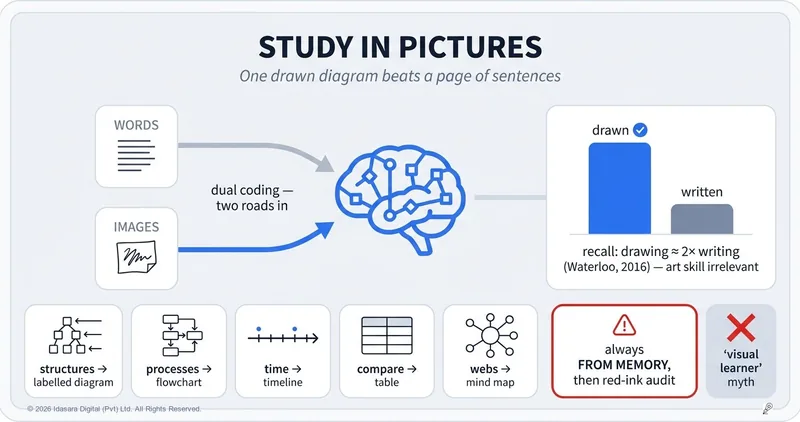
Your brain has two roads into memory — words and images — and most studying uses only one. This chapter of Learn to Learn is about deliberately using both: the science of dual coding, the remarkable "drawing effect" (sketching can double recall — artistic skill irrelevant), which picture fits which kind of material, and why diagrams aren't just a study aid but literal marks on your exam paper.
Try a small experiment on yourself.
Think of the water cycle. What came to mind — a paragraph of sentences, or the picture: arrows rising off the sea, a cloud, rain falling on hills, a river running back? Now think of the heart. Words — or the diagram with its four chambers?
For almost everyone, the picture arrives first, years after the sentences have gone. Teachers see the same thing from the marking side: students reproduce the textbook's diagrams long after they've lost the textbook's prose. "A picture is worth a thousand words" turns out to be roughly accurate memory science — and yet look at how most students study: page after page of words, read, copied, and re-read, with the picture-road into memory left completely unused. This chapter puts it to work.
What is dual coding?
The mechanism has a name — dual coding — and a simple shape: verbal material and visual material are processed and stored along partly different routes. Study something only as words, and you've built one trace. Study it as words plus a matching image — a diagram, a sketch, a timeline — and you've built two, connected. Come exam day, either can retrieve the other: the diagram surfaces and the labels bring the sentences; the term surfaces and drags the picture up with it.
The practice, per the learning-science guidance, is deliberately simple: when you meet material, look at how the visuals and the text correspond — then make your own visual from the ideas, and eventually reproduce both the words and the picture from memory. Notice that last clause: dual coding doesn't replace this book's engine, it runs inside it. A diagram you drew from memory and audited in red is dual coding and retrieval and self-checking in one act.
What is the drawing effect — and why is your pen a memory machine?
Now the finding that should change your notebook. Researchers at the University of Waterloo ran a blunt experiment: given a word to remember, students either wrote it out repeatedly or spent seconds drawing it. Drawing won — participants often recalled more than twice as many drawn items as written ones — and it kept winning against every other strategy they tested. The researchers' explanation fits everything this book has taught you: a drawing forces one integrated act of meaning (what is this?), vision (what does it look like?), and movement (the hand making it) — three hooks into memory instead of one.
Two liberating details from the same research: artistic ability made no difference, and even four seconds of sketching produced the benefit. The memory is built by the act of translating an idea into a picture, not by the picture's beauty. Your ugly, wobbly diagram of the nephron is — scientifically — one of the most powerful study objects you can create. Nobody is grading the art. Something much better is being built.
Which picture fits which material?
"Visualise it" becomes practical the moment you match the picture-type to the material's shape — an extension of the lesson from the mind-map chapter (maps for webs, lists for sequences):
- Structures (the heart, a flower, a circuit, a cell) → the labelled diagram — the classic, drawn from memory, labels and all.
- Processes and mechanisms (digestion, a chemical mechanism, how a bill becomes law) → the flowchart: boxes, arrows, one verb per arrow.
- Time (history, plot, geological ages) → the timeline, with causes hung above the line and effects below.
- Comparisons (two reactions, three leaders, mitosis vs meiosis) → the table or side-by-side sketch — differences become visible as differences.
- Quantities and relationships (physics, economics) → the graph sketched by hand: axes, shape, the point where behaviour changes.
- Tangled everything-connects topics → the mind map, which has its own chapter.
The golden rule travels unchanged from every other chapter: draw it from memory, then audit against the source in red. A diagram copied while looking at the book is highlighting with extra steps; a diagram wrestled from memory is the drawing effect, dual coding, and the blank-page test — recall onto an empty page — in one.
The exam angle: pictures are marks
Here is where this chapter stops being a study tip and becomes exam currency. Look at any science marking scheme through the shopping chapter's eyes: labelled diagrams are listed items. "Draw and label…" questions carry marks per label; structure questions award the mandatory annotations; and even where a diagram isn't demanded, a clear labelled sketch inside an explanation frequently earns what tangled prose fails to convey. The student who has drawn the heart from memory eleven times doesn't revise the diagram question — they collect it.
And the inverse warning, from the same scheme logic: a diagram in your notes that you've only ever looked at is recognition in its purest form. The exam will hand you a blank box and the word "Draw." Only the practised hand answers.
Do this tonight
- Take the topic you studied most recently. Close everything. Draw its picture from memory — the labelled structure, the flowchart, the timeline, whichever shape fits — ugly and fast. Two minutes.
- Open the book. Audit in red: missing labels, wrong order, dropped arrows. (You know this ritual; you've just run it on a picture.)
- Add one rule to your short-note method from tonight on: every topic's note carries at least one image made by your hand — even three boxes and two arrows counts. Your future revision self will land on the picture first, exactly as your brain prefers.
At a glance
- Dual coding: words and images take different roads into memory — use both and each can retrieve the other.
- The drawing effect (Waterloo): sketching an idea can more than double recall vs writing — artistic skill irrelevant, seconds are enough. The act builds the memory, not the artwork.
- Match picture to material: structures → labelled diagrams · processes → flowcharts · time → timelines · comparisons → tables · quantities → sketched graphs · webs → mind maps.
- The golden rule holds: from memory, then red-ink audit. A copied diagram is highlighting in disguise.
- Exam currency: labelled diagrams are listed scheme items — practise drawing what papers ask you to draw.
One step further with Idasara Academy
Your hand draws; the system checks. The short notes (free to start) and Lesson Notes packs (a one-time purchase per subject) carry the syllabus-standard diagrams for your grade, so tonight's from-memory sketch has its mirror for the red-ink audit (which labels did the syllabus expect that your hand forgot?). And on the paid tiers, Exam Paper Marking reads your photographed answer pages and marks them against the scheme — so the picture habit gets checked the way the exam will check it.
Start Free — Create Your Account →
FAQ
I genuinely can't draw. Does this still apply to me? More than to anyone — because the research is explicit that drawing ability doesn't matter. Boxes, stick figures, wobbly arrows: the memory benefit comes from translating the idea into any picture at all. If your nephron looks like a sad balloon, label the sad balloon. It's working.
Is this the same as being "a visual learner"? No — and the difference matters. The learning-styles idea (match teaching to your "style") doesn't hold up in research; the guidance is blunt that style-matching isn't useful. Dual coding is different: combining words and images helps everyone, whatever they'd say their preference is. You're not a visual learner. You're a human — with two roads in.
Should I make my visuals digitally — apps, diagrams tools? For studying, the hand wins for the same reasons as always: the drawing effect is partly a motor effect, paper needs no unlocked phone, and the exam will demand a hand-drawn diagram anyway. Digital tools are fine for polished project work — different job.
How does this fit with mind maps and the memorising chapter? Cleanly: the mind-map chapter is one picture-type (webs) for one job (tangled topics); the memorising chapter's keyword-picture handles are dual coding at single-fact scale; this chapter is the umbrella — the two-roads principle and the full picture toolkit. Together they make Part 3's promise complete: notes that teach you, in words and pictures, all from memory.
Further reading
Handwritten notes, diagrams from memory, and the red-ink audit are the method's first layer: Part 1 — The Human Foundation & Active Recall.
Sources
- The Learning Scientists: Learn How to Study Using… Dual Coding (combine words and visuals; learning-styles caveat)
- Wammes, J., Meade, M. & Fernandes, M. (2016). The drawing effect — University of Waterloo study, ScienceDaily summary
- Novak, J. & Cañas, A. — The Theory Underlying Concept Maps (knowledge as visible structure)
- The Idasara Method: Part 1 — The Human Foundation & Active Recall