Pair a Hard Subject With an Easy One: The Evening That Doesn't Collapse
The short answer: Give your hardest subject the evening's first block, at your best energy, then switch at a fixed, written time to a genuinely different, lighter subject. The pair keeps the evening moving and ends the hard subject at its best — so you're still willing to face it tomorrow.
A chapter of the free book Learn to Learn
Published 2026-08-31 · updated 2026-08-31
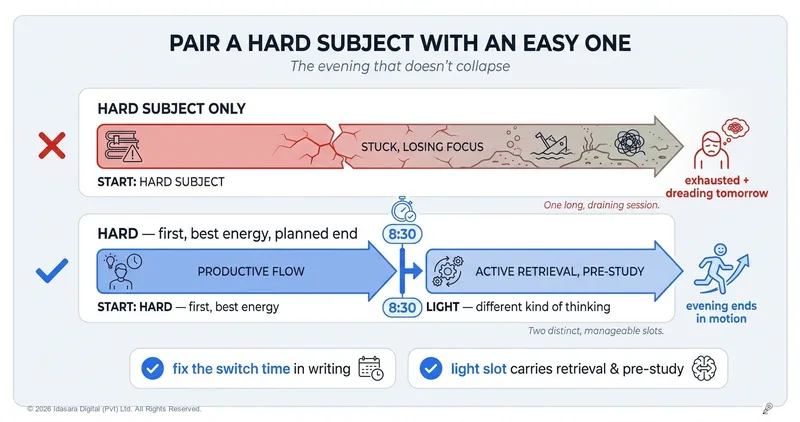
One difficult subject, faced alone, can swallow an entire evening and poison the next one — while a well-paired evening stays in motion and ends with momentum. This chapter of Learn to Learn explains the pairing rule: why hard-plus-easy outlasts hard-alone, how the pair protects both subjects, and how to build tomorrow's pairing in one minute.
Here is an evening every student has lived, and its shape deserves a close look.
Tonight is Combined Maths night — or physics night, or accounting night: whatever your heaviest subject is, it has the whole evening to itself. That was the plan, and the plan felt virtuous.
The first hour goes honestly. The second hour thickens — the problems fight back, progress slows, and the fatigue of one kind of thinking starts compounding. Somewhere in hour three you're re-reading the same worked example with less comprehension than an hour ago, morale sinking with efficiency, until the evening ends in the familiar swamp: exhausted, behind where you'd hoped, and — this is the expensive part — dreading the next session of that subject. Tomorrow's plan quietly bends away from it.
Now the alternative shape. The same evening opens with ninety minutes of the heavy subject — fresh mind, best energy, real progress. Then, at the planned moment, you switch: forty minutes of a lighter subject — vocabulary, a history chapter's short note, revision questions you're good at. Different mental muscles; visible, satisfying progress. The evening ends in motion instead of a swamp — and, crucially, the heavy subject's session ended at its best, not at its worst.
Same hours. Same subjects. The difference is one scheduling rule the method states plainly: pair a hard subject with an easy one.
Why does the pair outperform the marathon?
Cognitive fatigue is task-specific — and switching is a partial reset. Three hours of one kind of demanding thinking doesn't drain "energy" evenly; it exhausts the particular circuits doing that work, which is why hour three comprehends less than hour one. A genuinely different subject engages different processing — and while it works, the strained system recovers somewhat. The pair converts your evening's late, low-quality heavy-subject hour into an early, high-quality light-subject hour. You're not studying less of the hard subject; you're refusing to study it at its worst.
The pair protects tomorrow. The marathon's worst product isn't tonight's inefficiency — it's the dread. Sessions that end in swamps teach your brain that the subject is a swamp, and avoidance grows from exactly that lesson (you watched this mechanism build "I'm weak at maths" in the debt chapter). Paired sessions end the hard subject at a planned point, usually mid-competence — and a subject that regularly ends well stays approachable all year. Consistency, this book's whole engine, is mostly a product of sessions you're willing to come back to.
The pair keeps the portfolio alive. Remember the time chapter's third question — is everything still moving? Marathon evenings starve every other subject while one gets gorged. Pairing bakes rotation into the day's structure: the heavy slot rotates through your hard subjects across the week, the light slot sweeps the rest — and the never-abandon-a-subject rule gets satisfied by design rather than willpower. (Memory research adds a quiet bonus: varied, interleaved practice looks less productive session-to-session and produces more durable learning than blocked marathons — one more case of effective feeling worse than comfortable.)
How do you build the pair?
The mechanics take one minute at the end of each day:
- Anchor the heavy slot first — your hardest current subject gets the evening's first and best block (the energy rule from the time chapter; the two rules compose). Give it a named outcome and a real length: one to two focus blocks, deep-work length for A/L material.
- Choose tomorrow's light partner deliberately — genuinely different in kind, not just in difficulty: pair calculation-heavy with reading- or writing-flavoured work; pair theory-dense with practice-flavoured. The reset comes from difference, not ease alone.
- Fix the switch point in advance — the pair only protects you if the handover actually happens. "Switch at 8:30" written down beats "switch when it feels right," because the swamp never feels like the right time; it feels like five more minutes.
- Let the light slot double as maintenance — it's the natural home for the portfolio's upkeep: yesterday's ten-minute retrieval, revision questions on an old topic, the week's flipped pre-study. Light never means idle.
One honest boundary: the pairing rule manages evenings, not priorities. The hard subject still gets more total hours across the week — pairing decides when and with what company, so those hours stay high-quality. If you find your "light slots" quietly eating the schedule, that's avoidance wearing the rule as a costume; the weekly tracker — your honest record of what got done — will catch it.
Do this tonight
- Name tomorrow's pair: heaviest current subject + a genuinely different light partner. Write the switch time.
- Give each slot a named outcome ("exercises 1–6 marked" / "French Revolution short note + red audit").
- Run it, and at evening's end notice two things: where the heavy session ended (at its best?), and how the evening felt to finish. That feeling is what you'll be willing to repeat for two hundred more evenings — which is the entire game.
At a glance
- Hard-subject marathons decay: hour three comprehends less than hour one, and swamp-endings teach dread that bends tomorrow's plan away.
- Pair hard with easy: heavy subject first at best energy, planned switch to a genuinely different light subject — the evening ends in motion.
- The pair protects three things: tonight's efficiency, tomorrow's willingness, and the whole portfolio's rotation.
- Mechanics: anchor the heavy slot → pick a different-in-kind partner → fix the switch time in writing → let light slots carry maintenance (retrieval, revision, pre-study).
- Pairing schedules the week's hours; it doesn't reduce the hard subject's share. The tracker keeps the rule honest.
One step further with Idasara Academy
Composing a balanced day across nine O/L subjects — or three heavy A/L ones — is exactly the kind of daily arithmetic worth automating. Idasara Academy's Today's Plan — free to start — builds the mix each morning: heavier tasks for the subjects your marks currently swing on, lighter maintenance tasks keeping every other subject alive, sized into focus-block-shaped pieces. The pairing rule, the rotation guard, and the energy rule — pre-computed, so your one decision each evening is simply to start.
Start Free — Create Your Account →
FAQ
Isn't switching subjects mid-evening bad for deep focus? Switching within a block is the killer — that's the distraction tax the Pomodoro chapter closed. Switching between blocks, at a planned boundary, is recovery. One deep session, honoured to its planned end, then a clean handover: that's structure, not fragmentation.
What if I only study one or two subjects — A/L with a single hard stream? Pair across modes instead: derivation-heavy work paired with note-writing or marked-paper review in the same subject family. The reset comes from changing the kind of thinking; the principle survives even a narrow portfolio.
Should the easy subject ever go first as a warm-up? Five minutes of warm-up, fine. But you met this trick in the time chapter: warm-ups that grow into hours are avoidance in a tracksuit. The hard subject goes first because everything in you prefers otherwise — and because first is where your best thinking lives.
What about days when even the hard block goes badly? Then the pair earns its keep: switch at the planned time anyway, bank the light slot's progress, and end the evening in motion regardless. A bad session inside a good structure stays one bad session; a bad session inside a marathon becomes a bad week.
Further reading
Subject pairing, the rotation guard, and the six habits of sustainable focus are written up in the Idasara Method: Part 4 — Time Management & Flipped Learning.
Sources
- UCLA Bjork Learning and Forgetting Lab — research overview on interleaving and varied practice
- Francesco Cirillo — the official Pomodoro Technique site (block boundaries and rest)
- The Idasara Method: Part 4 — Time Management & Flipped Learning