How to Memorise Dates, Formulas and Vocabulary — Without Hating Your Life
The short answer: Facts are kept by being pulled out of you, repeatedly, on a schedule — never by copying or re-reading. Test yourself in small batches from the first minute, re-test the misses, then retrieve each batch again tomorrow, a few days later, and next week; mnemonics help as handles, but the testing and the schedule do the remembering.
A chapter of the free book Learn to Learn
Published 2026-08-31 · updated 2026-08-31
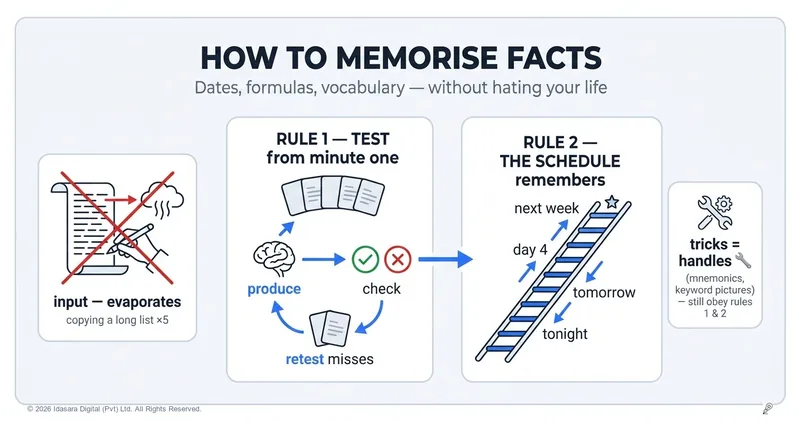
Some things must simply be known cold: dates, formulas, vocabulary, definitions, valencies, quotes. This chapter of Learn to Learn is the honest craft of memorising — why copying a list twenty times fails, the two mechanical rules that make facts stick, and the tricks (mnemonics, stories, songs) used the way they actually work: as handles, not as the memory itself.
Every subject has its brute-fact layer, and every student knows the despair of it.
The history dates that won't stay in order. The chemistry valencies. The English vocabulary list. The physics formulas that blur into each other. You copied the list out five times — your hand aches as proof — and two days later, half of it has evaporated again. So you conclude what students always conclude: "I just have a bad memory."
You don't. You've been using a method that doesn't work, on the one kind of material that most brutally punishes it. Facts are where this book's whole engine runs at its purest — so let's tune it for them.
Why does copying the list fail?
Copying, re-reading, and staring at lists are all input — and by now you can recite this book's oldest law: input builds familiarity, output builds memory. Fact-lists make the trap crueller than usual, because facts are arbitrary. A concept has logic to cling to; "1815" and the symbol for potassium have almost none. Material without logic has exactly one road into long-term memory: being pulled out, repeatedly, at the right times.
That sentence contains both rules. Everything else is decoration.
Rule 1 — Facts go in through the mouth and the pen, not the eyes
Never study a fact-list. Test it, from the very first minute:
- Read a small batch — five to eight items, no more.
- Cover it. Produce the items — write them, or say them aloud: question side to answer side ("Potassium? … K. Waterloo? … 1815.")
- Check. Mark the misses.
- Re-test only the misses until the batch runs clean. Then the next batch.
This feels slower than copying the full list. Per minute of real memory built, it is several times faster — and the exam-nerves chapter holds the astonishing bonus: memory built by testing holds under stress, which is exactly when your fact-layer is usually asked for.
The classic tool here is the humble flash card — question one side, answer the other — and it earns its fame because it forces Rule 1: you cannot use a flash card passively. Paper cards work perfectly. Two disciplines keep them honest: produce before flipping (guessing counts; peeking doesn't), and keep failed cards in the deck until they've passed on separate days — not just twice in a row tonight.
Rule 2 — The schedule does the remembering
The second rule is the forgetting-curve chapter, applied at fact-scale: a fact is kept by being retrieved just as it starts to slip — and for raw facts, the slipping is fast and the schedule is everything.
The working rhythm, batch by batch: tonight (learn, by Rule 1) → tomorrow (re-test the batch cold; expect misses — they're the system working) → three or four days later → the next week → then weekly-ish until the exam. Each successful retrieval stretches the safe gap longer. Miss a fact at any stage? It rejoins the young batches and climbs again. Ten minutes a day, rotating batches through this ladder, will hold hundreds of facts — this is precisely the drudgery flash-card systems and spaced-recall apps automate, and precisely why "I revised the list last month" fails: facts don't stay revised. They stay scheduled.
Do memory tricks — mnemonics, rhymes, stories — actually work?
Mnemonics, rhymes, absurd stories, memory palaces: do they work? Yes — for what they actually do. A trick gives an arbitrary fact a handle: something with pattern or imagery for retrieval to grab. The sillier and more vivid, the better the handle. Three honest uses:
- Order and lists → first-letter sentences and rhymes (the classic planet-order and colour-spectrum sentences you already know are exactly this species). Make your own for the history chronology; the making itself is half the memorising.
- Pairs that won't bond (word↔meaning, symbol↔element) → the keyword picture: link the sound of one to a vivid image of the other. The more absurd the mental picture, the stickier it is — research on the keyword mnemonic confirms it helps precisely here, on paired arbitrary facts.
- Formulas → don't rote-chant symbols; memorise the formula saying something ("force is how hard, times how much stuff") and then use it — three problems per formula beats thirty recitations, because using is retrieving with meaning attached.
And the honest limits, so the tricks stay servants: a mnemonic is a retrieval aid, not a replacement for Rules 1 and 2 — the handle itself must be practised and scheduled, or you'll stand in the exam holding the memory of having once had a trick. And mnemonics suit the fact layer only; understanding-heavy material (why the reaction proceeds, what the poem means) is built by the book's main loop — read, produce from memory, check — not by handles.
Do this tonight
- Pick your ugliest current fact-list — the one you've "memorised" three times. Split it into batches of six.
- Run Rule 1 on two batches: produce, check, re-test misses to clean. (Cards if you like; a covered page works.)
- Diary the schedule: same batches tomorrow, then day 4, then next week. Write it down — the schedule is the method.
- For the three slipperiest items, build one absurd handle each. Enjoy this part; the enjoyment is glue.
At a glance
- Facts are arbitrary — they have one road in: retrieved repeatedly, on a schedule. Copying lists is input; input evaporates.
- Rule 1: test from minute one — small batches, produce before checking, re-test misses to clean. Flash cards force this.
- Rule 2: the schedule remembers — tonight → tomorrow → day 4 → next week → weekly. Missed facts drop back down the ladder.
- Tricks (mnemonics, keyword pictures, rhymes) are handles for arbitrary material — genuinely useful, still subject to Rules 1 and 2.
- Formulas: memorise the meaning, then use them — three problems beat thirty recitations.
One step further with Idasara Academy
Rule 2 is pure bookkeeping, and bookkeeping is what apps are for: Idasara Academy's flash cards — on the paid tiers — run the spaced-recall ladder for you, resurfacing each fact just as it starts to slip, and micro-quizzes keep the produced-not-recognised standard honest per topic. Your part is Rule 1's ninety honest seconds per batch; the scheduler never forgets a review day, even in the weeks you would.
Start Free — Create Your Account →
FAQ
I genuinely have a terrible memory. Will this really work for me? The Rule 1 + Rule 2 machinery is exactly how memory works in everyone — differences between people are mostly differences in method already being used. Run the two rules on one list for two weeks before accepting any verdict about your brain. (And the students you envy for "photographic memory"? Watch them study — you'll usually find self-testing and repetition hiding under the talent story, as this book keeps finding.)
How is this different from "cramming", which you told me fails? Cramming is mass input, once, late — maximum evaporation. This is spaced output, small, early — maximum retention. Same material, opposite mechanics. A fact-schedule started early is the least cram-like thing in your whole preparation.
Sinhala/Tamil/English vocabulary — same method? Identical, and language is where the keyword-picture handle shines brightest. Add one upgrade: retrieve vocabulary in both directions (word→meaning and meaning→word), because exams ask both ways and each direction is its own memory.
Should I make my flash cards digital or paper? Whichever you'll actually use daily — the schedule matters more than the medium. Paper wins for exam-likeness (handwriting, no phone in reach); a good spaced-recall system wins for never-forgotten scheduling across hundreds of cards. Many students run paper for the current fortnight's facts and the app for the long tail.
Further reading
Retrieval and spacing — the two rules underneath this chapter — are the method's core science: Part 1 — The Human Foundation & Active Recall.
Sources
- The Learning Scientists: Retrieval Practice · Spaced Practice
- Dunlosky, J. et al. (2013). Improving Students' Learning With Effective Learning Techniques — overview at the Association for Psychological Science (practice testing, distributed practice, keyword mnemonic)
- Smith, A. et al. (2016). Retrieval practice protects memory against acute stress — ScienceDaily summary
- The Idasara Method: Part 1 — The Human Foundation & Active Recall