Deep Work for A/L: Why Your Hardest Problems Need 90 Unbroken Minutes
The short answer: A/L problems must be held in the mind whole, so the training unit that builds that strength is the 90–120 minute deep-work block — one subject, one hard target, zero interruptions. The first twenty minutes only load the problem; the payoff lives in the unbroken stretch after, and one interruption destroys — not pauses — everything being held.
A chapter of the free book Learn to Learn
Published 2026-08-31 · updated 2026-08-31
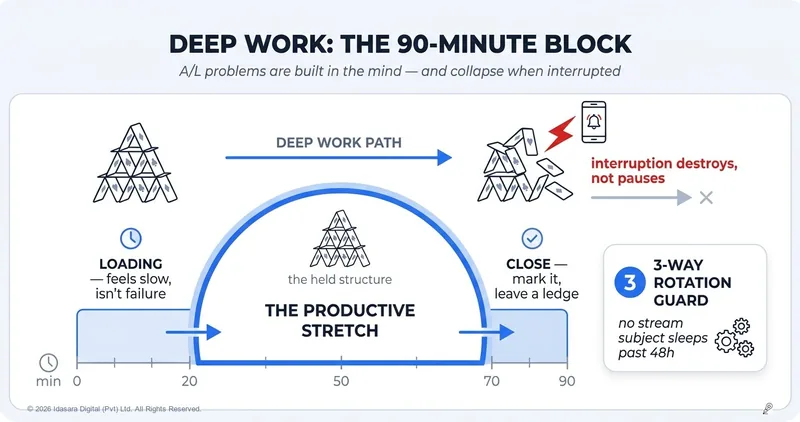
A/L problems are not O/L problems grown larger — they are multi-storey constructions that must be held in the mind entire, and they collapse under the interruptions that O/L-style micro-tasks tolerate. This chapter of Learn to Learn explains why the A/L student's core training unit is the 90–120 minute deep-work block, how to run one, and the rotation guard that keeps three heavy subjects alive at once.
An A/L Combined Maths student sits down with a past-paper question — one of the long ones, the kind worth real marks. Twenty-five minutes in, something delicate has formed: the whole problem is loaded. The structure of the derivation, the substitution being carried, three intermediate results, the strategy for the remaining parts — all of it held, live, in working memory, like a house of cards four storeys tall.
A message chirps. Thirty seconds of glancing.
The cards fall. Not the paper — the paper still shows the working — but the held structure is gone, and the student now faces their own half-built solution almost as a stranger, re-loading for ten minutes what one glance unloaded. Multiply that collapse across an evening of chirps, and you have the puzzle so many A/L students live inside: "I study for hours — why can't I finish the long questions?"
The answer is that A/L work has a property nobody warned them about, and it changes what a "study session" has to be.
Why can't you finish the long questions?
O/L study, this book said, thrives on bite-sized tasks — twenty minutes here, fifteen there. That was the right tool, because O/L pieces are mostly single-storey: a note to retrieve, a set of short exercises, vocabulary.
A/L stream subjects — the multi-stage derivation, the organic synthesis route, the electromagnetics problem, the extended accounting case — are different in kind. Their difficulty is the integration: holding many parts in mind simultaneously and manipulating the whole. That holding takes significant time to establish (the first twenty minutes of a hard session are largely loading, which is why they feel unproductive), it pays out only in the later stretch (the insight at minute seventy exists because of the unbroken sixty before it), and it is destroyed — not paused, destroyed — by interruption. Attention doesn't have a bookmark. Every switch pays the reloading tax again.
Hence the method's prescription for A/L: the core training unit is the 90–120 minute deep-work block — one subject, one hard target, zero interruptions. Not because longer is more virtuous, but because the mathematics of loading and holding make ninety minutes the honest minimum for the work to reach its productive stretch. A student who only ever studies in fragmented half-hours can know every individual technique and still be unable to assemble them — and assembly is precisely what the three-hour paper examines.
How do you run a 90-minute block?
The deep block is the Pomodoro chapter's contract, scaled up — same physics, higher stakes:
- One target, chosen for depth: a full long-form question set, a complete derivation family, one synthesis route mastered end-to-end. Named in advance, per the standing rule.
- Interruption-proof the environment like you mean it. At this block length the phone-in-another-room rule stops being advice and becomes the whole difference between one 90-minute session and three 25-minute fragments stitched together. Household negotiations done beforehand; everything needed on the desk.
- Expect the slow first act. Minutes 0–20 are loading: re-reading the question, sketching structure, assembling tools. It feels unproductive. It is the foundation being poured — do not mistake it for failure and do not spend it "warming up" on something else.
- Work the middle hard, on paper, full working, exam-style — everything the writing and marking chapters trained now runs at length.
- Close deliberately: the last ten minutes are for marking or checking what was produced and one line of notes — where this stands, what's next — so the next block's loading phase starts from a ledge instead of the ground floor.
- Then genuinely rest. After ninety deep minutes, the twenty-minute break is structural. Two, at most three, deep blocks is a formidable day; four is a lie that borrows from tomorrow.
The 3-way rotation guard
A/L's second trap is subtler than fragmentation: absorption. Deep work is engaging, and a student can fall into a glorious fortnight of Combined Maths while Physics and Chemistry quietly rot — a portfolio failure the Z-score punishes without mercy (the next chapter is devoted to exactly that arithmetic).
The method's answer is the 3-way rotation guard: across any short window of days, all three stream subjects get deep attention — no subject sits beyond about 48 hours without real practice. In practice: one or two deep blocks a day, rotating the lead subject daily, with the pairing chapter's lighter slots carrying the third subject's maintenance (marked-paper review, revision questions, note audits). The guard costs nothing when followed and compounds savagely when ignored — a heavy subject left a week reloads like a stranger.
The weekly shape that falls out is simple enough to keep on one line of your planner: each stream subject leads deep blocks on alternating days; nothing sleeps past two.
Do this tonight
- Choose tomorrow's deep target in your lead subject — one long-form, integration-heavy piece of work, named.
- Book the block where your best energy lives (you know your map by now): 90 minutes, environment pre-cleared, phone exiled.
- Run it with the six steps — and when the first twenty minutes feel slow, name it: loading. Then watch what the back hour does. One completed deep block teaches an A/L student more about their real capacity than a month of fragmented evenings.
At a glance
- A/L problems are multi-storey: their difficulty is integration — holding and manipulating many parts at once — and that holding is destroyed, not paused, by interruption.
- The core unit: 90–120 minute deep-work blocks — one subject, one named deep target, zero interruptions.
- Respect the arc: 0–20 min is loading (feels slow, isn't failure) → the productive middle → a deliberate close that leaves a ledge for next time.
- Two deep blocks is a strong day; rest between them is structural, not optional.
- The 3-way rotation guard: every stream subject leads regularly; nothing sleeps past ~48 hours. Absorption in one subject is a Z-score tax in disguise.
One step further with Idasara Academy
The deep-block rhythm needs scheduling discipline across three subjects and a calendar — exactly what Idasara Academy runs for A/L students: Today's Plan schedules deep-work sessions by subject health with the rotation guard enforced, and the free My Schedule + tuition classes tool maps your real week so blocks land around your actual classes, not an imaginary empty calendar. Your part is the ninety honest minutes; the system's part is making sure they land on the right subject, in the right order, every day until the exam.
Start Free — Create Your Account →
FAQ
I can't focus for 90 minutes. Am I not cut out for A/L? Nobody starts with 90 — the capacity is trained like any endurance: begin at 45–60 unbroken minutes, extend weekly. What matters from day one is the unbroken part; a defended hour outbuilds a leaky two.
Does the Pomodoro technique still apply, or does deep work replace it? Same physics, adjusted interval: many A/L students run deep blocks as paired 45-minute pomodoros with a micro-break that stays at the desk (stretch, water — no phone, or the house of cards falls). Others hold the full stretch. The non-negotiables are the single target and the sealed environment, not the exact minutes.
Where do deep blocks fit on a school-plus-tuition day? Often only one fits — early morning or the first rested evening slot — and that's fine: one true deep block a day, rotated across the three subjects, meets the guard. Weekends carry the double blocks and the full-paper sittings.
My tuition classes already run for hours. Isn't that deep work? It's valuable, but it's mostly guided time — the tutor holds the structure for you. Deep blocks are where you practise the holding, which is what the exam hall demands. Class teaches the technique; the block builds your strength to hold it alone. Both, per the method's tuition-integration rule — with your scripts marked within a day.
Further reading
The A/L deep-work strategy — block lengths, Z-score protection, tuition integration, and the rotation guard — is written up in the Idasara Method: Part 4 — Time Management & Flipped Learning.
Sources
- Francesco Cirillo — the official Pomodoro Technique site (focus intervals and structured rest)
- UCLA Bjork Learning and Forgetting Lab — research overview on effortful, integrated practice
- The Idasara Method: Part 4 — Time Management & Flipped Learning