How to Study A/L Commerce and Arts: Know What Kind of Subject You're Actually Holding
The short answer: Sort each subject into what it really is, then run that method: Accounting is a practice subject — daily problems worked on paper, never just read; Economics and Business run a fact schedule, trained essays, and a deck of labelled diagrams; the Arts core runs on weekly timed essays and argument banks. The marking scheme, not the timetable label, tells you which method each subject needs.
A chapter of the free book Learn to Learn
Published 2026-08-31 · updated 2026-08-31
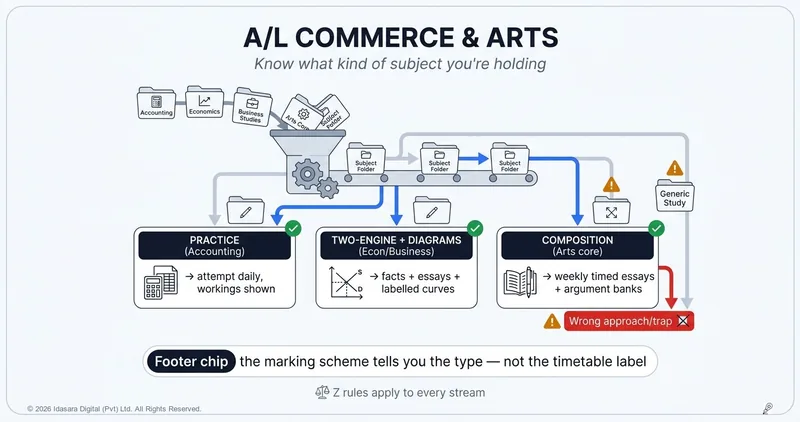
Commerce and Arts students get the least study-method attention in the country — as if only the science stream needed technique. Wrong, and expensively wrong: these streams hide a practice subject wearing a theory costume (Accounting), two-engine essay subjects with diagrams (Economics), and the heaviest composition load in the A/L. This chapter of Learn to Learn sorts each subject into what it really is — because the sorting picks the method.
Here is a quiet unfairness of Sri Lankan study culture: everyone accepts that Combined Maths needs method — but Commerce and Arts students are handed nothing except "read more" and "write more." Then Accounting breaks the readers, Economics breaks the memorisers, and Political Science essays break everyone in November.
The whole playbook for these streams is one skill, applied subject by subject: identify what kind of subject you're actually holding — because every subject in these streams is one of three types you've already mastered the method for. The label on the timetable doesn't tell you; the marking scheme does.
How do you study Accounting — the practice subject in disguise?
Accounting is the stream's great method-trap. It looks like a theory subject (a textbook full of principles and formats) and it marks like Combined Maths: papers pay for performed procedures — entries posted, statements built, balances struck, workings shown.
So Accounting runs the maths playbook, whole: worked examples covered-and-attempted (never read — an account format you've watched is an account you can't produce), daily paper-first problem volume, full workings always (method marks — the marks paid for shown working — live in the ledger lines), errors mined by species — and Accounting's species skew heavily toward precision (a figure transposed, a side confused) and format (the statement's furniture wrong), both curable by checklist, not by more theory. Weekly timed mixed sets teach the recognising skill: which format does this question actually want?
The aha that saves Commerce students a year: you cannot read your way to an Accounting A. The students who "know all the theory" and score C are the maths-watchers of this stream. Done, not read — same law, different uniform.
How do you study the two-engine subjects — Economics, Business Studies, and friends?
Economics and Business Studies are the essay-subject chapter's two-engine model with one addition. Engine one: the fact layer — definitions with exact wording, laws, examples, current-ish cases — on the spaced schedule. Engine two: composition — verb, skeleton, claim-evidence-link, trained weekly under time.
The addition: the diagram is a scheme item. Demand-supply curves, cost curves, business cycles, organisational structures — Economics marks its diagrams the way O/L Science marks the labelled cell: axes named, curves labelled, the shift shown with its arrow, the point marked. Every syllabus diagram goes into your deck (the pictures chapter's rules: drawn cold, red-audited, scheduled), and every essay skeleton asks "which diagram does this answer deploy?" An Economics answer with the right sketched diagram plus a claim-evidence paragraph routinely outscores two pages of prose — it's the densest mark-per-minute act in the stream.
How do you study the composition-heavy subjects — the Arts core?
Political Science, Logic, History at A/L, Geography, Languages, Media: here the essay-subject machinery is the subject, at double depth. What changes from O/L essay subjects is scale and standard: more sources, longer arguments, markers who pay analysis over narration. Three upgrades carry the load:
- Volume of timed essays is your paper-practice — the Arts equivalent of the science stream's 20 papers is a large stack of marked, timed essays across the question archetypes. Arts students who write one essay a week per subject from second term are running the ladder — the staged practice climb; those who "read all year and write in December" meet the composition wall in the hall.
- Argument banks, not just fact banks: for each recurring debate in the syllabus (is X justified? causes of Y?), maintain a skeleton-bank — the three best claims each way, with their evidence attached. Fresh architecture per question (the essay chapter's rule), pre-loaded ammunition.
- Reading is active or it's nothing: the Arts reading load is the stream's real weight, and the reading chapters carry it — read-to-the-end, question log, notes as structure-diagrams. An Arts student running passive reading is the stream's version of the highlighter student, with more pages.
And the stream truths hold here too: the Z arithmetic doesn't care which stream you're in — your weakest subject is still the boss (floor-first allocation applies); the deep-block architecture serves an Arts essay session exactly as it serves a derivation; and the fact schedules run daily in the light slots. Commerce and Arts are not the "easy streams." They are streams whose difficulty was never given a method — until now.
Do this tonight
- Sort your three subjects honestly: which type is each? (Accounting → practice; Econ/Business → two-engine + diagrams; the rest → composition-heavy.) Write it at the front of each file.
- For the practice subject: two problems, covered-and-attempted, full workings. For the two-engine subject: one diagram cold + red audit. For the composition subject: one ten-minute skeleton on a past question.
- Check your week against the stream architecture: does your weakest subject lead tomorrow's best block?
At a glance
- The streams' playbook is one skill: sort each subject into its real type — the marking scheme, not the timetable label, tells you.
- Accounting = a practice subject: the maths playbook whole — you cannot read your way to an Accounting A.
- Economics/Business = two engines + the diagram deck: labelled curves are scheme items; the right diagram + one tight paragraph beats pages of prose.
- Arts core = composition at depth: weekly timed essays as your paper-volume · argument banks (claims + evidence, both sides) · reading that is active or nothing.
- Z-arithmetic, deep blocks, floor-first allocation: the stream rules apply to every stream.
One step further with Idasara Academy
The sorting done, each type finds its mechanic: micro-quizzes — free to start — run the fact layers and Accounting's daily reps with slips banked by topic, and on the paid tiers Exam Paper Marking covers this stream's two hardest checking jobs — accounts marked with workings read line by line, and essays checked against the scheme's points, diagram included. The Mistake Bank sorts your species (you'll be surprised how much of Accounting is precision, not knowledge), and Today's Plan keeps the floor subject in charge of the week.
Start Free — Create Your Account →
FAQ
Everyone says Commerce/Arts are the easy streams. Why do I need all this? The Z-score is relative — each subject's marks are standardised against everyone who sat that subject, including its best students. "Easier content" just moves the competition to execution: coverage, essay quality, Accounting precision. Method is more decisive where raw difficulty filters less.
For Economics, should I memorise model essays? Same answer as O/L English, same reason: memorised essays collapse on the first reworded question and markers see the seams. Memorise the diagram deck and the argument banks; build architecture fresh per verb. That combination is rewording-proof.
How current do my Economics examples need to be? The syllabus's own examples and mechanisms come first — they're what schemes list. A few well-chosen recent examples strengthen evaluate answers, but a current example deployed without the mechanism earns sympathy, not marks. Mechanism first, garnish second.
I chose Arts because I hate maths — and Economics has curves and calculations. Help? Economics' quantitative layer is small, closed, and learnable with the maths playbook's gentlest tools (cover-and-attempt on the standard calculations; the walk-backwards rule if fractions themselves wobble — no shame, the Hard Mode chapters — the book's catch-up track — exist). Don't let a thin maths layer cost a subject you're otherwise strong in.
Further reading
The two-engine model and the marks-shopping eye this chapter leans on: How to Study Essay Subjects and Part 3 — The Grade Progression Ladder & Paper Marking.
Sources
- Dunlosky, J. et al. (2013) — overview at APS
- The Learning Scientists: Dual Coding (the diagram deck)
- Trinity College Kandy — A/L stream guidance (stream entry context)
- The Idasara Method: Part 3 — The Grade Progression Ladder & Paper Marking