The Repeat Year: How to Do It Right — and How to Know If You Should
The short answer: Decide nothing in results week: first diagnose where the marks actually went — coverage, method, format, volume, or circumstances. Repeat if the leak is nameable and fixable and the goal truly needs the grades; otherwise the other roads — vocational, professional, employment-with-study — are real roads, not consolation prizes.
A chapter of the free book Learn to Learn
Published 2026-08-31 · updated 2026-08-31
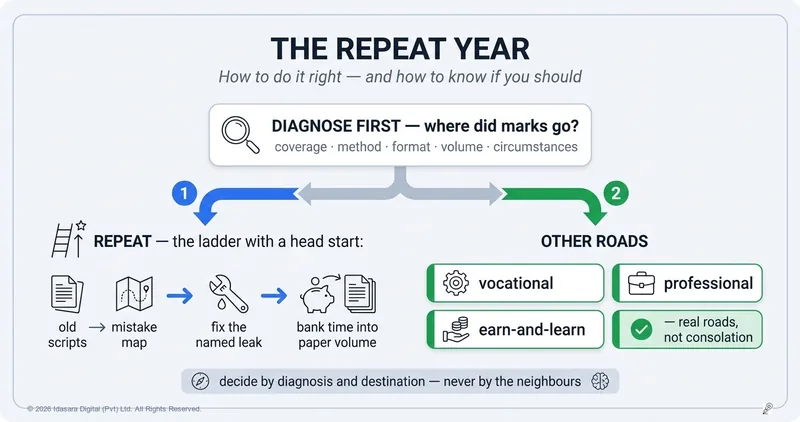
Every year, thousands of students open a results sheet that doesn't say what they needed it to say — and face a choice almost nobody teaches: repeat, or take another road. This chapter of Learn to Learn is for that student and their family: the honest grief of results day, the diagnosis that must come before any decision, the plan that makes a repeat year actually different — and the equally honourable paths that aren't a repeat at all.
There is a day this book has not yet spoken about directly, and it deserves better than silence.
Results day, when the sheet says less than you hoped. The quiet house. The phone you don't want to answer, because relatives are calling. The sentence forming in your own head — "I wasted the year. I'm finished." — and, somewhere underneath it, the question nobody prepares you for: now what?
First, the thing that must be said before any strategy: a disappointing result is a result — it is not a verdict on you. This book opened with the difference between effort and method, and nothing exposes that difference like a results sheet: behind most disappointing results stands a student who worked, with methods that leaked. That is a fixable situation. It has always been a fixable situation. Now let's fix it properly — which begins, as everything in this book begins, with evidence instead of feelings.
Before any decision: diagnose the year
The worst repeat-year mistake happens in the first week: deciding to repeat — or not to — while the result is still a fog of shame, before anyone has asked where, exactly, did the marks go? You cannot choose a road until you know what happened on this one. So run the diagnosis this book has trained you for:
- Get the real numbers. Subject by subject, how far from the needed grades? A near-miss year and a distant-miss year are different situations with different answers. (And where re-scrutiny of a close result is available through official channels, ask your school about it — but plan as if the numbers stand.)
- Autopsy the preparation, honestly, by species. You know the instruments. Was it coverage (whole sections never truly finished — the capped-maximum arithmetic)? Method (a year of re-reading and copying — input without output)? Format (knew the content, undertrained on real papers, time, and marking dialect)? Volume (two practice papers instead of ten or twenty)? Or circumstances (illness, family crisis, a school with no teacher for a subject)? Write it down. Most disappointed students discover their year leaked in one or two nameable places — not everywhere.
- Only then, decide. Because the diagnosis is what the decision actually depends on.
Should you repeat — or take another road?
Here is what the pressure of results week hides: repeating is a strategy, not a duty. It is the right road in some situations and the wrong one in others, and both deserve daylight.
A repeat year makes strong sense when the diagnosis shows a fixable leak — method, format, volume, coverage, or disrupted circumstances — and the goal genuinely requires the grades (the university seat, the stream). A near-miss with a named leak is the best repeat case there is: you are not "doing the year again"; you are correcting two specific things with eleven months of road ahead.
Think harder before repeating when the diagnosis is murkier: when the year was run with honest, sound methods and full effort and the result still fell far short of a very competitive cutoff; when the repeat would be driven mostly by family expectation or shame rather than a goal that needs it; or when a third attempt is being considered mainly to avoid deciding anything else. In those cases, the braver move may be the other roads — and this must be said plainly, because almost nobody says it to Sri Lankan students: the other roads are real roads. Vocational and NVQ tracks, professional qualifications, employment-with-study paths, private and external higher-education routes — these are not consolation prizes; for many people they are the faster route to the same destination (a good income, a real career), and the working world a decade from now will care far more about what you can do than which year your certificate says. The lifelong-learning chapter of this book is the honest foundation here: the engine you built is portable to every road.
One rule for the family conversation: decide by diagnosis and destination, never by what the neighbours will say at the next almsgiving. A year of a young person's life is too expensive to spend on other people's commentary.
If you repeat, what makes the year actually different?
A repeat year fails when it's run as the same year again, but sadder and harder. It succeeds when it's run as what it actually is: the ladder — this book's grade-climbing system — with a head start and a map of exactly where you leak. The differences, concretely:
- Your old scripts and results are the syllabus. Start the year by mining last year's papers and marked work into a mistake bank — a log of your errors, species-sorted. The repeat student's advantage is information: you know precisely where marks died. Aim the year there, not at re-attending everything equally.
- Fix the leak the diagnosis named — as the year's spine. Coverage leak → the contract and tracker — your written syllabus plan — from day one. Method leak → the loop — read, produce from memory, check — honestly, from chapter one of this book (a repeat year run on re-reading will end the same way; this is the hardest truth in this chapter). Format/volume leak → a year weighted heavily toward marked papers, starting months earlier than last time.
- Coverage is faster the second time — bank the surplus into Rung 3. Material genuinely learned last year revives quickly through retrieval passes; don't re-teach yourself what a blank-page test proves you kept. The repeat year's structural gift is time for volume: the ten-to-twenty marked papers that last year never got.
- Protect the person, not just the plan. A repeat year carries loads a first year doesn't: watching friends move on, the household's held breath, the voice that whispers last chance. The nerves chapter's rules apply doubled — evidence over feelings, sleep guarded, one exam-free channel alive — and the parent chapters' instruments matter doubled too: a repeat student measured weekly by calm evidence thrives; one measured daily by anxious hope corrodes. Families: your job this year is to be the calmest room the student enters.
Do this — in results week
- Feel it first. A disappointing result deserves a few honest days; grief rushed is grief prolonged. Then open the notebook.
- Run the diagnosis: real numbers, leak species, one page, written.
- Book the decision conversation — student and family together, diagnosis on the table, both roads laid out honestly with their real destinations. Then commit to the chosen road in writing, and stop re-deciding it every bad morning.
- If the road is repeat: start the mistake-bank mining this month. The head start is the advantage; don't spend it grieving what the plan has already answered.
At a glance
- A disappointing result is a result, not a verdict — behind most stands honest effort through leaking methods, and leaks are fixable.
- No decision before diagnosis: real numbers + leak species (coverage · method · format · volume · circumstances), written down.
- Repeating is one road: strong for near-misses with nameable leaks and goals that need the grades; the other roads (vocational, professional, employment-with-study) are real roads, not consolation prizes.
- A repeat year that works = the ladder with a head start: old scripts mined into a mistake bank · the named leak as the year's spine · surplus time banked into paper volume.
- Protect the person: evidence over hope, sleep, one exam-free channel — and a family that decides by diagnosis, never by neighbours.
One step further with Idasara Academy
The repeat year's two hard jobs — honest diagnosis and a genuinely different method — are the system's home ground: last year's papers mined into the Mistake Bank give the year its map, the full engine (plan, marking, tracker) makes this year structurally different from the one that disappointed, and for the other-roads decision, the free path comparison and Look Ahead tools put the alternatives side by side with evidence instead of stigma. Whichever road you choose, choose it looking at a screen of facts — not a room of opinions.
Start Free — Create Your Account →
FAQ
Everyone will know I'm repeating. How do I face that? With the reframe that happens to be true: you are running a targeted one-year project with better information than any first-timer has. The discomfort of the first month fades; the people whose opinions deserve weight will judge the December version of you, not the January one. And the friends who moved on? Their road and yours reconverge more often, and sooner, than results week can imagine.
How many attempts are allowed, and do universities treat repeaters differently? Attempt limits and selection rules are set by the official bodies and do change — verify the current rules for your exam year with your school and the Department of Examinations rather than with any book or forum. What doesn't change: a repeat plan should be built on the current official rules, checked at the start, in writing.
Is repeating worth it for a small Z-score shortfall? That's the best-case repeat scenario if the diagnosis shows a fixable leak — a near-miss plus a named leak plus a year of volume is a strong equation. But run the other-roads comparison anyway, honestly: sometimes the destination behind the cutoff is reachable by a route that doesn't cost the year. Decide with both columns filled in.
As a parent, I'm afraid a repeat year will break my child. How do I tell? (for parents) Watch the instruments, not the mood swings — some heaviness is normal grief and season pressure. The line the health guidance draws is the one to honour: anxiety or low mood that is severe, persistent, and interfering with daily life is a doctor conversation, not a discipline conversation. And your calmness is load-bearing: the repeat students who thrive almost always describe one adult who treated the year as a project, not a shame.
Further reading
The ladder the repeat year re-runs — and the readiness evidence that replaces hope — is written up in the Idasara Method: Part 3 — The Grade Progression Ladder & Paper Marking. The engine you keep on every road: the lifelong-learning chapter.
Sources
- National Institute of Education, Sri Lanka — nie.ac.lk (syllabi; verify current exam rules with official bodies)
- NHS — When exam stress is more than stress (the severe-persistent-interfering line)
- The Idasara Method: Part 3 — The Grade Progression Ladder & Paper Marking
- The Idasara Method: Part 4 — Time Management & Flipped Learning