Your First 7 Days: The Whole Method, One Small Week
The short answer: Start with one small habit per day for seven days — honesty test, short note, question log, focus block, syllabus audit, mistake bank, Sunday ritual — each about twenty minutes, each making the next one easier. By Sunday night the whole method is running in miniature; never try to start six habits on one Monday.
A chapter of the free book Learn to Learn
Published 2026-08-31 · updated 2026-08-31
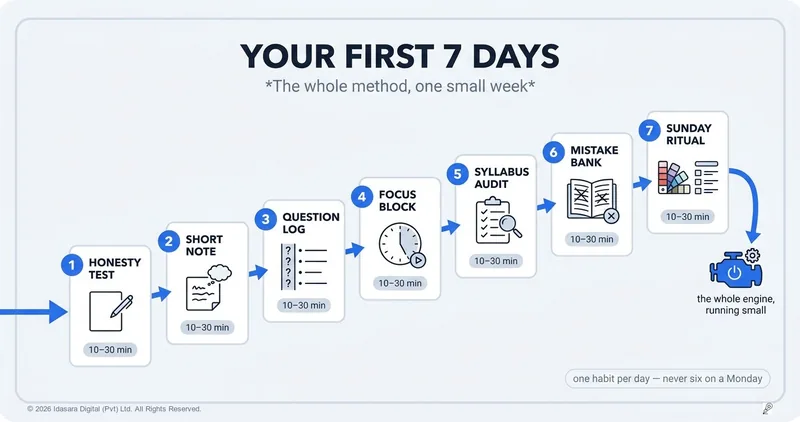
This book hands you many habits — short notes, question logs, trackers, mistake banks, focus blocks — and no one can start six habits on a Monday. This chapter is the assembly guide: one small thing per day for seven days, each about twenty minutes, in the order that makes each one easier than the last. By Sunday night you'll be running the whole engine — in miniature.
Here is the mistake eager readers make with a book like this: they read ten chapters in one weekend, feel a fire lit under them, and on Monday try to do everything — new notes, new timetable, new rules, new life.
By Thursday, everything is too much, nothing has stuck, and the fire is out — one more piece of evidence, whispers the old voice, that "systems don't work for me."
Systems work fine. Starting six systems at once doesn't — for anyone. So here is the week that actually works: one small piece per day, each built on yesterday's, none longer than half an hour. Do only what each day says. Resist doing more; the resisting is part of the training.
(One routing note: this week is for a student whose studying basically works and wants the method installed. If you're coming back from a wasted term or year, start instead with the 30-day turnaround — it's this week's gentler, longer cousin, built for that situation. Run one or the other, never both.)
Day 1 — Run the honesty test (15 minutes)
Take the topic you feel most confident about in any subject. Blank page, book closed, five minutes: write everything you can produce — ideas, formula, diagram. Then open the book and compare.
That gap you're looking at is the illusion of competence — the reason working hard hasn't been working. You've just done the most important thing in this book: seen your real starting point, at your desk, where it costs nothing. (The full story: the illusion chapter.)
Day 2 — Write your first real short note (30 minutes)
Pick one small section — two or three pages — of a subject that matters. Read it once, pen down. Close the book. Write half a page from memory, in your own words. Then compare against the book and fix what you missed in red ink.
That red-marked half page is worth more than an evening of highlighting — and it's the daily move everything else supports. (The craft: the short-note chapter.)
Day 3 — Open your question log (10 minutes, inside normal studying)
Rule a margin column in your notebook. Tonight, while studying anything, finish every section you start — no stopping at confusing paragraphs — and write whatever confusion survives as one precise question in the margin: not "I don't get it," but "why does ___ happen when ___?"
Tomorrow, spend one question on a teacher, a friend, or an AI tutor — and strike it through when it dies. (Why this works: the reading-past-fog and question-log chapters.)
Day 4 — Run one focus block (25 minutes + 5 rest)
One task, chosen small: tonight's short note, or five exercises. Phone out of reach — another room, or another person's keeping; any clock as the timer. Twenty-five minutes, only that task. Then five real minutes of rest — stand, stretch, water, no screen.
Notice how much one clean block produced. That's your work-unit from now on. (The full technique: the Pomodoro chapter.)
Day 5 — Sign the contract, one subject (20 minutes)
Take your hardest subject. Get its topic list — the syllabus outline or your term-mapped materials — and mark each topic honestly: finished (read, noted, exercises done and checked), in progress, or untouched. Most students get a surprise here. Good — a surprise on Day 5 is a rescue; the same surprise in exam season is a disaster.
Circle the oldest gap. That's next week's first repair. (The whole discipline: the syllabus-contract chapter.)
Day 6 — Open the mistake bank (15 minutes)
Find your most recent marked work — a test, checked homework, anything with red on it. In a fresh notebook section, log every lost mark: the topic, what actually went wrong, and which kind of wrong — didn't know it, wrong method, careless slip, or answered the wrong question.
You've just started the notebook that A-students run on: a list of exactly what to fix, written by your own evidence. (The full system: the mistake-bank chapter.)
Day 7 — The Sunday ritual (20 minutes, then rest)
Three small acts, which together become your weekly engine:
- Blank-page test on one thing you studied this week — is it still there?
- Colours: list your subjects, mark each green, amber, or red — by evidence (Day 5's list, Day 6's bank), not feelings.
- Tomorrow's list: three to five small named tasks, aimed at your reds, with the Day 4 block as the delivery vehicle.
Then close the books and rest properly. Rest is part of the system — you'll meet the science of that in the sleep and cramming chapters, but for now, obey it.
What just happened
Look at the week from above. You tested honestly (Day 1), produced from memory (Day 2), converted confusion into questions (Day 3), built the work-unit (Day 4), took command of the syllabus (Day 5), started mining your mistakes (Day 6), and wired it all into a weekly rhythm (Day 7). That is the method — every chapter in this book is one of these seven moves, grown to full size.
Week two is simply: keep the seven alive, small. The daily short note. The log filling and dying. One or two blocks a night, aimed by Sunday's list. One old gap repaired per week. The book's remaining chapters are there for when each habit is ready to deepen — read them as you need them, not all at once. You already know why.
At a glance
- Never start six habits on a Monday — start one per day, smallest useful size: honesty test → short note → question log → focus block → syllabus audit → mistake bank → Sunday ritual.
- Every day is 10–30 minutes; each makes the next one easier.
- Day 5's surprise (real coverage) and Day 6's list (real mistakes) are the two instruments everything else aims by.
- The Sunday ritual — blank-page test · colours · tomorrow's list — is the whole engine in twenty weekly minutes.
- Week two: keep all seven alive, small. Deepen with the relevant chapter when each habit is ready.
One step further with Idasara Academy
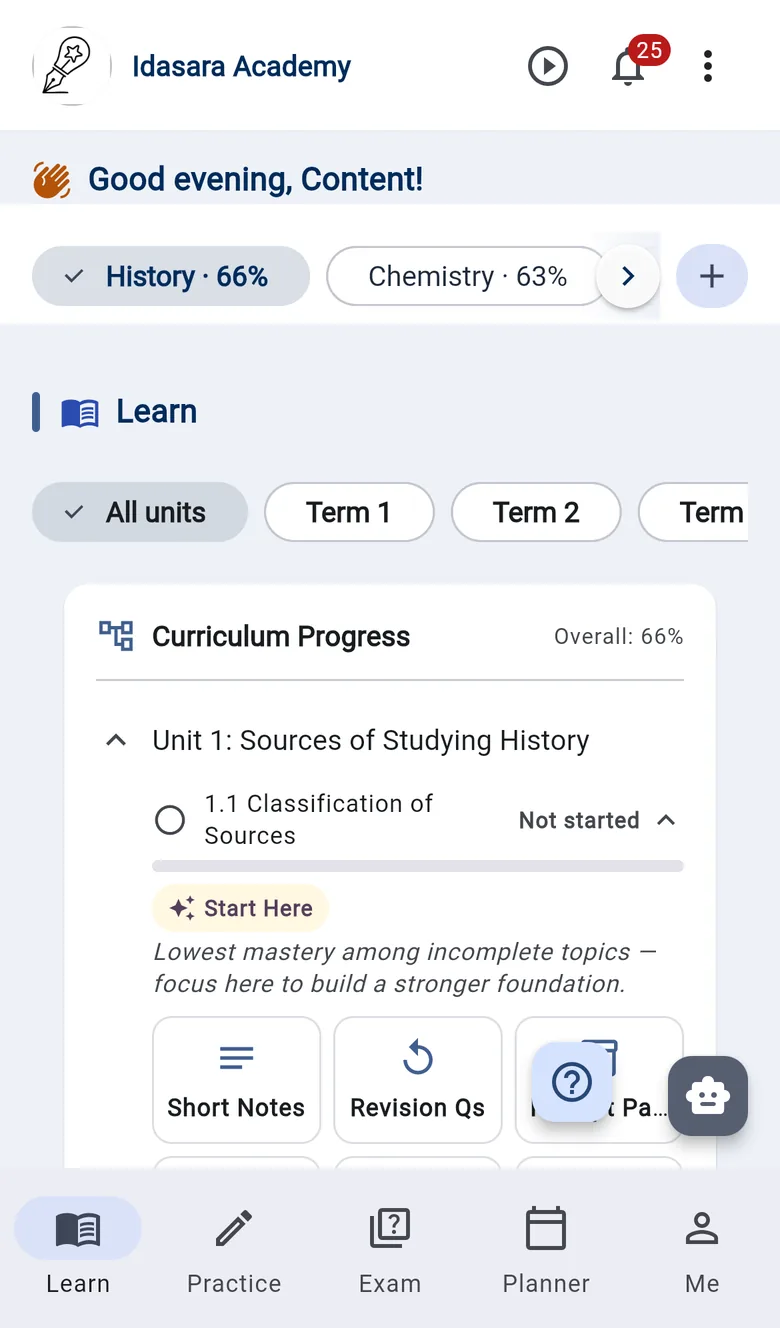
This week, automated, is essentially what signing up to Idasara Academy starts: the plan hands you the daily small tasks, the mistake bank runs itself (with marked answers feeding it on the paid tiers), and the Sunday picture is a live dashboard. Free to start — but run the seven days on paper first if you prefer. The engine is yours either way; the app just keeps it running when willpower has a bad week.
Start Free — Create Your Account →
FAQ
I'm mid-term and busy — should I wait for a holiday to start the week? No — the week is designed to fit inside normal studying (Days 3 and 4 literally are your normal studying, done differently). A holiday start feels cleaner and teaches the habits in conditions that don't resemble your real life. Start on an ordinary Monday.
What if I miss a day? Do that day's piece the next evening and shift the rest along. The order matters more than the calendar — the week can take nine days and lose nothing.
Can I do the days faster — two or three per evening? You can, and it usually backfires into the Thursday collapse this chapter opened with. The one-per-day pace isn't caution; it's how habits attach. Trust the small week.
Exams are very close. Is this still the right first week? The pieces change size but not order: Day 5 (coverage audit) and Day 6 (mistake bank) become your biggest days, and the exam-season chapters — the grade ladder, past-paper volume, cramming-vs-consistency — become week two. Start the same way; steer harder.
Further reading
Every day of this week is a chapter grown small — start at the shelf and deepen each habit as it takes hold. The method behind the whole assembly: Part 1 — The Human Foundation & Active Recall.
Sources
- Dunlosky, J. et al. (2013). Improving Students' Learning With Effective Learning Techniques — overview at the Association for Psychological Science
- The Learning Scientists: Retrieval Practice · Spaced Practice
- The Idasara Method: Part 1 — The Human Foundation & Active Recall