How to Ask a Good Question (The Skill Behind Every Answer You'll Ever Get)
The short answer: Aim at something small — the exact sentence or step where you stopped following — show what you already have, including your partial working, and name the kind of answer you need: a why, a where, or a difference. Those three upgrades turn a vague ask into one worth answering.
A chapter of the free book Learn to Learn
Published 2026-08-31 · updated 2026-08-31
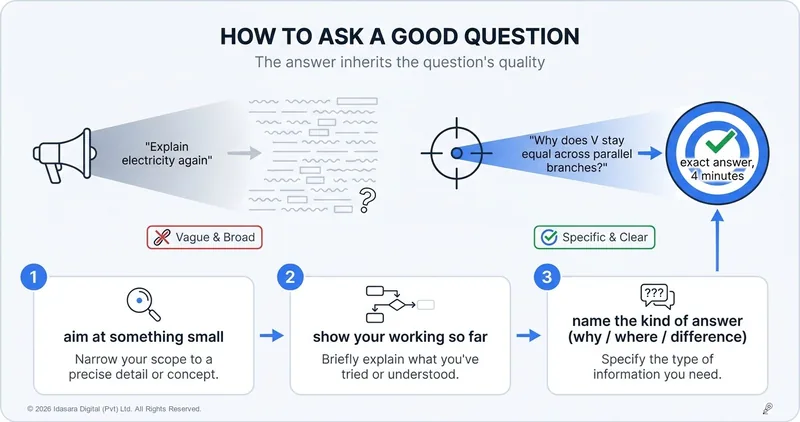
The quality of every answer you receive — from teachers, friends, books, or AI — is set by the quality of the question you ask. This chapter of Learn to Learn breaks down what makes a question answerable, the three upgrades that turn a vague ask into a surgical one, and why this one skill now multiplies everything else.
Two students approach the same teacher after the same lesson.
The first says: "Sir, I didn't understand the lesson. Can you explain it again?" The teacher sighs — kindly, but visibly. Explain what again? All forty minutes? He offers a two-minute summary of everything, which helps with nothing in particular, and both walk away vaguely dissatisfied.
The second says: "Sir, I followed until we divided both sides — why are we allowed to divide by x there when x could be zero?" The teacher's face changes. Now there's something to answer. Ninety seconds later, the student has exactly what they needed — and the teacher has quietly re-classified them as serious.
Same teacher. Same goodwill. The only difference was the shape of the ask. That shape is a skill — maybe the most under-taught skill in education — and it can be learned in an evening.
Why do vague questions get vague answers?
A question is a targeting instruction: it tells the answerer where to aim. "Explain electricity again" aims at a whole territory, so the answer sprays across the territory — general, familiar, and useless to you, because your actual problem lives at one specific address the question never mentioned.
There's a harder truth underneath, and this book has met it before: a vague question is usually vague because the asker hasn't yet located their own confusion. "I don't get it" almost always means "I haven't yet found the exact sentence where I stopped getting it." The work of finding that sentence is the question-asking skill — and here's the beautiful part: that work is itself learning. Researchers who study elaborative interrogation — the strategy of generating precise how- and why-questions about material — find that forming the question forces you to map what you know against what you don't, right up to the exact edge. Again and again, students find the question answering itself as they finish writing it. That's not a trick of luck; that's what locating a confusion precisely does.
In simple terms: a good question is half the answer, and the asker earns that half.
The three upgrades
Take any vague ask and run it through three upgrades:
Upgrade 1 — Aim at something small. Replace the topic with the exact sentence, step, or claim where you stopped following. Not "I don't understand photosynthesis" but "I don't see where the oxygen in the equation comes from." The test: could someone answer without first asking "what exactly don't you understand?" If they'd need to ask that, you haven't finished aiming.
Upgrade 2 — Show your state. Tell the answerer what you do have: "I followed until the third line…", "I can solve it when the angle is given, but…", "Here is my working — it diverges from the answer at step 4." This transforms the answer you get: instead of re-explaining from zero (wasting both your time on what you already know), the answerer starts precisely at your frontier. Showing partial work feels exposing; it is actually the single biggest answer-quality multiplier there is.
Upgrade 3 — Name what kind of answer you need. "Why does this work?" wants a reason. "Where did my step go wrong?" wants an error located. "What's the difference between these two?" wants a comparison. You learned to read command verbs in exam questions; now write them into your own. A question with a clear verb gets an answer with a clear shape.
Watch all three land at once: "I don't get organic chemistry" becomes "In this reaction, I understand why the OH attacks the carbon (that part's fine) — but why does the bromine leave rather than the hydrogen? Which rule decides who leaves?" The second version is barely longer. It is a different instrument entirely.
One skill, every source
Here is why this chapter sits at the centre of the book's fourth part: every source of help you will ever use pays out in proportion to this skill.
- Teachers answer surgical questions brilliantly and vague ones wearily — you saw the two students above. A question log — the notebook where your asks wait — full of precise questions turns every class into a targeted service.
- Friends give four focused minutes to a precise ask, or a rambling half-hour to a vague one that helps neither of you.
- Books and searches can only be interrogated with words you supply; precise words find precise passages.
- And AI — the newest answerer — is the most extreme case of all. An AI tutor answers exactly the question asked, instantly, without ever getting tired: which means it amplifies your question's quality in both directions. Surgical in, surgical out; fog in, confident-sounding fog out. The students getting remarkable value from AI and the students getting generic mush are separated almost entirely by this chapter's skill. (What AI should and shouldn't be asked to do gets its own chapter next.)
The pattern is worth saying once, plainly: as answers get cheaper — and they have never been cheaper than now — the scarce skill moves to the question side. You are practising, on tonight's homework, the exact capability the coming decades will pay for.
Do this tonight
- Open your question log (start one tonight if the earlier chapter hasn't caught you yet). Take its vaguest entry.
- Run the three upgrades: aim it at a sentence, add your state, give it a verb. Write the upgraded version below the original — keeping both teaches you the difference better than any example of mine.
- Spend it tomorrow: on a teacher, a friend, or an AI tutor. Notice the answer's precision — then notice who set that precision.
At a glance
- Answers inherit their quality from questions: a question is a targeting instruction.
- Vague asks usually mean the confusion hasn't been located — and locating it precisely is itself learning (elaborative interrogation).
- The three upgrades: aim at something small · show your state (including partial work) · name the kind of answer (why / where / what's the difference).
- One skill pays everywhere: teachers, friends, books, searches — and AI amplifies question quality in both directions.
- As answers get cheap, the scarce skill moves to the question side. Practise it nightly; it compounds for decades.
One step further with Idasara Academy
A surgically-aimed question deserves an answerer that's always awake and never syllabus-confused. Idasara Academy's AI Study Coach (Ask AI) — free to try with 5 messages a day; the paid tiers remove the cap — takes the exact question from your log at any hour, in your language, grounded in the national curriculum. It meets you at Upgrade 2 too: give it your partial working and ask where the logic diverged, and it guides the step instead of dumping the answer. And the free Prompt Packs are worked examples of upgrade-quality asking — study how they're built, and your own questions sharpen everywhere, teachers included.
Start Free — Create Your Account →
FAQ
Doesn't asking precise questions make me look like I know less? The reverse, reliably: vague questions signal unstarted work; precise ones prove engagement up to a located frontier. Watch which students teachers take most seriously — it's the surgical askers, every time.
What if I'm too confused to even find the sentence where I got lost? Then ask the locating question — "Which earlier idea does this section assume?" — or walk backwards through the material until it last made sense; the boundary you cross is your answer. "Find where it last made sense" is itself a precise, answerable task.
Is it rude to tell a teacher what kind of answer I need? Framed as need, never: "I think I need the reason, not the steps — I can do the steps." Most teachers are delighted; you've done the diagnostic half of their job and handed it over politely.
Should I write questions down even when I can ask immediately? Yes — writing is where the three upgrades happen. A question asked as it first occurs to you is usually the vague version; thirty seconds of writing turns it into the version worth someone's answer.
Further reading
Surgical queries and the targeted-clarification workflow are move 4 of the learning loop — written up in the Idasara Method: Part 1 — The Human Foundation & Active Recall.
Sources
- The Learning Scientists: Learn How to Study Using… Elaboration (elaborative interrogation)
- UCLA Bjork Learning and Forgetting Lab — research overview on generation effects
- The Idasara Method: Part 1 — The Human Foundation & Active Recall