What Is Time Management, Really? (It's Not Studying More Hours)
The short answer: Time management for a student is not finding more hours — it's answering three questions every day: what is this hour for (a named, finishable outcome), where is my best energy going (hardest subject, freshest hours), and is every subject still moving (nothing sleeps for more than a few days). Answer those and the hours take care of themselves.
A chapter of the free book Learn to Learn
Published 2026-08-31 · updated 2026-08-31
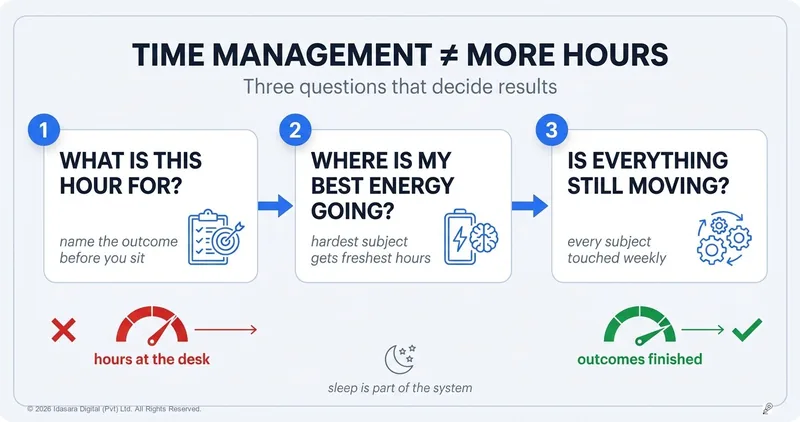
For a student, time management is not squeezing more hours out of the day — it is deciding what each hour is for, and matching your hardest work to your best energy. This chapter of Learn to Learn replaces the broken question "how many hours should I study?" with the three questions that actually decide results.
Ask a struggling student what they plan to change, and the answer is almost always the same: "I'll study more hours."
It sounds responsible. Parents nod. Teachers approve. And yet — have you noticed? — the students with the best results are rarely the ones studying the most hours. Some of them close their books earlier than everyone else and still walk out with the A.
So what do they know? They know that "how many hours?" is the wrong question. Time management stands on three better ones.
Question 1: What is this hour for?
An hour of studying is not a unit of work. It is a container — and most students fill it with fog: "tonight I'll do some physics." Some physics. Which pages? Which problems? Finished when?
Compare that with: "this hour is for exercise questions 1–6 from the current chapter, marked against the answers." Now the hour has a target, and something almost magical follows — you can fail it or finish it. Fog can be neither failed nor finished, which is exactly why fog feels safe and produces nothing.
In simple terms: an hour with a named outcome is worth three without one. Before you sit down, complete this sentence: "When this session ends, I will have ___." If you cannot complete it, you are not ready to sit down — and that one sentence is the whole discipline of planning, in miniature.
Question 2: Where is my best energy going?
Here is the quiet scandal of most study timetables: the hardest subject gets the worst hours.
All evening, the comfortable subjects get your fresh attention — because they're pleasant, and you feel productive doing them. The subject your marks actually swing on gets whatever is left at eleven o'clock: a tired brain, a wandering mind, an open book in front of closed eyes. Then, when that subject's marks disappoint, the conclusion drawn is "I'm weak at it" — when the truth is it never once received your real attention.
Energy, not time, is the resource that learns. The same hour is not the same hour: sixty fresh morning minutes can do what three drained late-night hours cannot. So the rule is simple and slightly uncomfortable: your hardest subject gets your best hours. The first block of any morning you control — a tuition-free weekend slot, a holiday, the hour before school — or the first block after you've rested on a school day: that prime slot belongs to the subject you'd rather avoid. The comfortable subjects will survive your tired hours; they always do.
Question 3: Is everything still moving?
The third question protects you from a mistake that feels like hard work: pouring everything into one subject while the others quietly rot.
A week of glorious mathematics focus feels heroic — but you sit for nine O/L subjects, or three A/L subjects, and the exam calendar does not care which one you were enjoying. Knowledge decays when untouched; a subject left alone for two or three weeks doesn't wait for you — it slides backwards, and the catch-up cost compounds.
So the third discipline is rotation: every enrolled subject gets touched every week, and no subject you're serious about sleeps for more than a couple of days. The touches don't need to be equal — the struggling subject earns bigger, better blocks; the strong one may need only a maintenance quiz — but nothing goes dark. A timetable's real job is not decoration on the wall; it is this guarantee that nothing is silently dying.
The three questions, working together
Notice what has happened to "how many hours should I study?" It has dissolved. Give each session a named outcome, give your hardest subject your freshest energy, keep every subject alive weekly — and the hours take care of themselves. Most students who adopt these three questions find they study fewer total hours than their panicked classmates — with better results to show for it.
And one more honest word, because this book doesn't sell fog: rest is part of the system, not a betrayal of it. Sleep is when the day's learning settles into memory; a schedule that sacrifices sleep throws away what it studied. The student who guards eight hours of sleep is not studying less — they are keeping what they studied. (How to run the individual focus blocks inside these hours is its own craft — the Pomodoro chapter of this book covers it.)
Do this tonight
- Write down your subjects, and beside each, the date you last actually worked on it — not attended a class: worked. Any subject past a week is your first flag.
- Name tomorrow's hardest subject, and give it tomorrow's best slot — before the comfortable subjects touch it.
- For that slot, complete the sentence: "When this session ends, I will have ___."
Three lines on paper. That is more time management than most students do in a year.
At a glance
- Time management is not more hours — it is three questions answered daily.
- What is this hour for? Every session gets a named, finishable outcome.
- Where is my best energy going? Hardest subject, freshest hours — never the leftovers.
- Is everything still moving? Every subject touched weekly; nothing sleeps for long.
- Sleep is when learning is kept — a schedule that cuts sleep throws away what it studied.
One step further with Idasara Academy
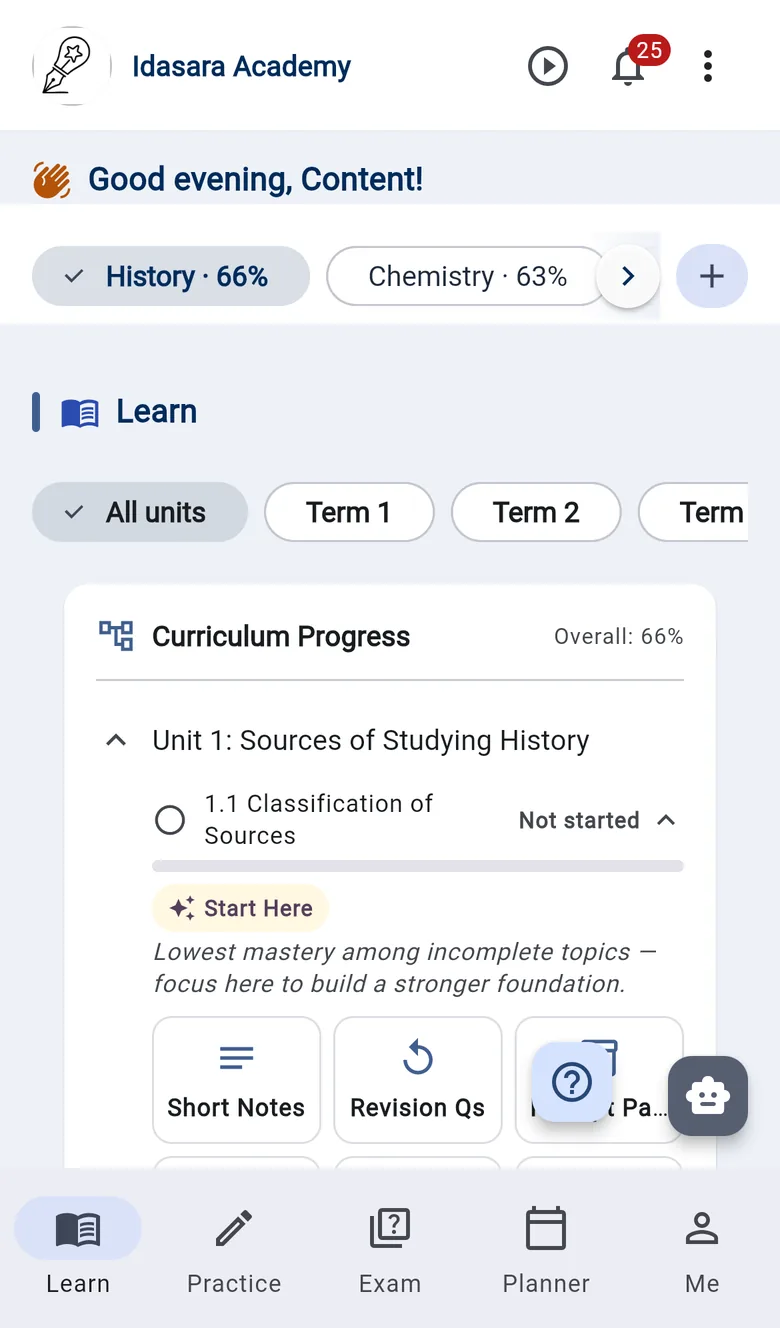
These three questions are exactly what Idasara Academy's Today's Plan computes each morning — and it's free to start: sign up, and tomorrow it hands you a short list of named, block-sized tasks, weighted toward where your marks currently swing, with every subject watched so none goes dark. There's also a free My Schedule that plans around your real tuition classes. You bring the energy; the plan brings the answer to "what is this hour for?"
Start Free — Create Your Account →
FAQ
So how many hours should I study a day? Fewer than you fear, if they're real. Three or four genuinely focused blocks on a school evening outperforms six foggy hours — and is repeatable for a whole year, which cramming is not.
My timetable never survives the first week. What am I doing wrong? Probably nothing except over-decorating. A colour-coded plan for every half hour breaks on first contact with real life. Plan only tomorrow: which subject gets the best slot, and what each session must produce. A plan you rewrite daily in two minutes beats a masterpiece you abandon.
What about school and tuition — they already take most of my time? They're fixed containers; your self-study is what you actually control. The three questions apply to the hours that are yours — and a later chapter on fitting self-study around tuition covers the joints between them.
Is it wrong to start with easy subjects to "warm up"? A five-minute warm-up, fine. But watch the trick your brain plays: "warming up" that lasts an hour is avoidance pretending to be preparation. The hard subject goes first because you don't want it to.
Further reading
Energy allocation, stage-based pacing for O/L and A/L, and the full schedule engine are in the Idasara Method: Part 4 — Time Management & Flipped Learning.
Sources
- UCLA Bjork Learning and Forgetting Lab — research overview on spacing and distributed practice
- Dunlosky, J. et al. (2013). Improving Students' Learning With Effective Learning Techniques — overview at the Association for Psychological Science
- Francesco Cirillo — the official Pomodoro Technique site
- The Idasara Method: Part 4 — Time Management & Flipped Learning