Sleep: The Unfair Advantage Hiding in Plain Sight
The short answer: A teenage student needs 8–10 hours a night — the health guidance's number, more than the adult 7–8 — and it is never the budget to raid for the syllabus, because sleep is when today's studying gets kept and tomorrow's learning gets funded. Fix a lights-out counted backwards from your wake time, and hold it seven days a week.
A chapter of the free book Learn to Learn
Published 2026-08-31 · updated 2026-08-31
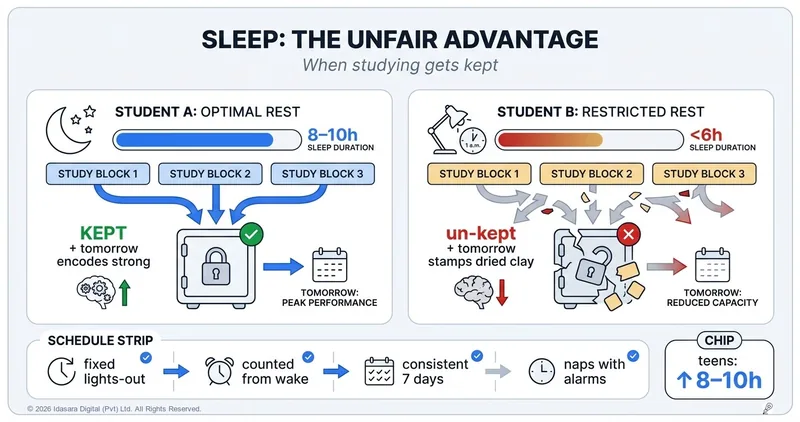
Study culture treats sleep as the flexible budget — the hours you raid when the syllabus presses — and wears exhaustion as proof of seriousness. The science says the culture has it exactly backwards: sleep is when studying gets kept, and the well-slept student is running performance enhancement the tired one can't buy. This chapter of Learn to Learn is the full case — consolidation, next-day encoding, the teen numbers — and the schedule that treats sleep as what it is: study infrastructure.
Two students study the same chapter tonight, equally well. One sleeps a full night. The other proudly pushes to 1 a.m. over the same books, then wakes at five to "revise more."
By every cultural measure, the second student is the serious one. By what actually happens in their skulls, the first student just ran the superior study program — because the night's work wasn't over when the books closed. Sleep is when the day's learning is kept.
This book has said it in passing for forty chapters (the cramming chapter, the nerves chapter, the best-hour chapter). Here is the full case, because a habit this load-bearing deserves its own foundations.
What does sleep actually do for a student? Two jobs
Job 1 — Consolidation: tonight's sleep keeps today's studying. During sleep, the brain runs its housekeeping: strengthening the pathways today's learning laid down, clearing the metabolic clutter of the waking day (the health services' plain phrasing: sleep is as essential to the brain as food). The practical translation is stark — the hours studied and the hours slept are not competitors for the same budget; the slept hours are how the studied hours get banked. The 1 a.m. student didn't add two hours of studying; they spent the deposit mechanism on more deposits it could no longer keep. You've met this arithmetic in the cramming chapter; it applies to ordinary Tuesdays too.
Job 2 — Preparation: tonight's sleep funds tomorrow's encoding. The tired brain doesn't just retrieve worse (the exam-day risk); it learns worse — tomorrow's classes and blocks write into it faintly, like pressing a stamp into dried clay. Chronic under-sleep therefore compounds in both directions at once: yesterday under-kept, tomorrow under-learned — the quiet engine under many "I study so much and remember nothing" stories that the illusion chapter's mechanics alone don't explain.
The teen numbers, plainly: the health guidance puts adolescent sleep need at 8–10 hours — not the adult 7–8, and the difference isn't softness; adolescence is heavy construction season for exactly the brain systems exams tax. A 6-hour-sleeping sixteen-year-old is running a chronic deficit that no study technique compensates, and the deficit feels normal within weeks, which is what makes it so expensive: tiredness stops reporting itself while it keeps charging.
What does the sleep schedule look like? Infrastructure, not leftover
The fix is structural, not motivational — sleep goes on the timetable first, like the shop's opening hours:
- A fixed lights-out, counted backwards from the wake time — school's 5:45 alarm minus nine hours names the night, and the night names the evening's endpoint. The daily plan runs toward that endpoint (the pairing chapter's planned finish), never through it.
- The last half-hour is a landing, not a crash: light work only (the figure walk — a pass through the chapter's figures — tomorrow's material laid out, the ten-line diary) — no deep problems (they churn), and no feed (the phone's bedroom exile from the phone chapter is half a sleep intervention; screens' light and stimulation both push sleep later).
- The consistency matters as much as the total — the weekend "catch-up" that shifts sleep hours wrecks Monday's morning gold (the best-hour chapter's asset); keep the wake time within an hour of itself, seven days, and the whole architecture of mornings this book keeps praising starts appearing on schedule.
- The nap, used honestly: twenty post-school minutes can rescue an evening block (the resting-before-late-work move from the working-student chapter); the two-hour dusk coma steals the night. Set an alarm; land, don't sink.
And in exam season, sleep gets more protected, not less — you know the exam-eve rule from the exam-day playbook. The season's version of seriousness is a student who treats the fixed lights-out the way they treat the exam timetable: printed, obeyed, defended to the household (the parents' chapters armed the family for exactly this defence).
Do this week
- Name the numbers tonight: wake time − 9 hours = lights-out. Write both on the wall over the desk.
- Build the landing: last half-hour's menu chosen (walk, layout, ten lines), phone exiled, alarm clock installed.
- Run one honest week, then check the two gauges: the morning block's quality, and the daily quizzes' scores. Sleep argues best with your own data — which is, of course, this book's favourite kind of argument.
At a glance
- Sleep does two study jobs: consolidation (tonight keeps today — studied hours are banked by slept ones) and preparation (tonight funds tomorrow's encoding). Cutting it un-saves and pre-weakens at once.
- The teen number is 8–10 hours — construction-season brains need more, and chronic deficit stops feeling like anything while it keeps charging.
- Schedule it as infrastructure: fixed lights-out counted back from wake time · a landing half-hour (light work, no feed) · consistent wake times all week · naps with alarms.
- Exam season protects sleep harder — exhaustion is not seriousness; it's spending the deposit mechanism.
- Sleep is the one advantage every student is allowed to take. Take it.
One step further with Idasara Academy
A small, honest tie: Today's Plan sizes the evening's tasks toward a finish, not through midnight — the system was built on this chapter's science, and it will never hand you a plan that needs your sleep to complete. The rest of this chapter needs no app at all: an alarm clock, a wall number, and a family that read the parents' chapters.
Start Free — Create Your Account →
FAQ
Night is genuinely my best focus time — the house is finally quiet. Give it up? Distinguish the two things night gives you: quiet (real — and the no-quiet-room chapter showed the morning provides it too, plus the science's favourite hours) and alertness at midnight (mostly the deficit talking — a chronically tired brain feels "awake" late the way the chapter described deficits hiding). Trade a fortnight honestly: early quiet for late quiet, full nights, then judge by produce. Most self-declared night owls are morning people in debt.
Eight hours is impossible in my exam year — the syllabus won't fit. Run the arithmetic this book keeps running: hours studied unslept are hours partly un-kept — the syllabus fits worse in a longer, leakier day. The time-layer chapters exist to make the work fit inside a slept day (that's their whole job); if it truly doesn't fit, the triage chapter's abandonment list is the honest tool — not the night.
I lie awake anxious even with good habits. What then? Exam-season minds race; the landing half-hour plus the nerves chapter's written-evidence ritual (read the tracker, not the fears) quiets most of it. Persistent sleeplessness — weeks, despite the habits — crosses into the when-it's-more-than territory: the GP conversation, without shame, as ever.
Further reading
The chapters this one underwrites: Cramming vs Consistency (the all-nighter's true price) · Your Hardest Subject Deserves Your Best Hour (the mornings sleep buys) · Exam Nerves (the body's settings).
Sources
- NHS — teen sleep: 8–10 hours; cramming all night "usually a bad idea"
- NIH / NINDS — Brain Basics: Understanding Sleep (consolidation; the brain's housekeeping)
- Murre, J. & Dros, J. (2015) — the forgetting curve (what unconsolidated learning does)
- The Idasara Method: Part 4 — Time Management & Flipped Learning