Clear While Reading, Blank While Writing: The Illusion of Competence
The short answer: Because re-reading builds recognition, not recall — the chapter looks familiar, so it feels known, but familiarity cannot be written onto a blank page, and it drains away within days. The fix is producing from memory: close the book, write what you know, and study only the gaps.
A chapter of the free book Learn to Learn
Published 2026-08-31 · updated 2026-08-31
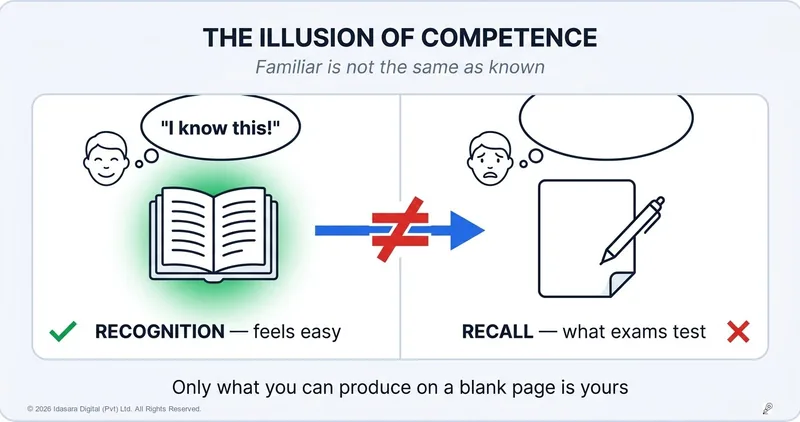
The most common study trap has a name: the illusion of competence — mistaking "this looks familiar" for "I can write this from memory." This chapter of Learn to Learn explains the two memory systems behind the trap, why exams test the one most students never train, and the one-minute habit that breaks the illusion.
You know this feeling. You have lived it.
You studied the chapter — properly, you thought. You read it twice. Everything made sense; nothing confused you. You closed the book feeling calm, even confident.
Then the paper was placed in front of you. And the knowledge that felt so solid the night before simply… wasn't there. Not gone exactly — you could almost see the page — but nothing would come out onto the paper.
Why does the mind do this to us? Was it nerves? Bad luck? A bad memory?
None of those. It was a trap with a name — and once you can name it, you can beat it.
Two feelings that wear the same face
Your brain has two different abilities, and from the inside they feel identical.
The first is recognition: you see something, and a quiet signal says I've met this before. It is effortless and instant — the same signal that tells you a song is familiar after two notes.
The second is recall: producing the knowledge yourself, from nothing — writing the definition on a blank page, rebuilding the derivation, drawing the diagram with no book in sight. Recall is slow, effortful, and honest.
Here is the trap. Re-reading a chapter floods you with recognition signals. Every paragraph looks familiar, so every paragraph feels known. Your brain files the whole chapter under "done." That comfortable feeling is the illusion of competence — familiarity dressed up as mastery.
And the exam? The exam never asks whether the page looks familiar. It takes the page away and asks you to produce it. It tests recall — the ability most students, through no fault of their own, have never actually trained.
In simple terms: you practised watching; the exam demanded performing.
The trap has a partner: forgetting
The trap deepens with time. Most of what we take in passively begins draining away within hours — the forgetting curve, which gets its own chapter in this book. So the student who "studied the chapter" on Monday and feels confident on Friday is fooled twice over: the material was never truly in recall memory, and even the surface familiarity has been quietly draining away all week.
This is why the discovery so often happens inside the exam hall — the one place where it is too late to act on it. The whole purpose of this chapter is to move that discovery to your study desk, where it costs nothing.
What is the one-minute honesty test?
Breaking the illusion needs no app, no teacher, and no talent. It needs sixty seconds and a blank page.
After you study anything — a section, a theorem, a process — close the book and write, from memory:
- the main idea, in your own words;
- the key definition or formula;
- the diagram, roughly, with labels.
Whatever flows out is genuinely yours. Whatever refuses to come — that's not failure, that's intelligence about yourself: a precise map of what still needs work, delivered while there is still time to do the work.
This is why every technique in this book — short notes written from memory, question logs, self-testing, past papers — is really one idea wearing different clothes: make the knowledge come out of you, and it will be there when the exam asks for it. Researchers who compared study techniques found exactly this pattern: methods built on retrieval sit at the top of the effectiveness table, while re-reading and highlighting — the comfortable, familiar-feeling methods — sit at the bottom.
Do this tonight
- Pick the topic you feel most confident about — that's where the illusion hides best.
- Blank page, book closed, five minutes: write everything you can produce about it.
- Open the book and compare. Greet every gap like a friend who told you the truth early.
- Study the gaps — not the whole chapter — and repeat the test tomorrow.
You may find the first test humbling. Good. One honest blank page in October is worth more than a thousand confident re-readings in November — because the blank page tells the truth while the truth is still cheap.
At a glance
- Recognition ("this looks familiar") and recall ("I can produce this on a blank page") feel the same from the inside — but exams only ever test recall.
- Re-reading and highlighting train recognition, which is why a chapter can feel mastered and still vanish in the hall.
- Passive knowledge also fades within days, deepening the illusion.
- The fix is the one-minute honesty test: book closed, blank page, produce what you know, study only the gaps.
- Every strong technique in this book is retrieval in different clothing.
One step further with Idasara Academy
The honesty test works best when someone keeps asking you questions you didn't choose yourself. Idasara Academy's micro-quizzes do that after every topic — free to start: pick tonight's topic and take its quiz cold, no book. They demand recall, not recognition, and every gap they expose is remembered and brought back until it closes. It is the blank-page test, running on schedule so you don't have to.
Start Free — Create Your Account →
FAQ
Is feeling confident always a bad sign? No — confidence after producing from memory is exactly the right kind. The warning sign is confidence that comes only from reading, before anything has come out of you onto a page.
I re-read because it feels productive. Is it completely worthless? Not completely — a first careful read builds understanding, and a targeted look-back patches specific gaps. It fails only as your main method, because it trains the wrong memory system.
Why does recalling feel so unpleasant compared to re-reading? Because effort is the active ingredient. The strain you feel when memory digs for an answer is the very process that strengthens it. Comfortable studying is usually a sign that nothing is being built.
How often should I do the honesty test? At the end of every study session, on that session's material — one minute. And once a week, on material from earlier weeks, because that is where the fading has been quietly working.
Further reading
This chapter is the foundation the whole system stands on. The full write-up — the science of cognitive effort, and the 7-move learning loop built on it — is in the Idasara Method: Part 1 — The Human Foundation & Active Recall.
Sources
- Dunlosky, J. et al. (2013). Improving Students' Learning With Effective Learning Techniques — overview at the Association for Psychological Science
- Murre, J. & Dros, J. (2015). Replication and Analysis of Ebbinghaus' Forgetting Curve, PLOS ONE
- The Learning Scientists: Learn How to Study Using… Retrieval Practice
- The Idasara Method: Part 1 — The Human Foundation & Active Recall