Beating the Phone: You're Not Weak — You're Out-Engineered
The short answer: You beat the phone with design, not willpower: put it in another room while you study (and outside the bedroom at night), log out of the feed apps and bury their icons, fill the gaps the scroll fed with real rest and scheduled leisure, and check the screen-time counter weekly against your study hours. The feed was engineered to defeat self-control; your side has to be engineered too.
A chapter of the free book Learn to Learn
Published 2026-08-31 · updated 2026-08-31
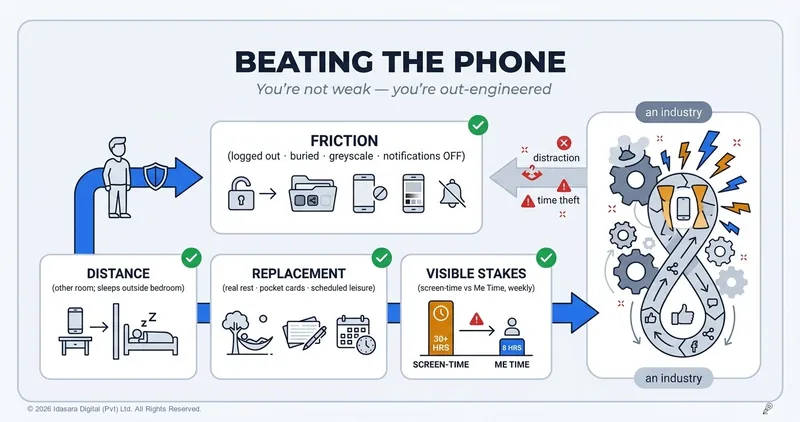
Every student who loses another evening to the scroll draws the same conclusion: "I have no self-control." Wrong diagnosis, and it matters: the feed is a product engineered by thousands of professionals to defeat exactly your self-control. This chapter of Learn to Learn reframes the fight — design against design — and installs the four defences that beat the feed without the daily willpower war you keep losing.
Open the ledger of the fight honestly. In one corner: you, tired at 8 p.m., with homework and a vague vow. In the other: the most sophisticated attention-capture machinery ever built — teams of engineers, infinite content tuned to your reactions, variable rewards timed like a casino's, autoplay burning your stopping-points, notifications engineered to itch. You bring willpower to this; they brought an industry.
So retire the character-verdict. Losing evenings to the feed proves you're human, not weak — and, more usefully, it reveals the winning strategy, because the feed's own designers gave it away: they didn't strengthen your desire; they engineered your environment. Do the same, in reverse. Four defences, in order of power.
Defence 1 — Distance: the geometry of temptation
Every centimetre between you and the phone is willpower you don't have to spend. The rules you've met (another room; another person's keeping; the shared-phone timetable) are this defence — now understand why they outrank everything else: the scroll mostly begins as a reflex-reach in a micro-boredom gap, and a reflex that requires standing up and walking dies unfired. The phone in the pocket loses the evening; the phone across the house loses only the reflex. Add the night geometry — the phone sleeps outside the bedroom (an alarm clock costs little and repays it in both sleep and mornings) — and the two most vulnerable hours of the day, last-thing and first-thing, are simply removed from the battlefield.
Defence 2 — Friction: make the feed expensive, the tools cheap
Where distance isn't possible, add steps. Log out of the feed apps (the password-entry pause is a decision-point the reflex can't cross), move them off the home screen into a buried folder, turn the screen greyscale in study hours if the phone allows (the feed runs on colour), and kill every non-human notification permanently — not silenced: off (each buzz is an engineered interruption you're paying attention-tax on, per the focus chapters). Meanwhile, run the same lever backwards: the study uses of the phone get zero friction — the app on the home screen, the card-deck one tap away. You're not fighting the phone; you're re-pricing its menu.
Defence 3 — Replacement: what fills the boredom the scroll was feeding?
The feed occupies a real vacancy: micro-boredom, rest-gaps, the discomfort of an unstructured minute. Delete the feed without filling the vacancy and the vacancy wins it back within a week — so the design must answer what happens in the gaps instead: real rest that isn't a screen (the pomodoro chapter's stand-stretch-water; the walk; the actual nap), the pocket-card fragments for waiting-time (Hard Mode's menu, from the book's difficult-circumstances chapters, turns queues into card-reps — the same gaps, converted), and honest leisure scheduled on purpose — this book has never demanded a phoneless life, only a phone that's a chosen pleasure at chosen times instead of an ambient leak. A deliberate evening episode outranks two hours of ambient scroll in actual enjoyment; the feed's dirty secret is that it doesn't even deliver the fun it charges for.
Defence 4 — The visible stakes: make the leak measurable
Willpower can't fight what it can't see. Check the phone's own screen-time counter weekly (the number is usually a shock — face it, don't flinch), and put the trade on paper once: your daily scroll-hours × 7 versus your weekly Me Time total — the week's self-study hours. For most struggling students, the feed is eating more than their entire conversion budget — the marks aren't missing; they're being spent, a few seconds at a time, on the feed. That framing — the scroll as spending, not resting — is what makes the defences feel like getting richer instead of being punished.
During exam season, the design tightens by agreement, not heroics: feeds logged out for the season (announced to friends — "back in December" posts are respected more than students fear), the phone's role reduced to its bounded jobs, the visible counter checked weekly as part of the Sunday ritual. Season rules, like an athlete's.
Do this tonight
- Tonight's geometry: phone out of the bedroom, alarm replaced. This one is non-negotiable and pays by tomorrow.
- Ten minutes of friction-work: log out of the two worst feeds, bury the icons, kill non-human notifications, study tools to the front.
- Check the screen-time counter and write the one-line trade: scroll-hours/week vs Me-Time-hours/week. Put it where the vow used to hang.
At a glance
- Losing to the feed isn't weakness — it's being out-engineered. The counter-strategy is theirs, reversed: design the environment, spend no daily willpower.
- Distance first: the reflex dies if it must walk; the phone sleeps outside the bedroom, always.
- Friction: logged-out feeds, buried icons, greyscale hours, notifications off — while study tools go frictionless. Re-price the menu.
- Replacement: fill the gaps the scroll fed — real rest, pocket-card fragments, leisure scheduled on purpose.
- Visible stakes: the screen-time counter vs your Me Time budget, weekly. The scroll is spending, not resting.
One step further with Idasara Academy
An honest note on which side of this fight the app was built for: it has no feed — nothing to scroll, no engineered infinity; its sessions are bounded jobs (a quiz, a plan, a photograph) that end, by design, back at your notebook (the pen-first architecture the whole book runs on). The phone-question chapter told parents the same thing. In the attention economy, that's not a missing feature. It's the feature.
Start Free — Create Your Account →
FAQ
I need the phone for studying — the app, the AI, the photos. Doesn't that break the defences? No — it's why the defences target the feed, not the device: study uses are bounded jobs (they end), and the fetch-then-study pattern from the shared-phone chapter works for phone-owners too: do the phone-jobs in one bounded window, then the phone takes its distance while the paper works. The enemy was never the tool. It's the infinity.
My friends are all in the group chats at night — going quiet costs me socially. Name it once and honestly: "phone's away 8–10, I'll reply after." Real friendships survive announced boundaries easily (and exam-year cohorts increasingly respect them out loud); what doesn't survive is the half-presence of replying all evening while "studying." Two clean hours of absence beat four hours of ambient half-there — socially and academically.
I deleted everything and reinstalled it all within a week. Hopeless? Standard, not hopeless — you ran deletion without replacement, the known failure mode. Re-run with Defence 3 in place and with the moderate ladder: friction before deletion, the counter watching, exam-season rules only in season. The scorched-earth vow is the phone-fight's version of the midnight vow, and it fails the same way.
As a parent, should I confiscate the phone entirely? (for parents) The blame-cycle chapter's economics apply: confiscation wins a battle and teaches concealment; a co-designed geometry (family charging spot outside bedrooms — yours too, which is the persuasive part — plus the timetable and the visible counter) wins the year. And where the app-jobs are real, total confiscation cuts the feedback loop with the studying. Design together; audit weekly.
Further reading
The pattern this deepens: The Pomodoro Technique (the block's phone rules) · One Phone, Whole Family (fetch-then-study) · Sleep: The Unfair Advantage (next — why the bedroom geometry matters double).
Sources
- NHS — screens, sleep and study
- Francesco Cirillo — the Pomodoro Technique (bounded attention; the phone's exile)
- The Idasara Method: Part 4 — Time Management & Flipped Learning