One Phone, Whole Family: Making the Shared Device Work
The short answer: Give the shared phone a timetable, not a winner: one bounded daily half-hour of phone-jobs for the student — mostly offline, running on what was already fetched — plus one longer weekly supply-run session at good signal that brings home the coming week. PIN-separated profiles keep each family member's space private on the one device.
A chapter of the free book Learn to Learn
Published 2026-08-31 · updated 2026-08-31
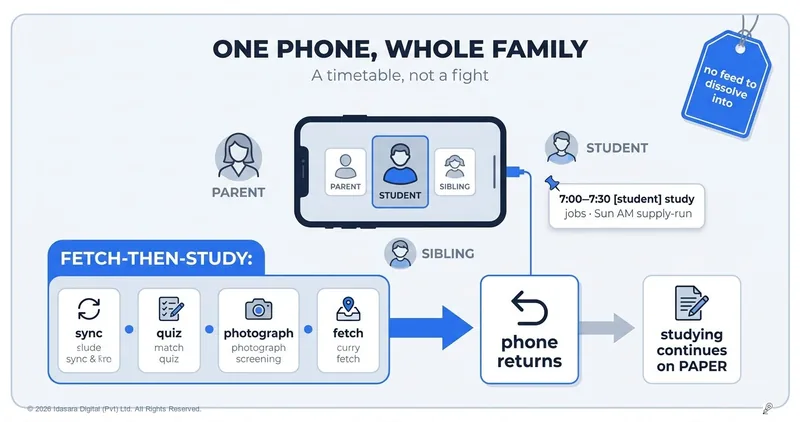
The study-app world assumes every student owns a phone; in much of the country the phone is the family's — father's by day, everyone's by evening, argued over nightly. This chapter of Learn to Learn turns the shared device from a nightly fight into a scheduled tool: the phone timetable, the fetch-then-study pattern, separated profiles — and the quiet advantage the one-phone student has over the phone-addicted one.
In the one-phone house, everyone wants their turn. The student needs it "for studying" — a claim the family half-believes (the blame-cycle chapter lives in this house too). The father needs it for work calls. The siblings for their own everything. The nightly negotiation burns exactly the calm the studying needed.
Two truths dissolve most of the fight. First — from the offline-first chapter — the student's real phone-need is small and schedulable: fetch, feedback, and reps, none of which needs to happen at a particular hour. Second: what can be scheduled can stop being fought over. The shared phone doesn't need a winner. It needs a timetable.
How do you make the shared phone work?
1. The phone timetable — booked like the well, not fought like a toy. The family names the student's slots out loud, at hours that fit this household's real day: the phone is [student's] for study use for one half-hour daily — ours is after the shop closes — plus one longer weekly session for the supply-run, at wherever the signal is good. Small, fixed, family-visible — the same negotiation craft as the quiet-half-hour and the study-shift (Hard Mode's one recurring move: turn a conflict into an arrangement). What makes it stick: the slots are bounded (a half-hour ends — the family can see the endpoint), and the studying is visible (the tracker fills, the quizzes log — the receipt the household can check). The nightly argument was never really about minutes; it was about trust, and timetables build trust.
2. Fetch-then-study — the slot's discipline. The daily half-hour is not "study time on the phone." It's the phone-jobs window, and — this matters for weak-signal homes — most of its jobs work offline: the day's micro-quiz and card reps run on what the weekly supply-run already fetched, and photographs of your answers queue up to send later. The jobs that genuinely need signal (syncing, sending the photos, fetching new material) wait for the weekly session at the good-signal place — exactly the little-data chapter's doctrine: the connection is a weekly event, not a nightly need. If your home does have usable signal, the nightly slot can sync too — a convenience, never a requirement. Then the phone goes back to the family and the studying continues on paper, where it always lived.
3. Separate profiles — one device, many people. The practical frictions of sharing — the student's progress tangled with a sibling's games, privacy at zero, the parent's chats a tap away — are solved by PIN-separated profiles: each family member their own space on the one device, switched in seconds. The student's study record stays theirs (the mistake bank — your own error log — is personal by nature), the parent's world stays closed, and the sibling's turn doesn't trample anyone's streak. One phone becomes, functionally, everyone's phone in turn.
What if the phone is the parent's?
In many one-phone homes the device is specifically the parent's — which, reframed, is an asset: the parent-held phone means the parent dashboard and the student's study slot live on the same device, so the arrangement audits itself (the visibility chapter's machinery with zero extra hardware). The evening rhythm becomes almost ceremonial in the houses that run it well: the student's half-hour, the handback, the parent's one-glance at the traffic light, the nod. Trust, manufactured nightly, on hardware the family already owns.
Do this week
- Hold the timetable meeting: the student's named slots (daily phone-jobs window + the weekly supply-run), bounded and family-visible. Write it where the phone charges.
- Set up the profiles — one per family member, PINs set, the student's study space its own.
- Run one week of fetch-then-study discipline and let the wall-tracker be the receipt. The second week's negotiation is always easier than the first's.
At a glance
- The shared phone needs a timetable, not a winner: small, fixed, family-visible slots — the daily phone-jobs half-hour + the weekly supply-run.
- Fetch-then-study: the daily slot runs mostly-offline jobs (quiz, reps, photos queued); signal-needing jobs wait for the weekly supply-run session — the little-data doctrine, kept. The slot ends — that's why the family grants it.
- PIN-separated profiles give one device many private spaces: the student's record, the parent's world, the sibling's turn — untangled.
- The parent-held phone is an asset: study slot and parent dashboard on the same device — the arrangement audits itself.
- Know the rough costs: a photographed answer page is a few MB; a synced quiz is far less; video is the budget-killer.
One step further with Idasara Academy
This chapter is one of the reasons the product is built the way it is: family accounts with PIN-separated profiles — free — put every learner (and the parent view) on one shared device without tangling anyone's record; data-lite mode keeps the half-hour cheap; and the paper-first design means the app's job fits a bounded slot by nature. The one-phone family was in the specification, not an afterthought.
Start Free — Create Your Account →
FAQ
My sibling and I both have exams. One phone, two candidates. Two profiles, two bounded slots, one shared supply-run (fetch both students' weeks in one session — it's cheaper too). Sibling candidates who share a timetable become each other's witnesses; the quizzing-each-other trick from the noisy-house chapter turns the rivalry productive.
My parents take the phone away completely in exam season "so I can focus." Show them the fetch-then-study pattern — the point they're protecting (paper focus) is the point the half-hour serves: marked answers, synced plans, the week's materials. Propose the season version: smaller slot, same jobs, parent present if they wish. Total removal doesn't remove distraction; it removes the feedback loop.
The phone is too old/full for anything to run well. Data-lite design targets exactly this hardware — and the stack chapter's order holds regardless: paper core first, phone jobs at whatever size the device allows, the school computer room as overflow for the supply-run. An old phone running a half-hour of jobs weekly still beats no system.
When does a student actually need their own phone? Later than the market says, and the money chapter will argue the family's rupees usually rank other purchases first (spectacles, books, data). The genuine threshold is when the jobs outgrow the slots — heavy exam-season marking volume, the earn-and-learn student's independent schedule. Until then, the timetable is not a compromise; it's the design.
Further reading
The machinery this chapter deploys: Studying on Little Data (the supply-run) · "I Never See You Studying" (visibility as trust) · What It Costs & the Phone Question (the parent's fuller answer).
Sources
- The Idasara Method: Part 1 — The Human Foundation & Active Recall (paper-first design)
- Idasara Academy — Trust & data safety (family accounts, privacy)
- NHS — family routines around study