The Pomodoro Technique: Why 25 Focused Minutes Beat 4 Distracted Hours
The short answer: Choose one small task, put the phone in another room, set a timer for 25 minutes, and work on that task alone until it rings — then rest five minutes, properly, and go again. Three or four of these blocks do more real work than a whole distracted evening, because the timer answers every distraction for you: not now, the bell is coming.
A chapter of the free book Learn to Learn
Published 2026-08-31 · updated 2026-08-31
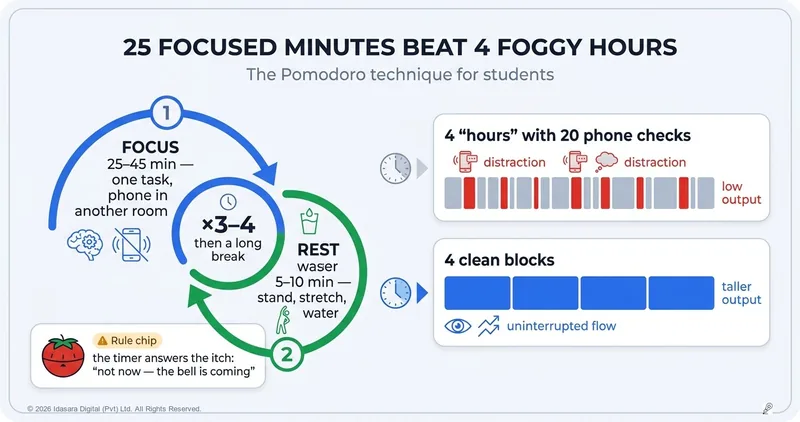
The Pomodoro Technique is a focus method: study in short, fully-committed blocks of about 25–45 minutes, rest briefly, repeat. This chapter of Learn to Learn explains why the timer works when willpower doesn't, how to run your first block tonight, and how to grow the rhythm into an exam-season engine.
Two students sit down to study on the same evening.
The first announces: "Tonight I will study for four hours." The phone stays on the desk. The four hours become a long soup — ten minutes of reading, a message, five more minutes, a video, a snack, more reading, another message. At eleven o'clock, exhausted and vaguely guilty, they close the book. Time spent: four hours. Work done: perhaps forty minutes' worth.
The second student says something much smaller: "For the next 25 minutes, I will do only this exercise. Then I stop." Phone in the other room. Timer on. When the bell rings, they stretch for five minutes — and go again.
By the end of the evening, the second student has done more real work in two hours than the first did in four. And, strangely, feels less tired. What does the timer know that willpower doesn't?
Why does the timer work when willpower doesn't?
The method the second student used has a name — the Pomodoro Technique, invented by Francesco Cirillo, who as a struggling university student grabbed a tomato-shaped kitchen timer (pomodoro is Italian for tomato) and made himself a deal: total focus until it rings, then a real break. That kitchen-timer deal works for three deep reasons.
It makes starting easy. "Study for four hours" is a demand your brain treats as a threat — so it delays, negotiates, tidies the desk. "Just 25 minutes" slips past the resistance. And starting, it turns out, was always the hardest part.
It gives distraction an answer. Mid-block, the itch arrives: check the phone, just for a second. Without a timer, that negotiation happens twenty times an hour — and each surrender costs far more than the seconds it takes, because attention needs time to sink back into hard material after every switch. With a timer, there is a standing answer: not now — the bell rings in eleven minutes. The itch, refused a few times, quietens.
It builds rest into the system. Your brain is not a machine that runs best flat-out; concentration is a resource that drains and refills. The five-minute break is not a reward for the block — it is part of the block, the moment the material settles. Students who skip breaks aren't studying more; they're studying worse, later into the night.
In simple terms: the timer replaces a thousand small decisions with one big one. You decide once — "this block is for this task" — and the clock defends that decision for you.
How do you run a block?
- Choose one task, and make it small. Not "study chemistry" — that's a subject, not a task. Instead: "solve exercise questions 1–4" or "write my short note for section 3.2." A block has one target.
- Get the phone out of reach. Not face-down. Not on silent. Out of the room — or, if it's a shared family phone or you study where the family sits, hand it to your mother or leave it on the other side of the room, screen away. The negotiation you avoid is the one you can't lose.
- Set the timer: 25 minutes to start. Any timer works — a clock, a kitchen timer, a cheap wristwatch. The timer's job is to ring; it doesn't need a screen. As your focus muscle strengthens — and it does strengthen — stretch toward 35 or 45 minutes. A/L students doing long derivations often settle nearer the top of that range.
- Work on only that task until the bell. If a stray thought or worry arrives, write one word on a scrap of paper — it will wait — and return.
- Rest 5–10 minutes, properly. Stand up, stretch, drink water, look out a window. The phone is not rest — it drains attention while pretending to be rest.
- After 3–4 blocks, take a longer break — half an hour, a meal, a walk.
That's the whole technique. No app required, no talent required. A timer, a task, and a door.
Do this tonight
Run exactly one block. Pick tomorrow's most-dreaded task, make it block-sized, put the phone out of reach, and give it 25 uninterrupted minutes.
Then notice two things. How much got done — usually more than a "normal" hour achieves. And how it felt to work with the interruptions switched off — most students describe it as the first calm studying they've done in months. That calm is not a trick. It is what your attention feels like when it stops being interrupted.
At a glance
- The Pomodoro Technique: one task, 25–45 fully-focused minutes, 5–10 minutes of real rest, repeat; a long break after 3–4 blocks.
- Small blocks beat big vows because starting gets easy and distraction gets a standing answer: not now, the bell is coming.
- Every phone-check costs far more than its seconds — attention takes time to sink back into hard material.
- Breaks are part of the method, not a reward: concentration drains and must refill.
- Grow block length as your focus strengthens; deep A/L problem-solving earns the longer blocks.
One step further with Idasara Academy
A timer solves the how of focus; the harder daily question is what deserves the next block. Idasara Academy's Today's Plan — free to start — answers it: each day it hands you a short list of block-sized tasks, weighted toward the subjects and topics where your marks currently swing the most. Set the timer, take the top task, and the whole system — focus method and study engine — turns together.
Start Free — Create Your Account →
FAQ
Is 25 minutes enough to achieve anything real? Twenty-five uninterrupted minutes is more than most students' distracted hour. And blocks chain: four blocks with breaks is a serious two-hour session that leaves you less drained than one foggy marathon.
What if I'm deep in a problem when the bell rings? Note where you are in one line, take the short break anyway, and dive back in — the thread survives five minutes better than your concentration survives skipping rests all evening. If this keeps happening, your block length is ready to grow.
Can I keep my phone with me if notifications are off? Its presence alone taxes you — part of your attention stands guard over it even when it's silent. Out of sight and out of reach — another room, or another person's keeping — is the technique's cheapest, most powerful move.
How many blocks should a school-day evening hold? Quality first: three or four genuine blocks is a strong evening for an O/L student. In exam season, with free days, six to eight blocks with proper breaks is sustainable — fourteen foggy hours is not, and a later chapter on cramming versus consistency explains why.
Further reading
Focus blocks are one rule of the method's time layer — alongside subject pairing, energy scheduling, and exam-countdown pacing. The full write-up is in the Idasara Method: Part 4 — Time Management & Flipped Learning.
Sources
- Francesco Cirillo — the official Pomodoro Technique site
- UCLA Bjork Learning and Forgetting Lab — research overview on spacing and effortful learning
- The Idasara Method: Part 4 — Time Management & Flipped Learning