The Grade Progression Ladder: The Exact Protocol From C to B to A
The short answer: You climb one rung at a time. An S becomes a C through full coverage — read every topic, work every textbook exercise on paper, get everything honestly marked; a C becomes a B through timed, sectional past-paper drills; a B becomes an A through full-paper volume — 10 papers for O/L, 20 for A/L — plus working your mistake list to zero.
A chapter of the free book Learn to Learn
Published 2026-08-31 · updated 2026-08-31
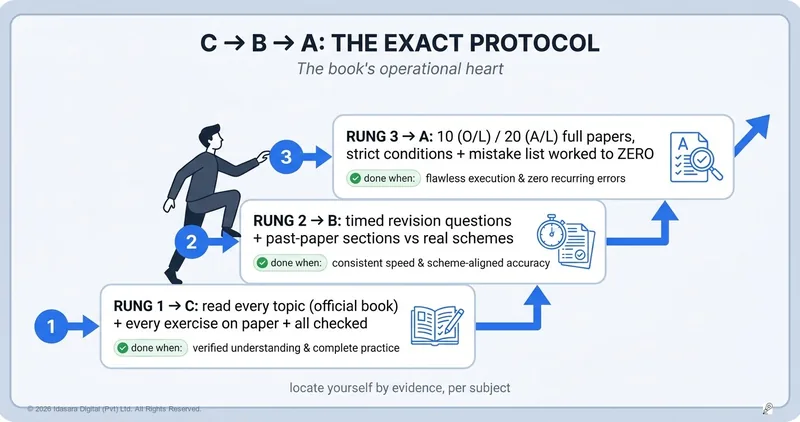
Earlier in this book you learned that grades are a ladder, not a lottery — this chapter is the climbing manual: the specific, complete protocol for each rung, from securing a C to the past-paper volume and mistake-elimination discipline that manufacture an A. This is the operational heart of Learn to Learn. Bookmark it; you'll return each term.
Every serious training discipline eventually writes its protocol down. Runners have marathon plans — week by week, distance by distance. Musicians have grade syllabi. Pilots have checklists.
Students, strangely, mostly don't. Ask a student aiming to move from a C to an A what, specifically, the path consists of, and you'll hear the fog: "study harder… do more papers… hope the paper is kind." For the most consequential performance of their young lives, no protocol.
This chapter ends that. What follows is the complete climbing manual — each rung defined by actions completed, not feelings felt. You'll recognise every component; the book has been building them one by one. Here they assemble into the machine.
Rung 1 — Securing the C: the coverage protocol
A C pass is manufactured by three actions, run over the whole syllabus. No more, no fewer:
- Read every topic from the official textbook or resource book — the full syllabus contract — your promise to finish every topic — honestly tracked, using everything the Plan chapters gave you.
- Work every end-of-chapter exercise on paper — paper-first, full working, stuck-steps logged and repaired.
- Get every attempt honestly marked — against real standards, while fresh.
Why does this so reliably deliver a C? Because — as the exercises chapter showed — the paper's foundational majority of marks is written to the textbook-exercise standard, distributed across the whole syllabus. Complete coverage plus baseline problem-solving plus verified correctness = those marks, banked. Notice what's absent from Rung 1: past papers. A student drilling past papers over unfinished coverage is polishing the top of a building with no lower floors — the coverage cap chapter did that arithmetic. Finish Rung 1 first. It is unglamorous, and it is the entire foundation.
You've completed Rung 1 when: your term tracker shows every topic genuinely finished — read, noted, exercised, marked — with no honesty gaps.
Rung 2 — Climbing to B: the performance protocol
Rung 2 changes the training stimulus from coverage to performance under exam conditions. Two actions:
- Timed revision questions, per topic. Re-answer each topic's revision questions against the clock — not to re-learn (Rung 1 did that) but to convert knowledge into retrievable-at-speed knowledge. This is where the fast-active-reading and write-fast-yet-clear skills start earning.
- Sectional past-paper drills. Take real past papers and attempt them by section — this term's topics, Part I MCQs one session, structured questions the next — under time, marked against the real scheme, every time.
The B-rung's purpose is honest exposure to the exam's format: its verbs, its time pressure, its marking dialect. Most students who stall at C aren't missing knowledge — they're missing format-fluency, and every marked sectional drill buys it. Expect early drills to score below your knowledge; that gap is the rung, closing with each rep.
You've completed Rung 2 when: sectional drills on covered material consistently score in the B band, under honest time, marked against the scheme.
Rung 3 — The A: volume plus elimination
The A-rung is the most mechanical of all, and the most avoided, because both its components are effortful. It is two disciplines, run together in the final phase:
Discipline one — full past papers, at volume, under strict conditions. The method's numbers: a minimum of 10 full papers for O/L subjects, 20 for A/L. Full papers — the paper's full official time, no pauses, exam-legal conditions, every script marked externally or against the scheme without mercy. Volume matters because the exam's difficulty distribution only reveals itself across many papers: the recurring question archetypes, the mark-scheme habits, the time-pressure patterns. One paper is a sample; ten is a map. Twenty, for the A/L's depth, is mastery of the territory.
Discipline two — zero out your mistakes. Every marked paper produces a list of exactly where you lost marks. Collect the lists (the mistake-bank chapter builds this into a full system). Then work the list, not your comforts: for each recurring error, targeted repair — re-study, re-drill, re-attempt cold — until it stops recurring. The A-student's defining behaviour, stated once more because it cannot be overstated: they study their weaknesses until the list is empty. Papers find the leaks; elimination seals them; the next paper verifies the seal. That loop, run to exhaustion, is the A.
You've completed Rung 3 when: the volume is done, recent full papers mark in the A band, and your active mistake list has been driven to zero — not "small." Zero.
How do you read the ladder honestly?
Three operating notes that decide whether the manual works:
Locate yourself by evidence, not ambition. The rungs are diagnostic: gaps in coverage put you on Rung 1 regardless of how many papers you've done. Most stuck students are working one rung above their true position — which feels advanced and builds nothing. The four questions from the ladder-mindset chapter (coverage? exercises? papers? mistake list?) place you; your term tracker and marked scripts hold the evidence.
The ladder runs per subject. You might be Rung 3 in one subject and Rung 1 in another — that's normal, and it's exactly what your weekly time allocation should reflect (the hardest-subject-best-hours rule, now with a map).
The calendar shapes the climb. Rung 1 belongs to the year's first two-thirds — it tracks the syllabus as it's taught (flipped, ideally). Rung 2 rides each term's end. Rung 3 owns the final months — which is why coverage debt is so expensive: every week of Rung 1 work still owed in exam season is a week stolen from the paper volume that manufactures the A.
Do this tonight
- For each subject, place yourself on the ladder — by evidence: tracker, marked work, mistake list. Write the rung number beside each subject.
- For your most important subject, write the completion condition of your current rung (they're stated above) — that's your definition of done.
- Do one hour of your actual rung's work. Not the rung you wish you were on. The ladder moves only under your real feet — and it moves every single time.
At a glance
- Rung 1 → C: full-syllabus coverage — official textbook + every end-of-chapter exercise on paper + everything honestly marked. No past papers yet; foundation first.
- Rung 2 → B: performance under conditions — timed revision questions per topic + sectional past-paper drills, marked against real schemes. Buys format-fluency.
- Rung 3 → A: volume + elimination — 10 (O/L) / 20 (A/L) full papers under strict conditions, and the mistake list worked to zero.
- Locate yourself by evidence per subject; most stuck students work one rung above their true position.
- Calendar: Rung 1 tracks the teaching year, Rung 2 rides term-ends, Rung 3 owns the final months.
One step further with Idasara Academy
The ladder is climbable with paper, schemes, and discipline alone — students have done it for generations. What Idasara Academy adds is the full engine under one roof: the free curriculum browser for Rung 1's coverage honesty, timed revision questions for Rung 2's reps, Exam Paper Marking for every script, real past papers in a timed Exam Hall for Rung 3's volume, the Mistake Bank collecting and scheduling your elimination list automatically, and — on the exam plan — a Readiness Score aggregating it all into a live per-subject position. The ladder, with a marker showing where you actually stand, updating with every week's climb.
Start Free — Create Your Account →
FAQ
Are 10 and 20 papers really necessary? That's an enormous commitment. It's the honest price of the top band, and it's cheaper than it looks once Rungs 1–2 are done — a well-covered student's papers are consolidation, not discovery. Attempting the volume without the lower rungs is what makes it feel impossible; that's a sequencing error, not a volume error.
Can I run rungs in parallel — some papers early, coverage continuing? Sectional drills on covered material, yes — that's Rung 2 working as designed alongside ongoing Rung 1. Full-paper volume only pays once coverage is substantially complete; before that, every paper mostly re-measures the coverage gap you already know about.
What if I do everything and the marks still say C? Then the protocol is finding something — look where the marks go missing. Marked scripts always answer it: coverage gap (Rung 1 leak), time/format losses (Rung 2 undertrained), or recurring error types surviving uneliminated (Rung 3's list not actually at zero). The ladder doesn't fail silently; read the scripts.
Where do wellbeing and rest fit in this machine? Inside it, structurally: the time-layer chapters (Pomodoro, energy allocation, cramming-vs-consistency ahead) are what make a year of climbing sustainable. A protocol that burns the climber is a bad protocol; this one budgets rest as a component, not a reward.
Further reading
The complete grade progression ladder — C, B, and A protocols with the marking and telemetry engines under them — is written up in the Idasara Method: Part 3 — The Grade Progression Ladder & Paper Marking.
Sources
- Dunlosky, J. et al. (2013). Improving Students' Learning With Effective Learning Techniques — overview at the Association for Psychological Science (practice testing and distributed practice, the ladder's two engines)
- UCLA Bjork Learning and Forgetting Lab — research overview on testing and spacing
- The Idasara Method: Part 3 — The Grade Progression Ladder & Paper Marking