Why Clear Handwriting Matters (The Examiner Marks What They Can Read)
The short answer: Yes — the examiner awards marks for what they can read, not for what you know, so an unreadable correct answer scores like an absent one. The target is not beauty: every letter decidable, every number unambiguous, at speed — built by daily handwritten practice, not by trying to be neat.
A chapter of the free book Learn to Learn
Published 2026-08-31 · updated 2026-08-31
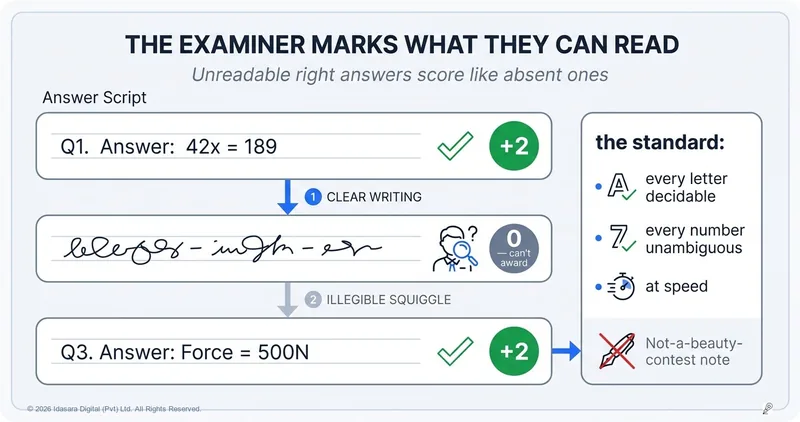
Every mark you will ever receive is awarded for something you wrote — and an examiner working through hundreds of scripts can only reward what they can actually read. This chapter of Learn to Learn explains why legibility is quietly worth marks in every subject, and how clarity is built as a daily habit, not a personality trait.
Picture the person who will mark your O/L or A/L paper.
They are not sitting with your script alone by a quiet window. They are working through a mountain of answer books — hundreds of scripts, thousands of answers, day after day, against a marking scheme and a clock. Yours is somewhere in the middle of the pile.
Now, on page three of your script, there is a line where you wrote the correct keyword — but the letters have collapsed into a hurried scribble. The examiner pauses. Squints. It might be the right term. It might be something else.
Here is the question your grade hangs on: how long will they dig to find out?
The examiner cannot mark your mind
There is a hard truth at the centre of every written examination, and the earlier a student accepts it, the better they perform: the examiner does not mark what you know. They mark what they can read.
You may have understood the concept perfectly. The understanding lived in your mind — but your mind never enters the marking room. Only the script does. Whatever failed to make the journey from your head to legible ink simply, for marking purposes, does not exist.
This is not examiner cruelty; it is how the system must work. Marking schemes award marks for specific things — the precise keyword in a definition, the intermediate step in a calculation, the label on a diagram. Each is a small treasure the examiner is hunting for in your handwriting. Clear writing puts the treasure in daylight. Unclear writing buries it — and a marker with hundreds of scripts left cannot dig for every one.
The subjects where this bites hardest are the ones students least expect. In mathematics, a 4 that reads as a 9, an x that collapses into a y, a misread index — and a correct method quietly bleeds accuracy marks. In science, the mandatory label on a diagram that cannot be deciphered is a mandatory label that is not there.
Where does messy exam writing actually come from?
Here is the encouraging part: exam-hall messiness is rarely about your handwriting at all. It is about speed beyond training.
Almost everyone's writing is legible at a comfortable pace. But an exam asks you to write fast, continuously, for three hours — and if your hand has never trained at that pace, it does what any untrained muscle does under load: it degrades. The letters that were fine in your notebook collapse in the hall, and they collapse most in the final hour, on the final questions, exactly where the last marks were waiting.
Which reveals something important: clear-and-fast is one skill, not two. You cannot fix it the night before the exam, and you cannot fix it by "trying to write neatly" — trying is not training. It is built the same way stamina is always built: by writing, by hand, at working pace, most days, for months. (The good news: if you are following this book — writing your own short notes, solving exercises on paper — you are already in training and may not have noticed.)
One clarification, so this chapter isn't misread: nobody is asking for calligraphy. Beautiful is irrelevant. The standard is humbler and completely achievable: every letter decidable, every number unambiguous, at speed — a script the examiner can move through without ever stopping to squint. Distinct letterforms, a touch of space between words, one honest line through mistakes instead of a scribbled cloud, and working that flows down the page instead of crowding into corners. That is the whole target.
Do this tonight
- Take a page you wrote quickly — class notes, a homework answer — and read it as a stranger would. Circle every word or number where a stranger would pause. Those circles are your future lost marks, visible in advance.
- Notice which letters and digits cause the trouble; most people have three or four repeat offenders. Decide, once, how you will form them distinctly — and hold that decision in tomorrow's notes.
- This week, write one full answer — a proper past-paper question — at exam pace, then judge its legibility, not just its content. That's the skill under real load, which is the only place it can grow.
At a glance
- The examiner marks what they can read, not what you know — an unreadable correct answer scores like an absent one.
- Marks live in specifics — keywords, steps, labels, digits — and each one must survive the trip into legible ink.
- Exam-hall messiness is usually speed beyond training, worst in the third hour; clear-and-fast is one trainable skill.
- The standard is not beauty: every letter decidable, every number unambiguous, at speed.
- Training is free and already in your routine: handwritten notes and paper-based practice, most days.
One step further with Idasara Academy
The honest test of your handwriting is whether a stranger can mark it — so let one. Idasara Academy's Exam Paper Marking (on the paid tiers) reads photographs of your actual handwritten answers and marks them against the official scheme. Where your writing is unclear, you will see it immediately — the same way an examiner would — while there is still time to train the fix. Your handwriting gets audited all year, not discovered on results day.
Start Free — Create Your Account →
FAQ
My handwriting has been bad since childhood. Isn't it too late? No — because the target isn't a new personality, it's a dozen letterforms made decidable and a hand trained for pace. Students see real change in weeks once daily handwritten practice begins. What is too late is starting in exam month.
Will examiners really cut marks just for untidiness? They don't deduct for untidiness — in practice something quieter happens: marks that were rightfully yours can simply fail to be awarded, because the scheme's keyword or step couldn't be confidently identified. Nothing is "cut." It just never arrives.
Should I write more slowly in the exam to stay neat? No — slow costs unanswered questions, which is a worse trade. The way out is to raise the speed at which your writing stays clear, through practice at pace before the hall. Inside the hall, clarity spends its budget best on the high-value items: keywords, digits, labels.
Does this still matter now that everything is typed? Your national exams are handwritten, so for the next few years it matters enormously. And the habit behind it — caring whether your reader can receive what you meant — is precisely the communication skill that outlives the exam hall.
Further reading
Why every mark is awarded for something you wrote — and how writing is trained as part of the daily loop — is in the Idasara Method: Part 3 — The Grade Progression Ladder & Paper Marking and Part 1 — The Human Foundation & Active Recall.
Sources
- The Idasara Method: Part 3 — The Grade Progression Ladder & Paper Marking
- The Idasara Method: Part 1 — The Human Foundation & Active Recall