The Exam-Year Map: Every Month Has One Job
The short answer: Give each month one headline job: Term 1 is coverage (and building the past-paper library), Term 2 is depth plus the first sectional drills, Term 3 closes coverage while the first full papers open, months 10–11 are paper volume and error elimination, and exam month is delivery only. The A/L runs the same sequence, stretched over two years.
A chapter of the free book Learn to Learn
Published 2026-08-31 · updated 2026-08-31
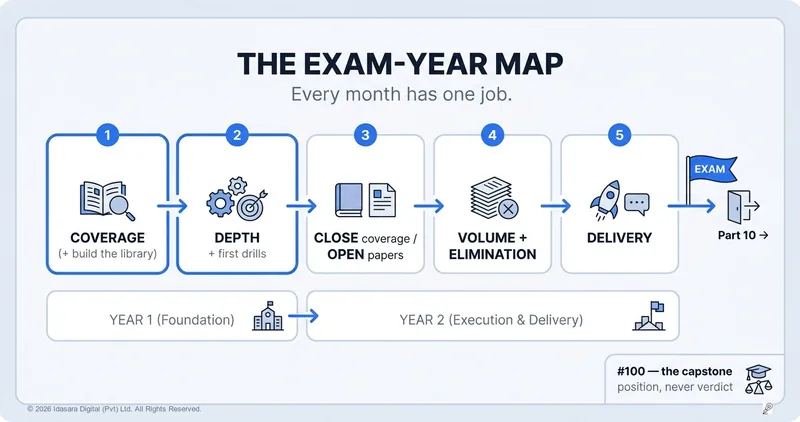
One hundred chapters of method deserve one page of calendar. This closing chapter of Learn to Learn lays the whole system on the year: the O/L year month by month, the A/L arc across its two years — each phase with its single headline job and the chapters that serve it. Print it, and let the months stop being a fog with an exam at the end.
Here is the last reframe this book has to offer, and it may be the most calming one: an exam year is not a year of everything, always. It is a sequence of months, each with one headline job — and a student who knows the current month's job is never lost, however heavy the season. What follows assumes a December exam; shift the map to fit your actual dates, and hold its proportions even where its months move.
The O/L year (Grade 11 — and the map Grade 10 should read early)
The year before (Grade 10): the real foundation season — the habits launched (the first 7 days), the loop — learn, recall, check, daily — running on every lesson, electives settled, Term-1-debt repaid while it's cheap (the debt chapter). The single biggest determinant of a calm Grade 11 is a Grade 10 that did its own year's job.
Months 1–3 (Term 1): the job is COVERAGE, current and honest. The contract signed (#24), the tracker weekly, the loop on every new topic, the paper library built now (#99) while nobody else wants papers. Nine subjects kept moving by the short daily list (#39).
Months 4–6 (Term 2): the job is DEPTH + the first performance layer. Term 2 carries the heaviest syllabus load in most subjects — the flip (#27, #57) makes its classes worth double. Sectional past-paper drills begin at the term's end (Rung 2 — #31); the mistake bank fills and gets worked weekly (#33). The mid-year term test gets the bounce protocol (#90) — it's the year's cheapest full diagnosis.
Months 7–9 (Term 3 into study leave): the job is CLOSING COVERAGE while opening PAPERS. The syllabus's tail finished (drift bridged where school lags — #28); the first full papers sat under conditions as coverage closes; readiness read monthly by instruments (#35). If the audit says the year drifted badly: the rescue order takes over (#84) — this is its season.
Months 10–11: the job is VOLUME + ELIMINATION. Rung 3 proper: the 10-paper diet with post-mortems, the bank driven toward zero, technique installed (#52 rehearsed as dress). Sleep becomes untouchable (#87); the household enters support-crew mode (#92).
Exam month: the job is DELIVERY. The playbook, paper by paper; the dress rehearsals done on the unseen papers you saved; light retrieval sweeps only (#56); the evidence read instead of the fears (#50). Nothing new is learned in exam month — you collect what the year built.
The A/L arc (two years, four seasons)
(O/L families: this section is for later — bookmark it and stop at the map above. A/L students: this is yours.)
Year 1, first half — FOUNDATIONS AT DEPTH: the stream's architecture installed (#64/#65): daily deep blocks, the 3-way rotation, the derivation/diagram decks begun, O/L-era debt repaid before it compounds at stream scale. The combination's doors verified once more while change is still cheap (#67).
Year 1, second half — COVERAGE PACE + watching the weakest subject: the two-year map tracked like a contract; the Z's floor subject identified by evidence and given the best hours (#41); sectional drills from each term's end; the paper library's A/L build completed.
Year 2, first half — DEPTH CLOSES, VOLUME OPENS: the syllabus tail against the calendar; full papers beginning per subject as coverage permits; the 20-paper arithmetic scheduled backwards from the exam (#32) so it never needs a miracle month; the burnout watch honest (#93 for the household's part).
Year 2, final months — THE SHARP SEASON: volume + elimination + technique, the O/L endgame at higher intensity; selection-season homework done in parallel (#69 — the handbook read before results week); the waiting months after the papers pre-planned as the asset they are.
How to hold the map
Three rules keep the calendar a servant, not another anxiety. The month's job is a headline, not a monopoly — the daily engine (the loop, the lists, the anchors) runs in every month; the headline just says where the weight goes. Behind-the-map is a position, not a verdict — the map's real use when you're behind is triage (#84): it tells you which season you're actually in, whatever the date says. And the map ends, on purpose: past the exam lies the door-map (Part 10), and past every door lies the engine you keep (#43) — this calendar is one lap of a track you now know how to run for life.
One hundred chapters ago, this book made a promise: that grades are made by method, and method can be learned. The map above is that promise in its final form — not a single secret but a sequenced year, every month's job named, every job's chapter written. You hold the whole machine now. Run it, one month's headline at a time — starting with this month's.
Do this today
- Find today on the map. Write this month's headline job at the top of your tracker.
- Check the two assets the map assumes early: the habit engine running, the paper library building. Whichever is missing is this week's work.
- Put the map where the year can see it — and beside it, the sentence the whole book was for: position, never verdict. The months each have a job, and I know this month's.
At a glance
- An exam year is a sequence of months, each with one headline job — never a year of everything, always.
- O/L: coverage (T1, + build the library) → depth + first drills (T2) → close coverage, open papers (T3) → volume + elimination → delivery. Grade 10 is the real foundation season.
- A/L: foundations at depth → coverage pace + watching the weakest subject → depth closes, volume opens → the sharp season + selection homework.
- Hold it rightly: headline ≠ monopoly (the daily engine runs always) · behind = a position, triaged · the map ends at the door-map, and the engine is yours for life.
- Print it. This month's job, at the top of the tracker. Begin.
One step further with Idasara Academy
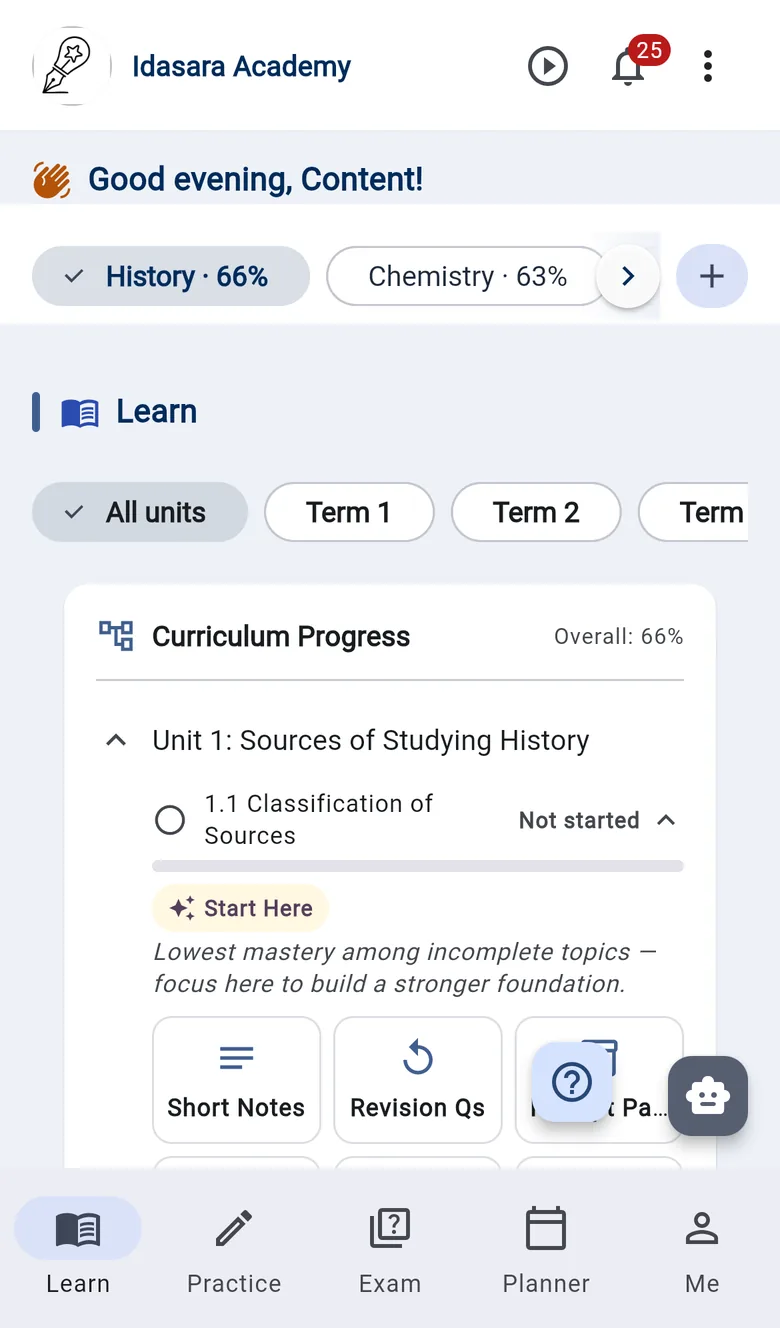
This map is, finally, what Today's Plan has been running underneath all along: the term-mapped syllabus as the calendar's spine, the daily lists as each month's headline broken into evenings, the season-pivots (drills, papers, elimination) arriving automatically as the year turns. One hundred chapters of method; one daily list to open. That was always the design — the book teaches the machine, and the machine runs the year with you. ඉගෙන ගන්න හැටි ඉගෙන ගන්න — and now, month by month, go win the year.
Start Free — Create Your Account →
FAQ
My exam isn't in December — how do I shift the map? Anchor from the exam backwards: the final two months are always volume+elimination, the two before that close coverage while opening papers, and everything earlier is coverage-and-depth in term order. The proportions are the map; the month names are just labels.
I'm reading this mid-year, behind on every headline. Where do I enter? At the triage chapter's door (#84) — it exists precisely to relocate you on this map honestly. The map's gift to the behind student isn't shame; it's knowing which season's work buys most right now.
Does the map change for the repeat year? It compresses beautifully: the repeat student enters with coverage partially banked and the mistake map pre-built (#53), so the year starts closer to the papers-season — which is the repeat's structural advantage, scheduled.
A hundred chapters is a lot. If someone reads only three, which? This one, for the year's shape; the illusion of competence, for the engine's core truth; and Me Time, for where it all actually happens. Then, when each month's job arrives, its chapters are waiting — that was the shelf's design all along.
Further reading
The whole book — start at the shelf. The method beneath the map: Part 2 — The Plan and Part 3 — The Grade Progression Ladder & Paper Marking.
Sources
- The Idasara Method: Part 2 — The Plan (the term structure)
- The Idasara Method: Part 3 — The Grade Progression Ladder & Paper Marking (the rungs the seasons climb)
- Department of Examinations — doenets.lk (the dates the map anchors to)