Nine Subjects Without Panic: How an O/L Student Keeps Everything Moving
The short answer: Stop choosing by feeling: give each day a short list of three to five small, named tasks; send the best hours to your weakest (red) subjects; and touch every subject at least once a week, even for ten minutes. A simple system decides what you open, so your energy goes into studying instead of deciding.
A chapter of the free book Learn to Learn
Published 2026-08-31 · updated 2026-08-31
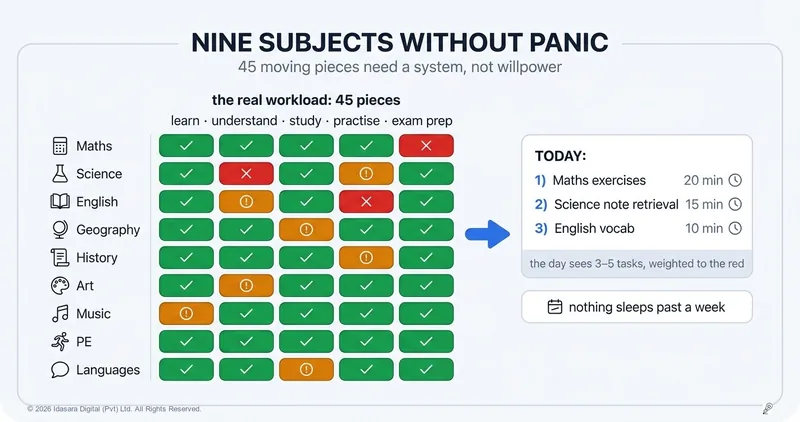
An O/L student isn't carrying nine subjects — they're carrying nine subjects that each need learning, notes, revision, practice, and exam preparation, all at once. That is too many moving pieces for anyone to manage by feeling. This chapter of Learn to Learn shows why the nightly panic is not your fault, and the three rules that replace it with a short daily list.
The O/L student's evening often begins the same way.
Nine textbooks. Nine sets of notes. your first language, English, Maths, Science, History, Religion, and the electives — each one carrying its own backlog, its own upcoming test, its own quiet guilt. The student sits down, honestly ready to work… and spends the first twenty minutes just deciding what to open. Some nights the choice falls on the easiest subject. Some nights on whichever teacher scolded most recently. Some nights the deciding itself is so tiring that not much studying happens at all.
Parents watching this see laziness or confusion. Let's see it correctly: it is a planning problem too big to solve in your head, every night, alone. And planning problems have planning answers.
Why does the evening feel impossible?
Here is why the evening feels impossible. Each subject is not one job. At any moment, every subject has work waiting at several stages: new lessons to learn, notes to write, old topics to revise, exercises to practise, and — as exams approach — papers to prepare for. Nine subjects, five kinds of work each. That is around forty-five separate things that could claim tonight's hours, all moving, all whispering me first.
Nobody — no adult, no teacher, no "organised" classmate — can weigh forty-five things in their head at 7 p.m. and pick correctly by feeling. When feelings choose, they choose comfort: the pleasant subject gets polished again, and the subject your marks actually depend on gets avoided again. The twenty-minute freeze isn't weakness. It's what happens to anyone asked to solve a too-big puzzle nightly, with no system.
The fix is the one every too-big puzzle gets: stop choosing by feeling. Let a simple system choose, and spend your energy on the studying itself.
The three rules
Rule 1 — Each day gets a short list, never the whole pile. A school-day evening should face three to five small, named tasks — "20 minutes: Science note from memory," "15 minutes: Maths exercises 1–4," "10 minutes: English vocabulary" — and nothing else. Never "study Science" (too vague to start), and never all nine subjects (too heavy to face). The nine subjects are balanced across the week; each day only ever sees its slice. This one change removes the freeze at its root: you don't sit down to a question with forty-five answers. You sit down to a list of three, and start at the top.
Rule 2 — Time flows to the weakest subject, not the nicest one. Left to feelings, your hours drift to subjects you enjoy — that's how History ends up gleaming while Maths quietly sinks. So flip it: once a week, give each subject an honest colour. Green = healthy (you're up to date, recent marked work is decent, few unfixed mistakes). Amber = slipping. Red = in trouble. You already have the evidence for this — your syllabus checklist (which topics are truly finished), your marked exercises and tests, and your notebook of collected mistakes. Then the week's hours follow the colours: red subjects get the biggest and best blocks; green subjects get a small keep-alive dose — one quick memory-test session is enough to keep a strong subject strong. Nine subjects never needed equal time. They need time where the marks can move.
Rule 3 — Nothing sleeps longer than a week. Even your best subject, even the one whose teacher never checks, gets touched weekly — ten minutes counts. A subject left alone for three weeks doesn't wait for you; it slides backwards, and you pay the catch-up later, in the exact weeks you'd planned for something else. This is the cheapest rule in the book and the most expensive one to break.
Run the three rules together and the O/L year changes shape. The evening question ("what do I even open?") disappears — the list answers it. The guilt-cloud disappears — the weekly colour check is your proof that nothing is being forgotten. What's left is something calmer: a simple picture of nine subjects, mostly green, with this week's red already scheduled for repair.
Do this tonight
- Write your nine subjects in a column. Next to each, put a colour — green, amber, red — using evidence, not mood: topics truly finished? last marked test? unfixed mistakes piling up?
- Build tomorrow's list: three to five small named tasks, most of them aimed at your reds, plus one ten-minute keep-alive touch for a green subject that's been sleeping.
- Tomorrow evening, open the list instead of the pile. Notice what doesn't happen — the twenty-minute freeze. That's the system paying you on day one.
At a glance
- Nine subjects ≈ forty-five pieces of waiting work — too many for anyone to choose between by feeling. The nightly freeze is a planning problem, not laziness.
- Rule 1: the day sees a short list — 3–5 small, named tasks — never the whole pile.
- Rule 2: hours follow the weekly colours (green/amber/red, judged by evidence): reds get the best blocks, greens get a cheap keep-alive dose.
- Rule 3: nothing sleeps past a week — a slipping subject slides backwards and charges you later.
- The result: a calm weekly picture of all nine, with the trouble spots already scheduled.
One step further with Idasara Academy
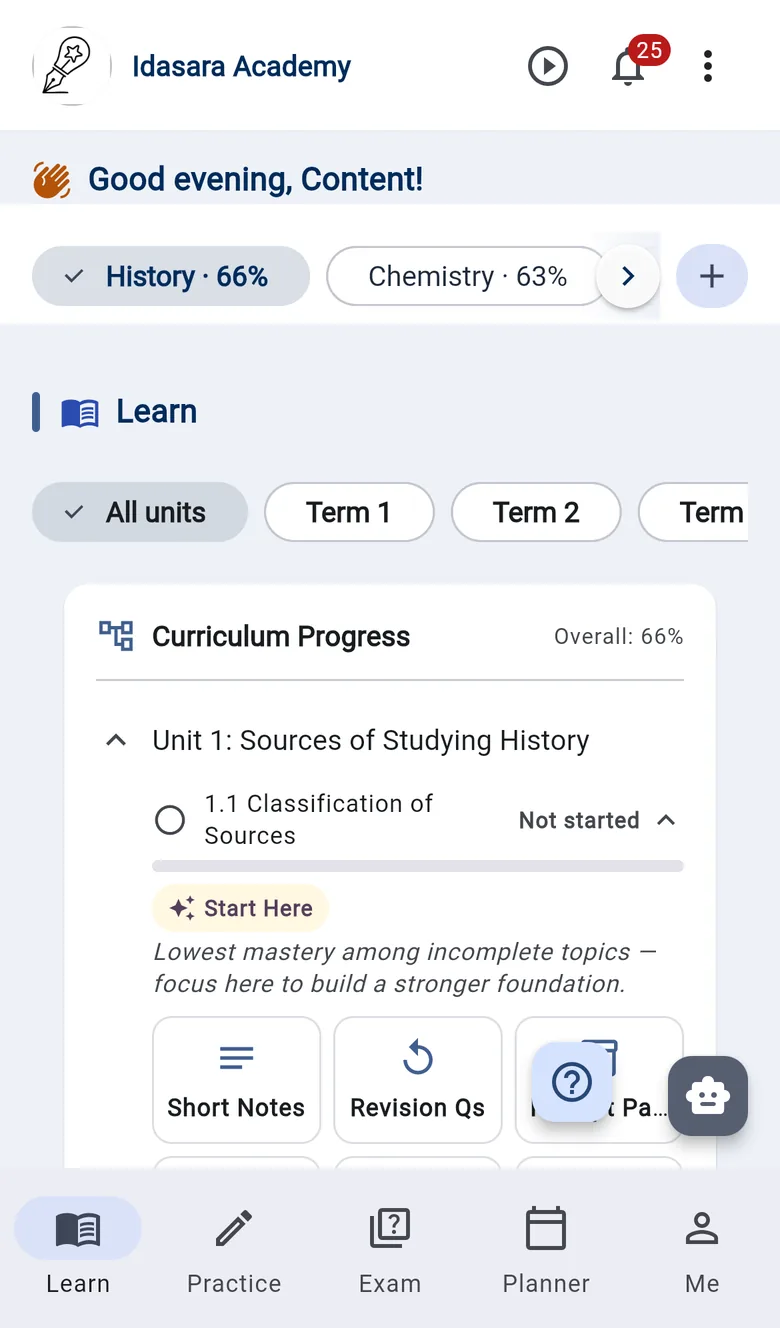
The three rules are exactly what Idasara Academy computes every morning. Today's Plan watches all nine subjects — your coverage, your quiz and marking results, your unfixed mistakes — and hands you the day's three-to-five small tasks, already weighted toward whatever is reddest, with every subject kept alive automatically. The colour picture is a live dashboard for you (and, in the parent view, for the people who worry about you). The forty-five-piece puzzle, solved daily, so your evening starts at task one.
Start Free — Create Your Account →
FAQ
Three to five small tasks — isn't that barely studying? Count the week: five finished tasks a day, six days, is thirty completed pieces of real work — far more than freeze-then-marathon evenings produce. Small tasks get finished, and finished is the only kind of studying that counts.
How do I give a subject a colour without fooling myself? Never by feeling — by three pieces of evidence: is the syllabus checklist for it up to date, what did the last marked test or exercise honestly score, and are its mistakes being fixed or piling up? "I feel okay about Science" is not a colour; you've known since the illusion-of-competence chapter what that feeling is worth.
Shouldn't my A/L-stream subjects (Maths, Science, English) get extra weight? Yes — a red in a subject your future stream needs should hurt more than a red in an elective. But that's extra weight inside the rules, not permission to abandon anything: O/L is a nine-subject certificate, and one collapsed elective stains the whole slip. Weight, yes; starvation, never.
This system is itself more work. When does it happen? Ten minutes on Sunday for the colours (do it alongside your weekly syllabus check — same sitting), two minutes each evening for tomorrow's list. Twelve minutes of planning to rescue hours of freezing is the best trade in this whole book — or let the app run the computation and spend the twelve minutes studying.
Further reading
The O/L scenario — nine subjects, choice paralysis, small daily tasks, and automatic workload balancing — is written up in the Idasara Method: Part 4 — Time Management & Flipped Learning.
Sources
- The Learning Scientists: Learn How to Study Using… Spaced Practice (small daily doses across subjects)
- Murre, J. & Dros, J. (2015). Replication and Analysis of Ebbinghaus' Forgetting Curve, PLOS ONE (why sleeping subjects slide)
- The Idasara Method: Part 4 — Time Management & Flipped Learning