The Figure Walk: Refresh a Whole Chapter in Fifteen Minutes Using Its Pictures
The short answer: Walk the chapter's figures: go image to image, skip the prose, cover each caption, and make yourself say what the figure shows before you peek — pencil-marking whatever blanks you. Because textbook figures sit where the load-bearing ideas are, fifteen minutes of this refreshes a whole chapter by retrieval, not re-reading.
A chapter of the free book Learn to Learn
Published 2026-08-31 · updated 2026-08-31
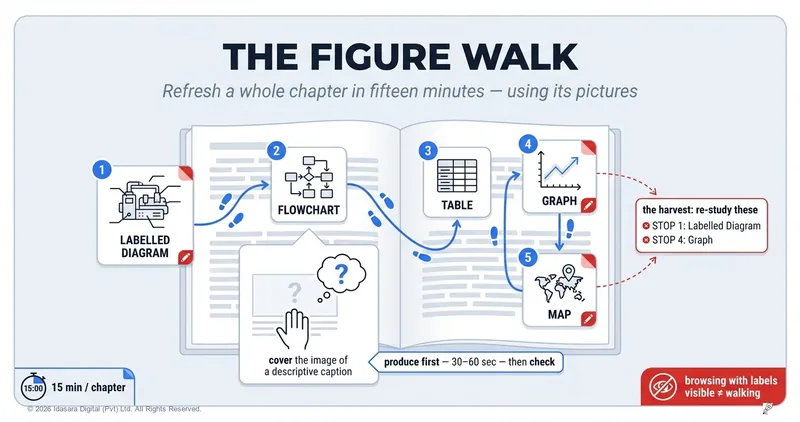
Every textbook chapter carries a built-in revision skeleton nobody uses: its figures, charts, and tables. This chapter of Learn to Learn teaches the figure walk — a fifteen-minute refresh where each image becomes a memory test, not a viewing — perfect for the night before class, the weekly sweep, and the small pockets of time too short for "real" studying.
Here is a situation every student knows: you have twenty minutes — before tuition, on the bus, at the end of a tired evening — and a chapter that needs refreshing. Re-reading it would take two hours you don't have. So the twenty minutes gets spent on nothing.
Now open that chapter and notice something you've been walking past all year: the figures. The labelled diagram. The flowchart of the process. The comparison table. The graph with its telling curve. Textbook authors don't scatter these randomly — illustration is expensive, so figures sit precisely where the load-bearing ideas are. The chapter's pictures are, in effect, the author's own map of what matters most.
Which means every chapter ships with a ready-made revision skeleton — five to ten images that, between them, touch nearly every examinable idea. The figure walk is the technique that uses it. Done right, it refreshes a chapter in about fifteen minutes. Done wrong, it's just looking at pictures — so let's be precise about the difference.
The walk, done right
The rule that makes it work is the rule that runs this whole book: produce before you peek. Each figure is a question, not a view.
- Go figure to figure, skipping the prose entirely. That's the speed: you're walking the skeleton, not re-reading the body.
- At each figure, cover the caption and labels — a hand or a folded paper strip does it — and interrogate yourself, out loud or in your head: What is this showing? What are the parts called? What happens next in this process? Why does the curve bend there? Give it thirty to sixty honest seconds of retrieval.
- Uncover and check. Right — move on, faster. Wrong or blank — mark the figure's page corner in pencil and say the correction once: that's a gap found and half-repaired in one minute.
- At tables and charts, ask the table's own question. A comparison table covered up becomes "what are the differences between X and Y?" — which is exactly the exam's "compare" question wearing revision clothes. A graph becomes "sketch the shape and explain the turning point."
- End with the corner-marked figures. Those are the walk's harvest: your precise re-study list, ready for the next real session — and candidates for your mistake bank — your log of repeat errors — if they keep failing.
Fifteen minutes, one chapter, every load-bearing idea touched by retrieval — and you already know what that buys from the science this book has stacked up: pictures are powerful memory cues (dual coding — each image drags its sentences up with it), retrieval strengthens what it touches while honestly exposing what's gone, and the found-gaps come pre-addressed. The walk is the forgetting-curve chapter's "ten-minute touch," running on the author's own map.
Where does the walk fit in your week?
The figure walk is a refresh tool — it maintains and audits knowledge you've already built with the full loop — read, produce from memory, check. Its natural slots:
- The pre-class flip, compressed. No time for the full twenty-minute pre-study? A five-minute figure walk of the upcoming section still delivers the flipped-learning advantage in miniature: you arrive knowing the shapes of the ideas and carrying located questions.
- The weekly sweep. The spaced-retrieval schedule's "next week" touches — one walk per finished chapter keeps whole subjects warm at minutes each.
- Small pockets of time. The walk is the rare technique that fits bus rides and waiting rooms with the textbook itself — no notes needed, no desk needed, phone irrelevant.
- Exam season's light passes. The night-before "light retrieval sweep" from the exam-day playbook is, for most subjects, precisely a figure walk of the syllabus's key chapters — dusting the surface without the late-night depth the cramming chapter forbids.
- After finishing a chapter — one immediate walk indexes it: you now know its skeleton, and every future refresh gets faster.
The honest boundary
Two things the figure walk is not, so it never becomes the comfortable trap this book keeps hunting:
It is not first-time learning. Walking figures you never studied produces the illusion of familiarity at maximum speed — pictures feel meaningful even when you can't explain them. The walk audits and refreshes what the full loop built; it cannot replace the loop. (The test is built into the technique: if most figures leave you blank with the caption covered, the chapter isn't ready for walking — it's ready for studying.)
And uncovered browsing is not walking. Flipping through pictures with labels visible is highlighting in disguise: pleasant, fast, and empty. The covered caption is the entire technique. No production, no walk.
Do this tonight
- Pick a chapter you finished in the last month. Walk it: figures only, captions covered, produce-then-check, corners pencil-marked. Time yourself — most chapters take twelve to eighteen minutes.
- Count the harvest: how many figures blanked you? That number is this chapter's true state — found for the price of a bus ride.
- Slot the walk into your week: one chapter per evening's end, or a batch in the weekend sweep. It stacks beautifully on the habits you already run.
At a glance
- Textbook figures sit where the load-bearing ideas are — every chapter ships a built-in revision skeleton of 5–10 images.
- The walk: figures only · captions covered · 30–60 seconds of retrieval per figure · check · pencil-mark the blanks · end with the harvest list.
- Tables are "compare" questions in disguise; graphs are "sketch and explain" questions.
- Fits the gaps real life offers: pre-class five-minutes, weekly sweeps, bus rides, exam season's light passes.
- Boundaries: not first-time learning, and browsing with labels visible doesn't count — producing the answer is the technique.
One step further with Idasara Academy
The walk's harvest deserves a checkpoint: after walking a chapter, take its micro-quiz — free — and let the questions confirm what the pencil corners found. The short notes' syllabus-standard diagrams give you a second walking track for chapters whose textbook is figure-poor, and every quiz slip lands in the Mistake Bank, so the walk's discoveries join the same repair queue as everything else. Fifteen paper minutes, one screen minute, chapter audited.
Start Free — Create Your Account →
FAQ
My subject's textbook has very few figures — history, literature, languages. Can I still walk it? Walk what exists (maps, timelines, source boxes), then build the missing skeleton yourself: the pictures chapter showed you how — one hand-drawn timeline or flowchart per chapter. Your own figures walk even better than the book's, because you built them from memory once already.
How is this different from just re-reading the summary? Direction. A summary read is input — recognition, comfort, little kept. A covered-caption walk is output at every stop. Same fifteen minutes, opposite mechanics — the oldest distinction in this book, at refresh speed.
Can I walk figures on a phone or PDF textbook? The mechanics survive (cover the caption with a finger), but paper wins the usual ways: no unlock, no notifications, pencil corners as your harvest list. If the phone is what you have on the bus, the walk still beats the feed.
Is the figure walk enough revision by itself? It's the maintenance layer — brilliant at keeping built knowledge warm and finding decay early. The heavy lifting (first learning, exercises, marked papers, mistake elimination) still belongs to the loop and the ladder. Think of the walk as the check-up, not the treatment.
Further reading
The walk runs on three of the method's engines — retrieval, spacing, and dual coding: Part 1 — The Human Foundation & Active Recall.
Sources
- The Learning Scientists: Dual Coding · Retrieval Practice · Spaced Practice
- Wammes, J. et al. (2016). The drawing effect — ScienceDaily summary (why images carry integrated memory)
- The Idasara Method: Part 1 — The Human Foundation & Active Recall