The Night Before Class: Read, Question, Ask
The short answer: Twenty minutes, three moves: read tomorrow's textbook section once and scribble a rough note from memory; write every confusion down as a precise question; then clear the basic ones tonight — against the textbook, with a sibling or friend, or with an AI tutor if you have one. The starred survivors are tomorrow's questions for the teacher.
A chapter of the free book Learn to Learn
Published 2026-08-31 · updated 2026-08-31
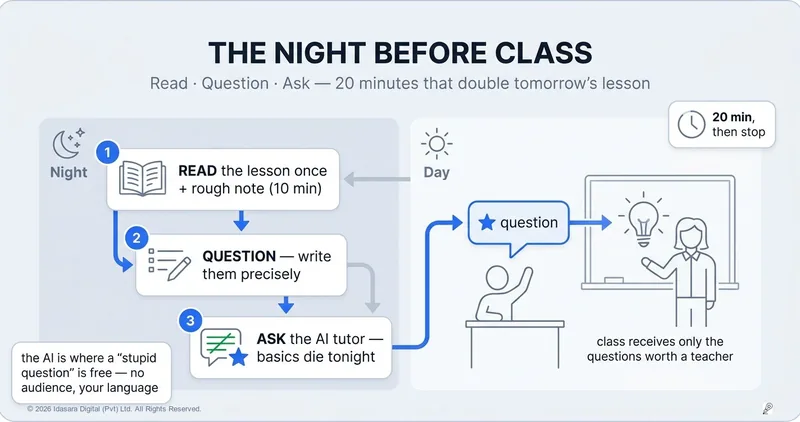
Twenty minutes tonight decide what tomorrow's lesson is worth. This chapter of Learn to Learn is the nightly ritual behind the flipped-learning advantage — read the lesson once, write your questions down, and clear the basic ones with your AI tutor before bed — so you walk into class carrying only the questions worth a teacher, and the shyness that kills questions never gets a vote.
In every class there's a moment worth studying: the teacher pauses mid-lesson, genuinely thinks, and says "…that's a very good question."
Watch the student who asked it. Here's the secret nobody mentions: that question was almost never invented in class. It was written the night before — at a desk, in a margin, by a student meeting the lesson for the second time while everyone else met it for the first. The flipped-learning chapter explained why that student's forty minutes are worth double. This chapter is the ritual that manufactures them — three moves, about twenty minutes, run the night before any lesson that matters.
The ritual: Read → Question → Ask
Move 1 — READ the lesson once (10 minutes). Find what tomorrow's class covers — your term map, the class schedule, or simply asking the teacher what's next — and read that section of the official textbook, once, actively but lightly. You're mapping the territory, not conquering it: what is this topic about, what are its parts, where does it get strange? Close the book and scribble a half-page from memory — the rough note the pre-study chapter taught. Gaps are expected. Gaps are the point.
Move 2 — QUESTION: turn every fog into a written line (5 minutes). Whatever refused to make sense goes into your question-log margin, phrased precisely — never "I don't get respiration", always "Why does the equation need oxygen on the left if anaerobic respiration exists?" Two or three questions is a healthy harvest. This is the move that changes tomorrow: an unwritten confusion walks into class as anxiety; a written question walks in as a tool.
Move 3 — ASK: clear what you can tonight (5 minutes). Most pre-study questions are basic ones — a definition, a step, a why — and most of them can die tonight, without waiting for anyone. Take each written question back to the textbook for five focused minutes: the glossary, the worked example, the paragraph you skimmed past. A sibling or a friend on the phone closes others. Write each answer beside its question, in your own words, strike the line through — the closed loop, in ink, as always. What survives is gold: the questions tonight couldn't settle. Mark those with a star. They're tomorrow's list — the deep questions worth a live teacher's pause.
The accelerator, if you have it: an AI tutor turns Move 3's five minutes into near-total clearance — grounded in the curriculum, in your language, no audience for a "stupid question" at 9 p.m. If your household's phone or plan doesn't allow it, nothing above changes: the ritual is Moves 1 and 2 plus tonight's textbook pass, and it worked for generations before AI existed.
Then sleep. Tomorrow, class runs as the flipped chapter promised: basics confirm instead of overwhelm, your attention goes to the hard parts, and at the first opening you spend a starred question. Tomorrow evening, ten minutes of red ink upgrades your rough note with what class added. The cycle closes.
Why does the Ask step change everything — especially for the quiet ones?
The flip worked before AI existed. But the Ask step upgrades it in a way worth naming honestly.
Without it, you carry all your questions to class — basic ones included. And basic questions in a classroom cost something real: the hand half-raised and lowered, the fear of the class hearing you ask what "everyone knows," the forty-to-one arithmetic that means most questions die unasked anyway. Every classroom in the country is full of students whose questions died unasked.
The night-before Ask step removes most of that tax, however you run it. Questions closed privately at home — against the textbook, with a sibling, or with an AI tutor for those who have one — cost nothing socially: no audience, no judgement, no queue. The shy student and the confident student arrive at class equally cleared of basics — and the questions they do ask publicly are the starred ones, the kind that earn "that's a very good question" instead of the fear of laughter. Teachers win too: a class whose basic confusions died the night before spends its forty minutes where a teacher is irreplaceable. Nobody in the room loses.
One boundary keeps the ritual honest: twenty minutes, then stop. The pre-study pass stays rough by design — mastery belongs to the full loop and to class itself. If the AI conversation starts ballooning into a full lesson, star the thread, note where you reached, and close it. The ritual is a scout, not the army. And the standing rules never sleep: the textbook outranks every answer, and anything headed for your notes gets written in your own words.
Do this tonight
- Find out what one class covers tomorrow — your hardest subject first, as always.
- Run the ritual: 10 minutes' read + rough note → questions written precisely → 5 minutes of Ask, answers closed in ink, survivors starred.
- Tomorrow, spend a starred question in class — out loud. Notice what it feels like to be the student whose question makes the room pause. That feeling is the ritual's real product, and it compounds.
At a glance
- The ritual: READ the lesson once + rough note (10 min) → QUESTION: precise written lines in the log (5 min) → ASK: close what you can tonight — textbook first, a sibling or friend, an AI tutor if you have one; answers in ink; star the survivors (5 min).
- Basics die privately at night; class receives only starred, teacher-worthy questions.
- The Ask step abolishes the shy-student tax: questions closed at home cost nothing socially — no audience, no queue, no laughter. AI accelerates this; it doesn't gatekeep it.
- Twenty minutes, then stop: the ritual is a scout, not the army. Textbook outranks everything, always.
- Next evening: ten minutes of red ink folds class back into your note. The cycle closes.
One step further with Idasara Academy
The ritual's three moves map straight onto the tools: the free curriculum browser tells you what tomorrow holds, the AI Study Coach (Ask AI) — free to try with 5 messages a day; uncapped on the paid tiers — is built to be Move 3's accelerator (curriculum-grounded, your language, guides rather than dumps), and the free Prompt Packs give you ready-made asking frames for the topic while you're learning what a surgical question looks like. Twenty minutes at night, and tomorrow's class arrives pre-cleared.
Start Free — Create Your Account →
FAQ
I can't find out what tomorrow's lesson covers. What then? Ask the teacher — "what are we doing next?" is a question teachers love, and it marks you as serious. Failing that, the syllabus term map makes the next topic a very good bet. And a "wrong" guess just means you pre-studied a syllabus topic slightly early — banked coverage, never wasted (the flipped chapter's rule).
Is clearing questions with AI before class disrespectful to the teacher — like arriving pre-taught? Read the teachers' chapter of this book: prepared students are what teachers ask for. You're not replacing the lesson — you're arriving able to use it. The starred questions you bring are a gift to a good teacher: they show exactly where the class's real difficulty lives.
I don't have the paid AI tier. Does the ritual still work? Yes — Moves 1 and 2 are the flip's engine and cost nothing; they worked for generations before AI. Your written questions then get spent on the free Prompt Packs, a friend, or the teacher next day. The Ask step accelerates the ritual; the reading and the written questions are the ritual.
Should I do this for every class, every night? Start with one — the hardest subject, per the energy rule — and let the twenty minutes prove themselves for a week. Most students settle at two or three flips a week on the heavy subjects, with the figure walk — a quick pass over a chapter's figures — covering lighter refreshes. The ritual scales by value, not by guilt.
Further reading
The strategy behind the ritual — why prepared brains learn double — is the flipped-learning chapter, and the question-and-clarification machinery is the method's first layer: Part 1 — The Human Foundation & Active Recall · Part 2 — The Plan.
Sources
- Carnegie Mellon University, Eberly Center — Flipping the Class (first exposure before class)
- The Learning Scientists: Elaboration (forming precise how/why questions)
- The Idasara Method: Part 1 — The Human Foundation & Active Recall
- The Idasara Method: Part 2 — The Plan