Flipped Learning: Hear the Lesson Second, Not First
The short answer: Flipped learning means meeting each topic at home before any teacher presents it — twenty minutes: read the textbook section once, write a rough note from memory, log your questions, stop. Class then becomes your second pass, spent on depth and answered questions instead of grabbing basics — which is how the same lesson teaches roughly twice as much.
A chapter of the free book Learn to Learn
Published 2026-08-31 · updated 2026-08-31
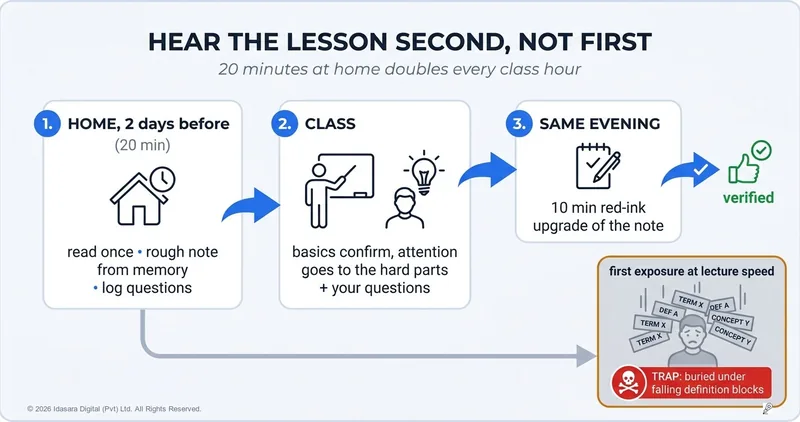
The students who seem effortlessly ahead share an invisible habit: they meet each topic at home before any teacher presents it — so class becomes their second pass, not their first. This chapter of Learn to Learn explains why the same lesson teaches twice as much to a prepared brain, and how to run pre-study in twenty minutes a topic.
Watch two students sit through the same forty-minute lesson on a new topic.
The first meets the material cold. Every definition is new, so their whole mind is spent grabbing basics — copying the board before it's wiped, hearing the teacher's explanation of this step while still digesting the previous one. They leave with incomplete notes, a fog of half-understood ideas, and homework that will require re-learning the lesson from scratch tonight.
The second student read the textbook section two days ago and wrote a rough short note. For them, the same forty minutes runs entirely differently: the basics land as confirmation — "yes, got that" — and their freed attention goes to the places a live teacher is actually irreplaceable: the tricky derivation step, the exam tip, the answer to the precise question they brought in their log's margin. They leave with the topic deepened, homework already half-done in their head.
Same room, same teacher, same forty minutes. One student's class hour purchased twice the learning — and the price of the difference was twenty minutes at home, two days earlier. That trade has a name, and universities now teach by it deliberately.
Why does a prepared brain learn double?
The habit is called flipped learning, and teaching centres at major universities — Carnegie Mellon's among them — have built whole course designs on its core move: first exposure to content happens before class, so class time can be spent applying, questioning, and going deeper.
The reason it works so well is a limit you've met throughout this book: attention is a narrow pipe. A brain meeting ten new ideas at lecture speed can't also evaluate, connect, and question them — comprehension traffic jams, and the lesson's deepest content drives past unheard. Pre-study clears the pipe. When the basics are already familiar, the lesson stops being a delivery of information (which a book does fine) and becomes what a live expert is uniquely for: error-correction, nuance, and answered questions.
Notice also what this does to the fear of hard lessons. The cold student experiences a difficult topic live, publicly, at the teacher's pace — confusion with no pause button. The prepared student already had their confusion at home, privately, at their own pace, and arrives carrying questions instead of dread. Same difficulty; completely different experience of it.
And there's a compounding effect on the teacher relationship itself: prepared students ask surgical questions, and — as you know from the asking chapters — surgical questions get a teacher's best answers. The flipped student isn't just learning more from the same lesson; they're quietly receiving a better lesson.
How do you pre-study a topic in twenty minutes?
Flipping does not mean learning the whole topic alone — that misunderstanding kills the habit under its own weight. Pre-study is a rough first pass, twenty minutes, with modest goals:
- Read the section once — the official textbook, per this book's standing rule. Active but light: you're mapping the territory, not conquering it.
- Rough short note from memory — half a page, main ideas, key terms, a sketched diagram. Gaps expected; gaps are the point.
- Log your questions — whatever refused to make sense goes in the question-log margin, written precisely. These are tomorrow's ammunition.
- Stop. Don't push for mastery — mastery is what the class, the exercises, and the full loop afterwards — read, note, audit, check — are for. Pre-study ends comfortable with the shape, specific about the confusions.
That's it. Which topics? The ones your classes will cover next week — your syllabus's term map tells you exactly what's coming, which is one more return on the contract you signed in the syllabus chapter. Run pre-study as two or three twenty-minute blocks a week, slotted where your daily plan puts them, and every school and tuition hour you already spend starts paying doubled interest.
Do the honest arithmetic: you attend perhaps twenty-five hours of school and tuition weekly. One hour of pre-study upgrades a large share of those twenty-five from first-exposure hours to deepening hours. There is no other one-hour investment in this book with that exchange rate.
After class closes the loop
Flipping has a back half, cheap and easily forgotten: the same evening, return to your rough pre-study note for ten minutes. Upgrade it in red with what class added — the corrected misunderstanding, the exam-relevant detail, the answered question. Now look at what you own: a note built by two spaced passes (home, then class) plus retrieval plus correction. You've run the forgetting-curve chapter's ideal schedule without scheduling anything — the flip generates spaced repetition as a side effect. That's why this habit sits in the method's Plan layer: it's not just a class trick; it's the loop, distributed across the week.
Do this tonight
- Find out what topics next week holds — ask, or read your term map. Pick the one from your hardest subject.
- Run the twenty minutes on it tonight: read once, rough note from memory, questions logged, stop.
- After that class next week, do the ten-minute red-ink return — and notice, deliberately, how differently the lesson landed. One noticed flip is what converts this from advice into your habit.
At a glance
- Flipped learning: first exposure at home, so class becomes the second pass — spent on depth, correction, and questions instead of basics-grabbing.
- A cold brain spends the lesson catching definitions; a prepared brain spends it on what a live teacher is uniquely for.
- Pre-study is twenty minutes and deliberately rough: read once → half-page note from memory → precise questions logged → stop.
- The evening after class: ten-minute red-ink upgrade of the pre-study note — two spaced passes plus retrieval plus correction, free.
- One hour of weekly pre-study upgrades twenty-plus hours of classes. No better exchange rate in this book.
One step further with Idasara Academy
Pre-study needs to know what's coming and needs the basics clarified at home — both are built in. The curriculum browser (free) shows exactly which topics your syllabus schedules next; the free short notes — joined by the Lesson Notes packs (a one-time purchase per subject) when you want a fuller walkthrough — give you the first-pass material; and the AI Study Coach (free for 5 messages a day; uncapped on the paid tiers) clears the basic confusions privately at home, so the questions you carry to class are the deep ones worth a teacher's forty minutes. Students moving up a level can even pre-study the next grade free with Look Ahead. The flip, with its logistics pre-solved.
Start Free — Create Your Account →
FAQ
Isn't pre-studying disrespectful to the teacher — like saying I don't need the lesson? Teachers experience the opposite: prepared students are the ones visibly engaged, asking real questions, using the lesson fully. Universities ask students to prepare before class for exactly this reason. Arriving cold is the choice that wastes the teacher.
What if I pre-study the wrong topic because the class schedule changes? Then you've pre-studied a syllabus topic slightly early — on a list you must finish anyway. In the flipped habit there is no wasted preparation; there's only coverage banked ahead of schedule.
I barely have time for homework. Where do twenty minutes come from? Usually from homework itself — prepared students finish homework dramatically faster because the lesson actually landed. Most flippers find the twenty minutes returns its cost the same week. Start with one subject and let the reclaimed time fund the second.
Does this work for tuition classes too? Identically, and often with higher returns — tuition moves fast and assumes school coverage. A thirty-minute review before a paper class (and prompt upload of your marked scripts afterwards, as the method's time layer prescribes) turns tuition's pace from a threat into an advantage.
Further reading
The flipped classroom — ahead-of-class mastery and leveraging teacher expertise — is written up in the Idasara Method: Part 2 — The Plan.
Sources
- Carnegie Mellon University, Eberly Center — Flipping the Class (first exposure before class; class time for application)
- The Learning Scientists: Learn How to Study Using… Spaced Practice (why two spaced passes beat one)
- The Idasara Method: Part 2 — The Plan