Your School May Be Behind. The Exam Paper Doesn't Care.
The short answer: The paper is set nationally, from the complete syllabus, blind to your classroom's pace — so any gap between what your class covered and what the calendar assumes belongs to whoever sits the exam: you. Measure the drift against your term-mapped topic list, then bridge it with textbook-first self-study, one fixed weekly slice, oldest topic first — with your teacher told, not bypassed.
A chapter of the free book Learn to Learn
Published 2026-08-31 · updated 2026-08-31
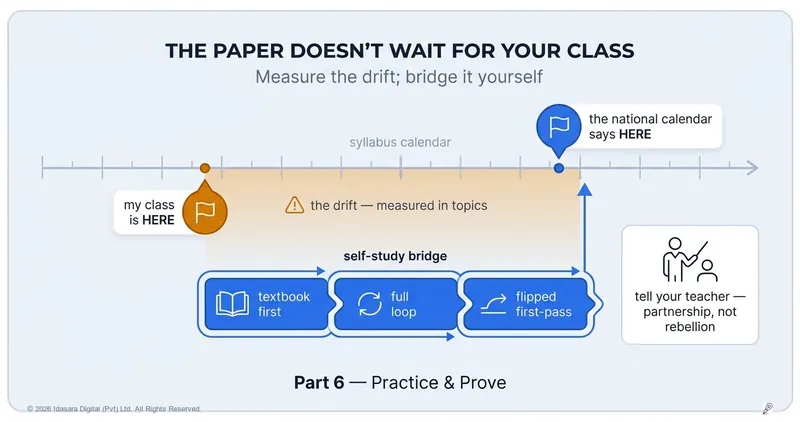
Every year, students walk into national exams with syllabus sections their school never reached — because the paper is set to the national calendar, not to any classroom's actual pace. This chapter of Learn to Learn is about the most important gap a student can learn to see: the drift between "what my class has covered" and "what the exam assumes" — and how to bridge it yourself, without blame and without panic.
Here is a conversation that happens somewhere in Sri Lanka every December, and it is heartbreaking every time.
A student walks out of a national paper shaken: "There were two whole questions from a section we never did. We never did it!" And the student is telling the truth. Their class genuinely never reached that section. The teacher ran out of year.
Now the hard question this chapter exists to ask early enough to matter: whose problem was that? Not whose fault — whose problem. Because those are different words, and the difference decides whether this story happens to you.
Why do good schools drift?
First, let's be fair, because fairness here is not politeness — it's accuracy.
A teacher facing forty students does not control the year the way a syllabus document assumes. Days vanish — holidays, events, disruptions. A hard topic lands badly and honestly needs a week the plan gave two days. Every re-explanation for the back rows — kind, correct teaching — spends calendar. Teaching forty real students at one pace is genuinely difficult work, and drift is its natural by-product, not a mark of a bad school or a careless teacher. Some drift happens almost everywhere, most years.
The system even knows it: it's part of why tuition culture exists, why past papers get squeezed into last weeks, why teachers themselves quietly advise strong students to read ahead.
But now hold the other fact beside it. The exam paper is not set by anyone who knows your classroom's pace. It is set nationally, from the complete syllabus, on the assumption that the national calendar was kept. The examiners never receive a note saying "this school reached Term 3 late — adjust accordingly." The paper tests the calendar's syllabus. Your class runs the classroom's. Any distance between the two is a real distance, and it belongs — this is the sentence to memorise — to whoever will sit the exam.
That's not injustice; it's just structure with no one assigned to it. The school can't own your individual gap; the examiner can't see it. Only one person is positioned exactly where the gap is. The students who learn this in March call it empowering. The ones who learn it in December call it something else.
How do you know if your class is behind?
You cannot bridge a drift you haven't measured, and feelings won't measure it — a comfortable class can be a behind class, and a fast-feeling class can be perfectly on time.
You already own the instrument: the syllabus contract. The weekly tracker's second rule — compare against the calendar, never against your class — is precisely this chapter in one line. The measurement:
- Open the term-mapped topic list — where the calendar says the class should be this week.
- Mark where your class actually is, subject by subject.
- The distance between the marks is your drift — written down, in topics, per subject.
Do this once and the fog becomes a number: perhaps zero in most subjects (good — keep watching monthly), perhaps two topics in one subject (a manageable repair), perhaps a term's worth somewhere (serious, and thank goodness you're seeing it now and not in the hall). Every one of those is better than not knowing — because every one has a March price and a December price, and you've just bought the right to pay the lower one.
How do you bridge the gap yourself?
Here's the quiet advantage you have over the December student: by this point in the book, you already hold every tool the bridge requires. Bridging drift is nothing new — it's the skills you've built, aimed at the drift list:
- The textbook chapter established that the official book is the primary source — which means a topic your class hasn't reached is fully learnable tonight: the source the exam is built from is on your shelf, in your language, free.
- The full loop — read, short note from memory, red-ink audit, exercises, checked — is exactly how a self-covered topic reaches "genuinely finished" quality rather than "I read it once" quality.
- The flipped-learning chapter showed you that self-first exposure is not emergency behaviour — it's what the strongest students do with every topic. Bridging drift is just flipping topics whose class pass hasn't arrived yet. If the class later reaches them: wonderful, you get the deepening pass. If it never does: you're covered where December's shaken student wasn't.
- The debt chapter's repayment structure applies unchanged: a fixed weekly slice for bridging, oldest-first, beside current work — never a panic month.
One more move, often skipped out of shyness: tell your teacher. Not as complaint — as the surgical ask you've trained: "I'm self-studying section 7 from the textbook to stay with the calendar — could I check my exercise answers with you?" Almost every teacher meets that student with respect and help. You're not going around your school; you're closing, with your teacher's blessing, a gap the structure never assigned to anyone.
Do this tonight
- Run the measurement on your two most exam-critical subjects: calendar position vs class position, in topics. Write the number down.
- If the drift is zero — celebrate briefly, diary a monthly re-check, done.
- If it isn't: put the oldest drifted topic into this week's plan as a flipped self-study (twenty-minute first pass tonight; full loop across the week), and draft the one-sentence surgical ask to your teacher.
At a glance
- Schools drift off the syllabus calendar for humane, structural reasons — but the paper is set nationally, to the full syllabus, blind to any classroom's pace.
- The gap between class-position and calendar-position is real, measurable in topics — and it belongs to whoever sits the exam.
- Measure it with the term tracker: calendar vs class, per subject, written down. Feelings can't measure drift.
- Bridge with tools you already own: textbook-first self-study, the full loop, flipped-learning first passes, a fixed weekly slice beside current work.
- Bring your teacher in with a surgical ask — bridging is partnership, not rebellion.
One step further with Idasara Academy
Drift-watching is exactly what a term-mapped system makes effortless — and the instrument is free: Idasara Academy's curriculum browser shows the full national-calendar topic list for every subject in your grade, so calendar-versus-class is visible at a glance, every week. Mark what's truly finished, and Today's Plan folds bridging work into your daily tasks beside everything else, with the Lesson Notes packs (a one-time purchase per subject) carrying the first pass on topics your class hasn't reached. The drift never gets to be a December discovery, because it was a number on a screen all year.
Start Free — Create Your Account →
FAQ
Isn't it the school's job to finish the syllabus? Why should I accept doing their work? It is their job, and nearly all schools try hard at it. But December's paper won't judge whose job it was — it will simply test the full syllabus, and the consequence lands on one person. "Whose problem is it" is answered by who bears the consequence. Accepting that early is not letting the school off; it's refusing to let their constraint become your cap.
How do I even know the official calendar position mid-year? The syllabus documents and term-mapped topic outlines carry it — the same term structure your contract chapter had you obtain. Teachers will also tell you plainly where the class stands against it if asked respectfully; most are relieved a student is watching.
What if the drifted topics are ones I can't understand alone? Then use the full toolkit: the reading-when-confused discipline, the question log, AI-tutoring for the basics at home, and your teacher for the deep questions — exactly as the flipped chapter arranged them. "Can't understand alone" usually means "can't understand in one pass" — which no topic was ever meant to survive anyway.
Our whole class is behind — won't the exam be marked leniently then? (a common hope) National grading reflects national performance, not your school's situation — and betting your grade on a hoped-for curve is trading your one controllable (coverage) for someone else's variable. The students the drift can't hurt are the ones who bridged it; be among them.
Further reading
"Compare against the calendar, not against your class" — and the term-tracker discipline behind it — is written up in the Idasara Method: Part 2 — The Plan.
Sources
- National Institute of Education, Sri Lanka — nie.ac.lk (the national syllabus calendar papers are set to)
- Educational Publications Department — edupub.gov.lk (the self-study source for uncovered topics)
- The Idasara Method: Part 2 — The Plan