The Skill Employers Will Pay For Is the One You're Practising Tonight
The short answer: The capabilities an AI-heavy workplace pays for are asking precisely, judging critically, and owning the result — which are writing, reading, and composition at a higher standard than ever. Your exam preparation trains exactly those three, so the past papers on your desk are strength-training for the AI age, not a relic of the one before it.
A chapter of the free book Learn to Learn
Published 2026-08-31 · updated 2026-08-31
Students hear that AI is changing every career and conclude their exam skills are becoming obsolete — the truth runs exactly backwards. This chapter of Learn to Learn shows why deep reading, precise writing, and sharp asking — the exact skills your exam preparation trains — are becoming the most valuable human capabilities in an AI-saturated workplace.
Somewhere this week, a student preparing for their A/L looked up from a pile of past papers and asked the question of their generation:
"What's the point? By the time I have a career, AI will do all of this anyway."
It's an honest question, and it deserves better than a motivational slogan. So let's answer it properly — by looking at what actually happens inside AI-heavy work, and discovering something almost nobody tells students: the exam hall and the AI-age workplace are, beneath the surface, testing the same three capabilities.
What's actually scarce when answers are free?
Start with what AI genuinely changed: answers became cheap. Fluent text, working code, instant summaries, plausible analysis — on tap, at almost no cost. A generation ago, producing those things was the job; that layer of work really is transforming.
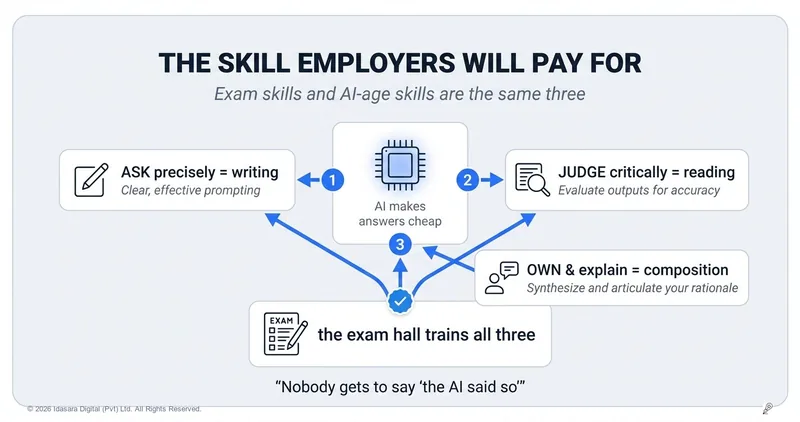
But watch a skilled person work with AI for an hour — a doctor, an engineer, an analyst — and you'll see where the entire outcome is decided. Three moments, over and over:
The asking. They specify what they need — precisely, with constraints, context, and a clear target. Vague direction in, expensive garbage out; the machine amplifies the quality of the request. You've lived this personally since the question-log chapters — where you trained precise asking: the answer inherits the question.
The judging. The output arrives fluent and confident — whether or not it's right. Someone must read it critically: catch the subtle error, notice what's missing, know when it contradicts the source. The machine cannot certify itself; the fluent-wrong answer looks identical to the fluent-right one. You've trained this too — it's the examiner's eye from the prompt-pack chapter, the textbook-outranks-the-chatbot rule.
The owning. Finally someone must take responsibility for the result — synthesise it, stand behind it, explain it to another human being clearly. No one gets to tell their boss, their patient, or their client "the AI said so." The judgement and the communication are, irreducibly, a person's.
Now name those three moments in older language: asking precisely is writing. Judging critically is reading. Owning and explaining is composition. The capabilities left standing when answers became free are literacy — at a higher standard than ever, because the machine punishes sloppy language and rewards exact language, instantly, all day long. This is why UNESCO's guidance on AI in education, for all its newness, keeps landing on the oldest ground: critical thinking and human judgement are the competencies no technology replaces.
The exam hall, reconsidered
Now look again at what your national exam demands, this time with the workplace list in hand.
Three hours. Dense questions that must be read precisely — where one verb changes everything, where a missed "not" wrecks an answer. Knowledge that must be retrieved from your own mind, unassisted. Answers that must be composed — structured, exact, legible — under time, for a reader who pays only for what's on the page.
Reading with precision. Producing under pressure. Composing for a demanding reader. The exam is not a relic that AI makes pointless — it is a training ground for exactly the three capabilities the AI age makes scarce. The formats will differ; the muscles are the same ones.
And here is the part worth saying directly to that student with the past papers: every practice this book has taught you is double-entry. The short note written from memory trains retrieval and compression — the skill of saying much in little, which is what precise prompting is. The question log trains locating your own confusion — which is what precise asking is. The red-ink audit — correcting your own work against the source — and the examiner's-eye reading of AI outputs are literally the same act on different material. The three-hour handwritten paper trains sustained, structured composition — the capability behind every report, proposal, and explanation your career will ever require. You are not studying for a world that's disappearing. You are strength-training, on the syllabus, for the one that's arriving.
The fork in front of your generation
Be honest about the other path, because it exists and it's crowded. A student can now go through school letting AI do the reading, the writing, and the thinking — arriving in adulthood fluent at receiving answers and untrained in asking, judging, or owning anything. That student doesn't become AI's director. They become interchangeable with it — and interchangeable-with-the-free-thing is the one position no market pays.
The fork isn't AI-users versus AI-refusers; refusing is neither possible nor wise. It's between those whose own reading, writing, and judging grew alongside the machine — and those whose atrophied in its shadow. Which side you land on is being decided in ordinary evenings: tonight's, for instance.
Do this tonight
- Reframe one hour: take tonight's most exam-shaped task — a past-paper answer, a short note from memory — and do it as career training: precision-read the question, compose tightly, audit ruthlessly. Same work; new eyes. Students report the "what's the point" feeling doesn't survive this reframe.
- Practise one full professional cycle on your revision: ask an AI something precise about tonight's topic (attempted first, as always) → judge the output against your textbook → write the owned conclusion in your notes, in your own words. Ask, judge, own — the whole future workflow, in miniature, on your syllabus.
- Close the session by writing a two-line summary of what you produced tonight, in your own words, as if reporting it to someone you respect. That's the ownership rep — the smallest version of the skill this chapter is about.
At a glance
- AI made answers cheap; it made three things scarce: asking precisely, judging critically, owning the result — which are writing, reading, and composition at a higher standard.
- The national exam trains exactly those: precision reading, unassisted production, structured composition under time. It's a training ground, not a relic.
- Every practice in this book is double-entry: short notes = compression = prompting; question log = locating confusion = asking; red-ink audit = output evaluation.
- The generational fork: literacy that grows alongside AI vs literacy that atrophies in its shadow. It's decided in ordinary evenings.
- Nobody gets to say "the AI said so." Judgement and clear explanation stay human — and paid.
One step further with Idasara Academy
The double-entry training runs all through Idasara Academy by design: the free Prompt Packs train structured asking tonight; the AI Study Coach (5 free messages a day; uncapped on the paid tiers) gives you outputs to judge against a curriculum standard; Exam Paper Marking audits your composed, handwritten answers the way the world will — by what's on the page; and finished skills become verifiable credentials you can actually show. Same hours, both educations; that's the architecture.
Start Free — Create Your Account →
FAQ
If AI keeps improving, won't it eventually do the judging too? Systems will check each other more, yes. But responsibility doesn't automate: someone signs off — to a client, a court, a patient. The chain of accountability ends at a human whose judgement and words must be trusted, and that seat is the one this training prepares you for.
Should I be learning coding and AI tools instead of my syllabus? Tools change yearly; careers are long. The durable stack is literacy + judgement + a deeply learned domain — your syllabus is the domain and the training material at once. Tool fluency layers on quickly if the stack under it exists; nothing layers on its absence.
Does this argument work for arts and commerce students, or only science? If anything, more strongly. Essay subjects are composition-and-judgement training in their purest form — evaluating sources, building arguments, writing precisely. That's the scarce capability, verbatim.
As a parent, what should I take from this? (for parents) That the "old-fashioned" parts of your child's education — handwritten answers, reading full textbooks, structured essays — are the future-proof parts. Guard them. The chapter to pair with this one is the honesty piece: no app, and no AI, can learn for your child.
Further reading
The dual-benefit skill architecture — how exam requirements and AI-age demands mirror each other — is written up in the Idasara Method: Part 3 — The Grade Progression Ladder & Paper Marking.
Sources
- UNESCO — Artificial intelligence in education: a human-centred approach (creativity and critical thinking as irreplaceable skills)
- Rayner, K. et al. (2016). So Much to Read, So Little Time — at the Association for Psychological Science (deep reading as trained skill)
- The Idasara Method: Part 3 — The Grade Progression Ladder & Paper Marking