Pen Beats Keyboard: What Brain Science Actually Says
The short answer: For learning, the pen wins: handwriting's slowness forces you to compress ideas into your own words, and its rich movements give memory more hooks — typing's speed invites word-for-word copying that skips the thinking. Keep the keyboard for storing, searching, and editing what you have already learned.
A chapter of the free book Learn to Learn
Published 2026-08-31 · updated 2026-08-31
Across memory experiments and brain-imaging studies, writing by hand consistently produces deeper processing and better conceptual learning than typing — for reasons built into how brains work, not nostalgia. This chapter of Learn to Learn lays out the honest evidence, its limits, and what it means for a student (and a parent buying a device).
A student with beautiful typed notes — organised, searchable, backed up — asks a fair question: "Everyone says handwrite. Isn't that just old people preferring old things?"
It deserves a fair answer, because this book has asked a lot of your writing hand — short notes by hand, exercises on paper, maps drawn from memory — and "tradition" is not a reason. So let's put the keyboard on trial properly, with the actual research. The verdict is more interesting than either side expects: the pen genuinely wins for learning — by a mechanism worth understanding — and the keyboard keeps some honest jobs.
Exhibit one: the laptop note-takers who learned less
The most famous experiment is easy to picture. Psychologists Pam Mueller and Daniel Oppenheimer had students watch identical lectures — some taking notes by hand, some typing — then tested them.
On raw facts, the groups tied. On conceptual questions — the understanding questions, the kind national papers love — the handwriters clearly won, and the advantage held even a week later.
The mechanism, visible in the notes themselves, is the interesting part. Typists, being fast, drifted into transcription — capturing the lecturer's sentences nearly word-for-word. Handwriters, being slower, couldn't transcribe — they were forced to compress: select what mattered, rephrase it their own way. And that forced selection-and-rephrasing is processing; the typists' fluency let them capture everything while engaging with almost nothing. The researchers' phrase for it has entered the textbooks: the pen is mightier than the keyboard.
Notice what this really says, because it's subtle: the pen's advantage is not magic in the ink — it's that the pen's slowness forces the brain to do the work that typing lets it skip. Which is exactly the pattern this book keeps finding: the effortful version is the one that teaches.
Exhibit two: the brain, watched while writing
A second line of evidence looks directly at the brain. Norwegian researchers fitted adults and 12-year-olds with high-density EEG caps and watched neural activity during handwriting, typing, and drawing.
Handwriting and drawing lit up a distinctive pattern — synchronised activity across parietal and central regions in rhythms the authors link to memory encoding and learning. Typing produced a measurably different signature. Their explanation fits everything else we know: handwriting is a rich sensorimotor act — each letter is a unique movement, felt and seen and steered as it forms — and that involvement of the body's movement-and-sensation systems gives memory more hooks to hang on. Every keystroke, by contrast, is the same small identical tap, whatever letter it makes.
For a Sri Lankan student there is also a third, blunter exhibit that needs no laboratory: your exam is handwritten. Three hours of it per paper. Every hour of typed studying is an hour your examined instrument — the hand — went untrained, a point the stamina chapters of this book have already made from the physical side. The science and the exam format point the same direction, which is convenient: there's no conflict to manage.
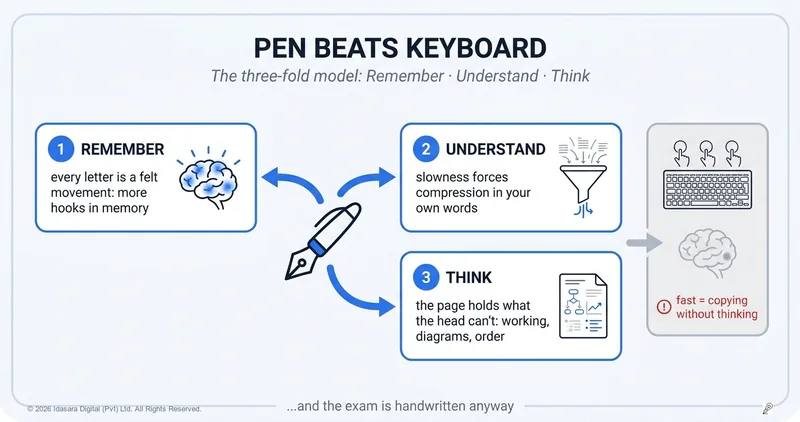
The pen's three-fold model: Remember · Understand · Think
Put the evidence together and the pen turns out to be doing three different jobs at once — worth naming as a model, because each job explains a different chapter of this book:
1. REMEMBER — the pen writes into more of your brain. Every handwritten letter is a unique, felt, steered movement — so each word lays down motor and sensory traces alongside the meaning (the EEG study's finding). Typing's identical taps lay down almost none. This is why the notes chapters insist on the hand: the same content, handwritten, simply has more hooks in memory.
2. UNDERSTAND — the pen's slowness forces compression. Because the hand can't keep up with speech or text, you must choose what matters and say it your own way — and that selection-and-rephrasing is understanding being manufactured (the lecture study's finding). The keyboard's speed removes the constraint, and with it the thinking. Slowness isn't the pen's weakness. It's the mechanism.
3. THINK — the page is where thinking becomes visible. A hard problem exceeds what any head can hold — so working memory needs somewhere to put the pieces. The page is that place: working written out, a diagram sketched, an argument ordered line by line. The pen doesn't just record thought; it carries it — which is why "show your working" isn't exam bureaucracy but literally how multi-step thinking gets done, and why the blank page is this book's honesty instrument: what the pen can't produce, the mind doesn't own.
Remember, understand, think — one cheap instrument, three engines. That's the model behind every chapter that put a pen in your hand.
What is the keyboard still good for?
A trial has two sides, so here is the keyboard's fair share — because "pen for learning" doesn't mean "pen for everything":
- Storage and search: typed archives of things you'll need to find later — vocabulary lists, formula sheets for quick lookup, project work.
- Length and editing: essays drafted for revision-heavy work, applications, anything that will be restructured repeatedly.
- Real production skill: typing fluency itself matters for university and career — it's just a different skill from learning, trained at a different time.
The clean division: learning happens through the pen; managing what's learned can happen through the keyboard. First contact with material — notes from the textbook, solving, deriving, mapping — belongs to the hand, where the science says encoding is strongest and where the exam will demand output. Organising, archiving, and looking things up afterwards — the keyboard is welcome.
One honest caveat so this chapter doesn't oversell: handwriting is not a spell. Mindless copying by hand is still mindless — a hand-copied page of the textbook teaches barely more than a typed one. The pen's advantage arrives when it's paired with the methods this book teaches: writing from memory, compressing in your own words. The pen makes the good methods natural and the lazy ones hard; that — not ink mysticism — is why this book keeps putting it in your hand.
Do this tonight
- If you currently study on a keyboard, run the one-week experiment: pick one subject, and for a week do its first-contact work entirely by hand — short notes from memory, exercises on paper. Keep typing the other subjects. At week's end, blank-page test both: which subject produces more, more easily?
- Sort your current digital notes into the two honest piles: learning material I typed (redo its next topics by hand) and reference material (keep it typed — that's its job).
- Parents, one adjustment tonight: praise the notebook the way screens get praised. The child hand-writing notes at the desk is running the most evidence-backed learning technology in the house.
At a glance
- The pen's three-fold model: REMEMBER (motor-sensory traces — more hooks in memory) · UNDERSTAND (slowness forces compression in your own words) · THINK (the page carries what the head can't hold).
- Lecture experiments: handwriters beat typists on conceptual understanding, even a week later — typing's speed invites transcription; the pen's slowness forces selection and rephrasing, which is the actual learning.
- Brain imaging: handwriting engages sensorimotor networks in patterns linked to memory encoding; typing measurably doesn't.
- Third exhibit, no lab needed: the national exam is three handwritten hours — train the examined instrument.
- Keyboard's honest jobs: storage, search, editing, long-form drafting — managing knowledge, not first-contact learning.
- Caveat: the pen isn't magic — hand-copying is still copying. Pen + from-memory methods is the winning pair.
One step further with Idasara Academy
A pen-first method needs tools built pen-first. Idasara Academy is deliberately arranged around your handwriting: study happens in your notebook, and the Exam Paper Marking tool (paid tiers) reads photographs of your actual handwritten answers and marks them against official schemes. The technology's job is to check and guide the handwork — never to replace it with typing. That's not a limitation; as this chapter argued, it's the design.
Start Free — Create Your Account →
FAQ
What about writing on a tablet with a stylus? Closer to the pen than to the keyboard — the motor patterns survive. Even the laptop-study researchers note stylus input as a reasonable compromise. For exam preparation, real paper still wins on one unarguable ground: it's the exam's own medium, distractions not included.
I type because my handwriting is slow and messy. Isn't typing better for me? That's the argument for training the hand, not retiring it — the exam won't accept a keyboard. The clarity and stamina chapters of this book are the programme; slow-and-messy is where every trained hand started.
Do these findings apply to Sinhala and Tamil, or just English? The mechanisms — motor richness, forced compression, sensorimotor encoding — are about hands and brains, not any alphabet. If anything, the rich letterforms of Sinhala and Tamil make each written word an even more distinctive motor pattern.
Should schools still teach handwriting seriously? (for teachers) The EEG researchers' own conclusion was yes — maintain handwriting instruction precisely because of its learning benefits. For exam-bound students, the case doubles: it's both a learning technology and the examination's required output format.
Further reading
Why the method puts pen and paper at its foundation — motor memory, forced synthesis, and exam stamina — is written up in the Idasara Method: Part 1 — The Human Foundation & Active Recall.
Sources
- Mueller, P. & Oppenheimer, D. (2014). The Pen Is Mightier Than the Keyboard — summarised by the Association for Psychological Science: Take Notes by Hand for Better Long-Term Comprehension
- Askvik, E. O., van der Weel, F. R. & van der Meer, A. L. H. (2020). The Importance of Cursive Handwriting Over Typewriting for Learning in the Classroom: A High-Density EEG Study, Frontiers in Psychology
- The Idasara Method: Part 1 — The Human Foundation & Active Recall