How Mind Maps Make Your Short Notes Better
The short answer: Mind maps turn a web-shaped chapter — systems, causes, comparisons — into a picture your brain can check at a glance, exposing missing connections that hide in a list. Draw the map from memory after reading, then correct it in red, and keep classic bullet notes for the exact wording and formulas.
A chapter of the free book Learn to Learn
Published 2026-08-31 · updated 2026-08-31
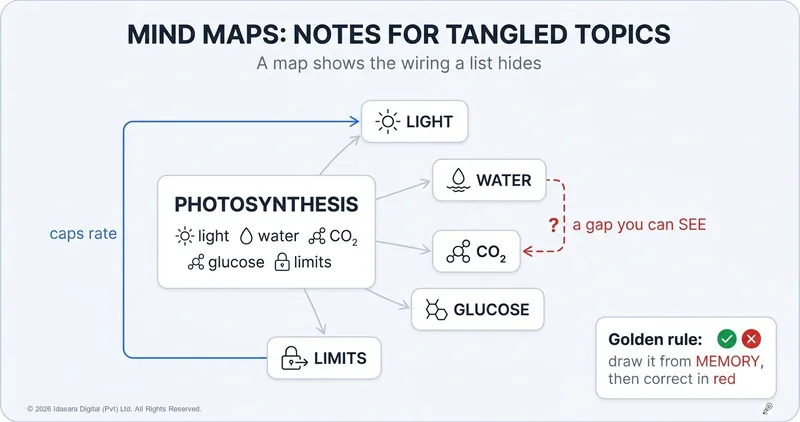
A mind map is a short note drawn as a picture: the topic at the centre, branches for the main ideas, and connections your brain can see at a glance. This chapter of Learn to Learn explains when a map beats a list, how to draw one that actually teaches you, and the golden rule that makes any map worth the paper.
Some chapters behave like lists. Study them top to bottom — a sequence of dates, a set of definitions — and a list-shaped short note fits them perfectly.
But you know the other kind of chapter. The one where everything connects to everything: a biology system where five processes feed each other, a history chapter where three causes tangle into two consequences, an economics topic that loops back on itself. You write it as a list — and the connections, the very thing the exam will ask about, fall between the lines.
Have you ever known every fact in a chapter and still failed its essay question? That is usually why. You learned the items but not the wiring. And for wiring, a different tool exists.
Knowledge is a web, not a queue
Here is the deep reason mind maps work: they match the true shape of understanding.
Learning researchers have shown that real understanding happens when new ideas attach to what you already know — knowledge in an expert's head is not stored as a queue of sentences but as a network of concepts and relationships. This is the foundation of concept mapping, developed by education researcher Joseph Novak: boxes for ideas, lines for relationships, and — crucially — a few words on each line saying what the relationship is.
A list hides that network. A map is that network, drawn. When you put "photosynthesis" at the centre and force yourself to draw what connects to what — what produces, what requires, what limits — you are not decorating your notes. You are making your understanding visible, including the holes in it.
And the holes are the point. On a list, a missing connection is invisible — the page looks complete. On a map, it stares at you: two branches that ought to touch, and no line between them. In simple terms: a list shows what you collected; a map shows whether you understand it.
How do you draw a mind map that teaches you?
A good study map takes ten minutes and one rule you already know from this book's chapter on short notes.
- Centre: write the topic in the middle of a blank page — landscape works better.
- Branches: draw a thick branch for each main idea of the chapter — aim for four to seven. Fewer means you haven't separated the ideas; many more means you haven't grouped them.
- Twigs: off each branch, add the details that belong to it — the formula, the example, the exception. Keep every entry to a word or two; a map that turns into sentences is a list in disguise.
- Cross-links — the mark-scoring move: now hunt for connections between branches, and draw them as lines across the page, each labelled with a word saying how they connect ("causes", "limits", "opposite of"). These cross-links are exactly what essay questions are made of — "explain the relationship between…" is a cross-link wearing exam clothes.
And the golden rule: draw it from memory. Read the chapter, close the book, and build the map from what your mind can produce — exactly like every short note in this book. Then open the book, find what you missed, and add it in red. A map copied from the textbook with the book open is highlighter work in a rounder shape: pretty, comfortable, and almost worthless. A map wrestled out of memory is a full workout of recall and understanding at once — memory researchers list "building concept maps from memory" among genuine retrieval practices for precisely this reason.
Should every short note become a mind map?
So should every short note become a map? No — and this book won't pretend one tool fits everything. Sequences, derivations, worked calculations: these are honestly linear, and a linear note serves them best. The craft is matching the tool to the chapter's true shape:
- List-shaped material (procedures, timelines, derivations) → classic short note.
- Web-shaped material (systems, causes and effects, comparisons, anything "discuss the relationship") → map first, then a few lines of notes for the details that need sentences.
Many strong students settle into a rhythm: map on the left page for the wiring, dense bullets on the right page for the precision — definitions with exact syllabus wording, formulas with units. The map answers how it fits together; the bullets answer what exactly to write for full marks. Revision then starts at the map — thirty seconds re-draws the whole chapter's shape in your head — and drops into the bullets only where the map felt shaky.
Do this tonight
- Pick the most tangled chapter you're currently studying — the one that refuses to stay in list form.
- Read the relevant section once more, then close the book.
- Ten minutes: centre, branches, twigs — from memory. Then hunt for cross-links and label them.
- Open the book. Add what you missed in red, especially missing cross-links.
- Keep the map inside your short-note book — it is one now.
At a glance
- Mind maps suit web-shaped chapters — systems, causes, comparisons; lists suit sequence-shaped ones.
- A map makes understanding visible: missing connections that hide in a list stare at you on a map.
- Build: centre → 4–7 branches → word-length twigs → labelled cross-links between branches (the essay-question material).
- Golden rule: draw from memory, then correct in red — a map copied with the book open teaches almost nothing.
- Strong combo: map for the wiring + dense bullets for exact wording, formulas, and units.
One step further with Idasara Academy
A map drawn from memory needs the same honest audit as any short note: did you miss a branch the syllabus considers essential? Idasara Academy's short notes — free to start — hold the curriculum-checked outline of every topic: put your map beside the screen, and any main idea your branches forgot shows up immediately, while the correction still costs a pen stroke instead of marks.
Start Free — Create Your Account →
FAQ
Aren't mind maps just for "creative" students? No — the map's power is structural, not artistic. Colours and drawings are optional decoration; the learning lives in the branching and the labelled connections, which any hand can draw with one pen.
Should I use a mind-mapping app? For studying, paper wins: drawing by hand keeps the memory-and-motor benefits of handwriting, and apps tempt you into rearranging boxes instead of retrieving ideas. Save digital maps for group projects.
My map became a giant mess. What went wrong? Usually the map tried to swallow too much — a whole subject instead of one chapter, or full sentences instead of words. One chapter, one page, one or two words per twig. If a branch grows huge, that branch wants to be the centre of its own map.
Can I answer exam questions directly from a mind map? The map gives you the skeleton of the answer in seconds — the points and their relationships. The flesh — precise definitions, formulas, syllabus wording — comes from your bullet notes. That is why the pair beats either alone.
Further reading
Mind maps are one member of a whole picture-toolkit — flowcharts, timelines, labelled diagrams, and the science of why drawing builds memory — covered in this book's chapter Study in Pictures. The method behind both: Part 1 — The Human Foundation & Active Recall.
Sources
- Novak, J. & Cañas, A. — The Theory Underlying Concept Maps and How to Construct and Use Them (IHMC)
- The Learning Scientists: Learn How to Study Using… Retrieval Practice (concept maps from memory as retrieval)
- Mueller, P. & Oppenheimer, D. (2014) — summarised by the Association for Psychological Science: Take Notes by Hand for Better Long-Term Comprehension
- The Idasara Method: Part 1 — The Human Foundation & Active Recall