Choosing Your O/L Electives: The First Fork Nobody Treats Like One
The short answer: Choose your basket subjects from your school's actual list, asking three questions of each candidate: which A/L stream does it preview, what does your marked work say about you in it, and can you live with its real textbook for two years? These electives are a two-year commitment ending in a national exam — and if you're undecided, a mixed basket keeps the most stream doors open.
A chapter of the free book Learn to Learn
Published 2026-08-31 · updated 2026-08-31
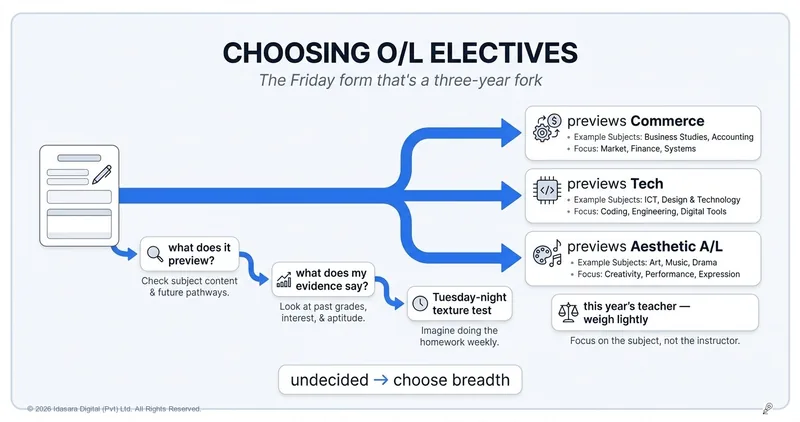
Around Grade 10, every student picks their elective subjects from the official baskets — usually in a week, usually by rumour, usually without anyone mentioning that these choices quietly preview and prepare A/L streams. This chapter of Learn to Learn treats the elective decision like the real fork it is: a two-year commitment with a national exam at its end, decided by the same doors-and-keys method as everything else — just scaled to a fourteen-year-old.
Who this chapter is for: the Grade 8–9 student about to fill the elective form, and the parents in the room with them. If your electives are already fixed, skip ahead — the stream chapter is your fork.
The A/L stream decision arrives with committees and ceremony. The O/L elective decision arrives on a form, due Friday.
And yet look at what that form does: it commits three subjects for two years of study and one national examination, it shapes what you'll have evidence in when the stream decision comes, and — the part nobody says out loud — some electives are effectively first chapters of A/L streams: business-basket subjects rehearse Commerce, aesthetic subjects feed the aesthetic A/L paths, technical subjects preview the Technology stream. Choosing them by "my friend took it" or "that teacher is easy" is making a real fork with coin-toss inputs.
The good news: you already own the decision method — it's the combination chapter's doors-and-keys — list the doors, check each key — scaled down and softened for the fact that at fourteen, keeping doors open matters even more than choosing between them.
How do you choose your basket subjects? The scaled-down method
Step 1 — Get the actual basket list from your school. Baskets and offerings vary by school and by circular — decide from your school's real list, not this book, not a cousin's memory of their year. (That sentence is the whole reason this chapter cites no basket contents: the official list in your hand outranks anything printed here.)
Step 2 — For each candidate, ask three questions: 1. What does it preview? Which A/L streams or paths does this elective rehearse or feed? An elective that previews a stream you're curious about is a cheap, low-stakes trial of that future — the best possible use of the choice. 2. What does my evidence say? Even at Grade 9 you have marked-work evidence: where do you perform vs survive? Two years is long to carry a subject your evidence already argues against — and remember the O/L certificate is a nine-subject result (the portfolio chapter's warning: one collapsed elective stains the slip). 3. What's the Tuesday-night reality? Read a chapter of each candidate's actual textbook — the elective's daily texture, not its title. The curriculum browser makes this a ten-minute test per subject.
Step 3 — Weigh the school reality, honestly but lightly. Teacher quality and timetable clashes are real inputs at this age — a subject taught brilliantly is worth something. But weigh it lightly: teachers change, and this book has spent thirty chapters proving a student with method can carry a subject the school carries badly (the self-study chapters exist for exactly that). Never pick a two-year subject only for this year's teacher.
Step 4 — Keep breadth if you're undecided. The elective set that mixes types — something quantitative-or-technical, something expressive, something knowledge-based — leaves the most stream doors ajar for a student who genuinely doesn't know yet. Specialising the basket early is for students with a real, tested pull toward a path; drifting into specialisation by rumour is the silent-lock mistake, junior edition.
For parents
Two sentences carry most of what helps. First: this decision deserves one evening of the family's attention — the form's casualness is a trap, and your fourteen-year-old can't see two exam years ahead alone. Second: the child's evidence and texture-test outrank both the prestige rumour ("technical subjects are for weak students" is the elective-level version of the stream ranking — and just as false) and the convenience vote. Bring the A/L preview knowledge; leave the verdicts.
Do this week
- Get the school's real basket list and each candidate's textbook (or its syllabus in the curriculum browser).
- Run the three questions per candidate — preview, evidence, Tuesday-night — one page total.
- If torn between two: prefer the one that previews a stream you're genuinely curious about; it converts a Grade-10 form into a cheap experiment on your own future.
At a glance
- Electives are a two-year commitment and an A/L preview — a real fork handed out as a Friday form.
- Decide from your school's actual basket list — it outranks every printed guide, this one included.
- Three questions per candidate: what does it preview? · what does my evidence say? · what's its Tuesday-night texture?
- Weigh this year's teacher lightly; never anchor two years on one timetable.
- Undecided? Choose breadth — mixed-type baskets keep the most stream doors ajar.
One step further with Idasara Academy
The texture-test is free: the curriculum browser carries every subject's syllabus outline, so a Grade-9 student can preview each elective candidate's actual shape in an evening — and the same tool becomes the coverage tracker for whichever three win. The form gets its evening of evidence; the evidence tool costs nothing.
Start Free — Create Your Account →
FAQ
Do electives affect university entrance directly? Mostly indirectly: A/L subjects carry the admission tables, but electives shape which A/L subjects you'll be prepared and permitted to take — and the O/L slip itself (all nine grades) appears in plenty of gates later (streams, some institutions, some jobs). Indirect is not unimportant; it's just one step removed.
I picked electives I now regret — Grade 11, too late to change. What do I do? What this whole book does: run the subject's playbook (every elective maps to one of the subject-family chapters), protect the nine-subject portfolio, and treat the regret as information for the next fork — the stream decision, which you'll now make with the doors-and-keys method instead. A regretted elective handled with method still becomes a credit on the slip.
Is it bad to take an "easy" aesthetic subject just to protect the average? Strategy is allowed — a subject you'll genuinely perform in protects the portfolio, and that's the third-question logic working. What's bad is only strategy: two years is long enough that pure-tactical choices with zero pull become the subjects that quietly rot (the rotation chapter knows them well).
My school pushes students into baskets by their marks. Can we push back? Schools advise from cohort experience, and that advice is data worth hearing — but the form is the family's to sign. Bring the one-page evidence-and-preview sheet to the conversation; schools respond differently to a family holding a method than to a preference held on feelings.
Further reading
The full-size version of this method: Choosing Your A/L Combination and After O/L: Choosing Your Stream. The portfolio warning: Nine Subjects Without Panic.
Sources
- Trinity College Kandy — A/L guidance (what the electives eventually feed; verify current circulars)
- National Institute of Education — nie.ac.lk (official syllabi for every elective)
- The Idasara Method: Part 2 — The Plan (syllabus outlines as decision instruments)