Read Even If You Don't Understand — and Why It Matters
The short answer: Keep reading to the end of the section — textbooks usually clear their own fog through the examples and diagrams a page ahead. Whatever confusion survives the section, write it down as one precise question and get it answered; never carry it as a vague feeling.
A chapter of the free book Learn to Learn
Published 2026-08-31 · updated 2026-08-31
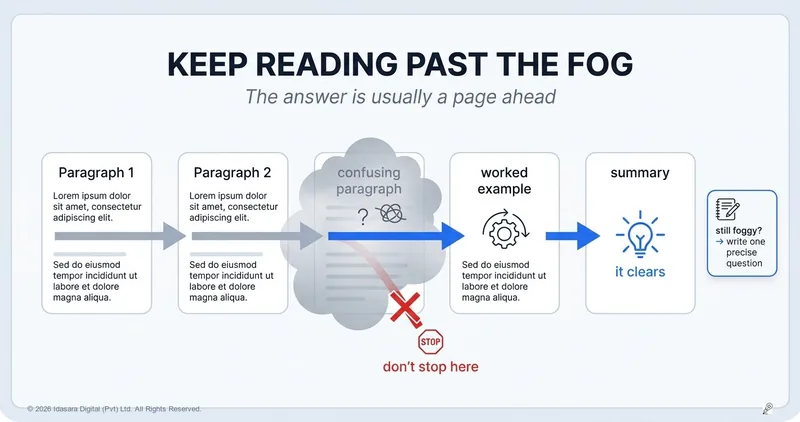
When a paragraph makes no sense, most students stop reading — and that stop, repeated nightly, quietly decides their grade. This chapter of Learn to Learn explains why confusion in the middle of a section is normal, why the answer is usually a page ahead, and what to do with the confusion that remains.
It happens to every student, in every subject, on almost every difficult chapter.
You are reading along, following well enough — and then one paragraph refuses to make sense. You read it again. Still fog. A small voice says: "I don't get this. Maybe I'm not good at this subject." The book closes. The phone appears. The evening is over.
Be honest: how many of your study sessions have ended exactly there?
Now here is the question this chapter turns on: what would have happened if you had simply… kept reading?
The answer is usually a page ahead
Textbook writers know that some ideas cannot be understood on first contact. That is why a well-built chapter doesn't say a thing once — it says it, then shows it. The dense paragraph is followed by a worked example. The abstract law is followed by a diagram. The confusing definition gets used, three pages later, in a problem where its meaning finally clicks.
In simple terms: the textbook often answers its own confusion — but only for readers who reach the answer. The student who stops at the fog never discovers that the clearing was on the next page.
So the first rule of reading difficult material is almost embarrassingly simple: finish the section. Not the chapter — just the section, to its natural end. Read past the paragraph that defeated you, through the examples, to the summary. Then look back. You will be surprised how often the fog has thinned on its own.
Confusion is not a verdict
There is a deeper reason to keep going, and it is about what confusion means.
Most students read confusion as a verdict: I am weak at this. But learning science tells a different story. Decades of research on how people learn — the work on "desirable difficulties" — shows that the strain of grappling with material that hasn't yet yielded is not a sign of failure; effortful conditions are precisely the ones that produce durable learning, while smooth, easy-feeling study tends to evaporate.
Confusion, in other words, is not the wall around learning. It is the doorway into it. Every scientist, every doctor, every engineer you admire spent thousands of hours confused — and kept reading. The difference between them and the student who closed the book was never talent. It was what they did in the minute after the fog rolled in.
And there is a compounding cost to stopping. The student who retreats at every hard paragraph trains a habit: difficulty means quit. By exam season, their syllabus is a landscape of half-read chapters, each abandoned at its first hard moment — which is usually exactly where the marks live.
What do you do with the confusion that survives?
Keep reading — yes. But suppose you finish the section and part of the fog remains. What then?
Then you do the second move: turn the feeling into a question.
"I don't get electricity" is a feeling — heavy, vague, and impossible to act on. "Why does adding a resistor in parallel decrease total resistance?" is a question — light, precise, and answerable in five minutes by a teacher, a friend, or a good tutor.
So keep a margin, or a facing column, in your notebook. When confusion survives to the end of a section, write it down as a question, as precisely as you can, and read on. Something remarkable happens in that act: the anxious feeling of "I'm lost" becomes the calm state of "I have two open questions." You have moved from panic to problem-solving — and your list of questions becomes a hunting list for your next class, not a reason to dread it. (This little column deserves its own chapter, and it has one: the Question Log.)
Do this tonight
- Open the chapter you most recently abandoned mid-way. Find the paragraph that stopped you.
- Read from that paragraph to the end of the section — no re-reading loops, no stopping. Let the examples do their work.
- At the end, look back at the paragraph. If it has cleared, notice what cleared it.
- If it hasn't, write one precise question about it in your margin — and consider the session a success, because a written question is progress in a way a closed book never is.
At a glance
- Confusion mid-section is normal by design — textbooks resolve their own hard paragraphs through the examples and diagrams that follow.
- Rule 1: finish the section before judging what you don't understand.
- Effortful, initially-confusing study produces more durable learning than smooth, easy-feeling study.
- Confusion that survives the section gets converted into a written, precise question — never carried as a vague feeling.
- Stopping at hard paragraphs, repeated nightly, is how syllabuses end up half-read.
One step further with Idasara Academy
A written question deserves a fast, accurate answer. Idasara Academy's AI Study Coach (Ask AI) — free to try with 5 messages a day; the paid tiers remove the cap — is built for exactly the questions your reading produces: grounded in the national curriculum, so the explanation matches your syllabus and marking scheme, not a foreign textbook. Not paying? The free Prompt Packs give you expert-built question frames for every topic — a strong way to spend your log's questions tonight. Either way: write the answer back beside your question, in your own words.
Start Free — Create Your Account →
FAQ
Isn't it a waste of time to read words I don't understand? You understand more than the fog suggests — usually it's one link in the chain that's missing, and the following examples supply it. Reading on costs five minutes; abandoning the section costs the whole topic.
What if I finish the section and understand nothing at all? Then the problem is usually a missing foundation from an earlier chapter, not this one. Write the question, step back one topic, and rebuild from where things last made sense. That's not falling behind — that's finding the real gap.
Should I re-read the confusing paragraph many times instead? Two readings, at most — then move forward. Looping on one paragraph builds frustration, not understanding; the clarification you need is more often ahead of you than inside the loop.
Does this apply to subjects like literature and history too? Fully. A dense poem or a tangled chain of historical causes clears the same way — through the discussion and examples that follow, and through precise questions about what remains.
Further reading
The reading discipline and the question log are moves 1 and 3 of a larger system — the full write-up is in the Idasara Method: Part 1 — The Human Foundation & Active Recall.
Sources
- UCLA Bjork Learning and Forgetting Lab — research overview on desirable difficulties
- The Learning Scientists: Learn How to Study Using… Retrieval Practice
- The Idasara Method: Part 1 — The Human Foundation & Active Recall