Study Groups That Actually Work: A Testing Venue, Not a Social One
The short answer: Study alone first; meet to test. A group works when everyone arrives already studied and spends a structured ninety minutes quizzing each other from written questions, swap-marking answers against the scheme, and rotating a teaching slot — two to four serious members, phones piled in the middle of the table.
A chapter of the free book Learn to Learn
Published 2026-08-31 · updated 2026-08-31
"Should I study with friends?" gets two confident answers — "yes, it's motivating!" and "no, it's just chatting!" — and both are right, about two different things wearing the same name. This chapter of Learn to Learn separates them: why groups fail at first-learning and shine at testing, the three rules that turn a gathering into a mark-machine, and the one group activity worth more than any other — teaching each other.
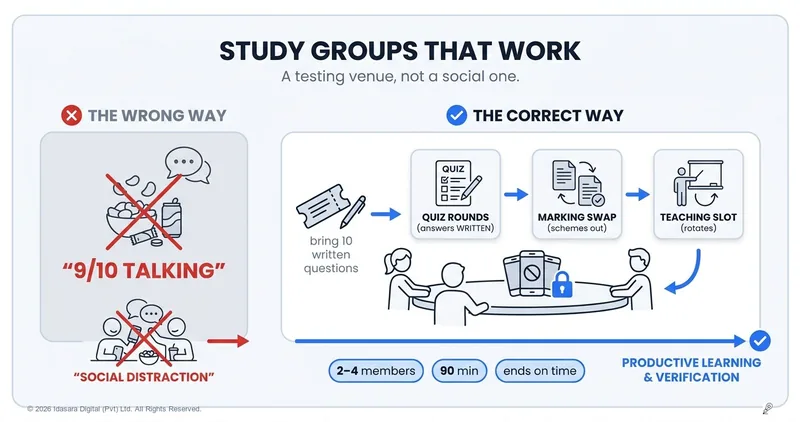
Watch the classic study group at work: friends, books open, snacks, good intentions — and a session that is one-tenth studying, nine-tenths talking about studying, with everyone leaving warmed and nothing learned. Verdict: groups don't work.
Now watch a different scene: four students, each having already studied this week's topics alone, meeting for ninety minutes to fire questions at each other, mark each other's answers against the scheme, and explain the bits someone got wrong. Verdict: groups work brilliantly.
Same word, opposite machines. The difference is the whole chapter: groups are terrible venues for input and superb venues for output. First-contact learning — reading, note-making, understanding — is Me Time work by nature (the safety-to-be-wrong, the personal pace: the Me Time chapter's whole case). But testing — retrieval under mild social stakes, answers checked by other eyes, explanations demanded out loud — is where a group adds what solitude can't. Run the group as a testing venue and every mechanism this book trusts fires at once.
Why does the testing group work so well?
It's retrieval with teeth. Being asked by a friend is a blank-page test — answering from memory alone — with mild, friendly pressure — closer to exam conditions than anything solo practice provides, and (per the nerves chapter's science) retrieval under mild stress stress-proofs the memory for the real day.
Other eyes catch what yours can't. Your confidently-wrong answers (the red-ink chapter's species) sail past your own checking and die instantly in a group — a friend's "wait, that's not what the scheme says" is external marking, free.
And teaching is the deepest test of all. The moment you explain a topic to a stuck friend, you discover — instantly, precisely — which parts you actually own and which you'd only recognised (explaining is the explain-it-aloud check from the science playbook, with a live audience). The teacher in the group learns more than the taught: prepare-to-teach is one of learning science's most reliable effects. A group that rotates the teacher role is running everyone's deepest practice for free.
How do you run a study group that works? The three rules
Rule 1 — Come tested-ready, or don't come. The group tests what members already studied alone; it never carries first-learning. The entry ticket makes it real: everyone brings ten questions on the agreed topics (writing good questions is itself the question-log skill — the craft behind your stuck-questions list) — arrive without them, and you're audience, not member. This one rule kills the chat-session at the root, because it moves the studying before the meeting, where it belongs.
Rule 2 — Structure the ninety minutes, and end on time. A working shape: quiz rounds (fired from the brought questions, answers written then checked — writing keeps it exam-real), a marking swap (last week's practice answers exchanged and scheme-checked), the teaching slot (this week's rotating teacher takes the group's hardest topic), and five closing minutes agreeing next week's topics. Bounded and structured beats long and loose — the group's end-time is what protects its start-quality (and everyone's evening).
Rule 3 — Two to four members, chosen for seriousness, not closeness. The group's ceiling is its least serious member on its most social day. Small enough that no one hides, serious enough that Rule 1 holds, and — the awkward truth said kindly — your best friend is not automatically your best study partner. The friendship survives separate studying; the exam won't survive a year of chat-sessions. (Mixed-strength groups work well because of the teaching slot: the stronger student's deepest practice is the weaker student's best explanation.)
Everything else is detail: meet weekly (the spacing chapter approves), keep phones in the middle of the table face-down as a pile (the group enforces what solo willpower can't), and let the group's WhatsApp exist for logistics only — the group is the ninety minutes, not the all-day thread (the feed chapter knows what all-day threads are).
Do this week
- Recruit by the rules: one to three serious candidates, the tested-ready ticket explained up front. Seriousness now saves awkwardness later.
- Run the first ninety minutes on the structure above, on topics everyone's already covered. End on time even if it's going well — especially if it's going well; appetite is what brings everyone back (the launch chapter's trick, group edition).
- Rotate the teacher from meeting one, and watch who learns most. Then tell them why — it'll keep the slot honest.
At a glance
- Groups fail at input (first-learning is Me Time work) and shine at output: retrieval with friendly stakes, external checking, and teaching — the deepest test there is.
- Rule 1: come tested-ready with ten written questions — the entry ticket that kills the chat-session.
- Rule 2: structured ninety minutes — quiz rounds (answers written), marking swap, rotating teaching slot — ended on time.
- Rule 3: 2–4 members chosen for seriousness; your best friend ≠ your best partner; mixed strength works because of the teaching slot.
- Phones piled center; the group's thread is logistics, not a feed.
One step further with Idasara Academy
The group's machinery has built support: micro-quizzes (free) and flash cards (paid tiers) are ready-made quiz rounds for the testing table, everyone's streaks and progress views make the process-scoreboard honest without anyone keeping score, and for the earning student studying alone, the working-teen community is a serious peer circle no town timetable could offer. The three rules still govern; the tools just carry the bookkeeping.
Start Free — Create Your Account →
FAQ
I'm the strong one — the group takes more than it gives me. Check the ledger again: the teaching slot is your deepest practice (you learn most explaining), the others' questions probe corners your solo practice skips, and their checking still catches your confident errors. If it still nets negative after honest weeks, shrink to one well-matched partner — the rules work at n=2.
My friends want to include everyone. How do I keep it small without wounds? Let the entry ticket do the gatekeeping: "bring ten written questions on the week's topics" filters kindly and impersonally — the unserious excuse themselves within two weeks, no one banished. And a second group can always exist; you're just not obliged to be its engine.
Online group sessions — do the rules survive the screen? Mostly: written answers photographed and swapped, the teacher slot on a shared screen, the timebox even easier to hold. What weakens is the phone-pile (each member polices their own) and the informal energy — so online groups need Rule 1 harder. For the data-poor member, one weekly voice call of quiz rounds costs little and carries most of the value.
Is competing with friends healthy or toxic? The scoreboard question — and the comparison chapter next door takes it fully. The short version: compete on process (streaks, papers completed, questions brought) and the group lifts everyone; compete on ranks and the group re-imports the classroom's worst weather. Choose the scoreboard deliberately.
Further reading
The solitary half this chapter assumes: Me Time. The explaining test at solo scale: How to Study Science (explain-aloud). The comparison machinery: "Everyone Is Better Than Me".
Sources
- The Learning Scientists — Retrieval Practice (testing as the core mechanism)
- Smith, A. et al. (2016) — retrieval under stress (friendly stakes as stress-proofing)
- The Idasara Method: Part 1 — The Human Foundation & Active Recall