How to Study Science: The Subject Where Marks Hide in Labels and Units
The short answer: Study Science for precision: learn definitions in the textbook's exact wording on a spaced schedule, draw every syllabus diagram from memory with its labels, turn processes into flowcharts you can explain aloud, and end every answer with a ten-second units-and-labels check. Science marks are paid for exact items, not for long paragraphs.
A chapter of the free book Learn to Learn
Published 2026-08-31 · updated 2026-08-31
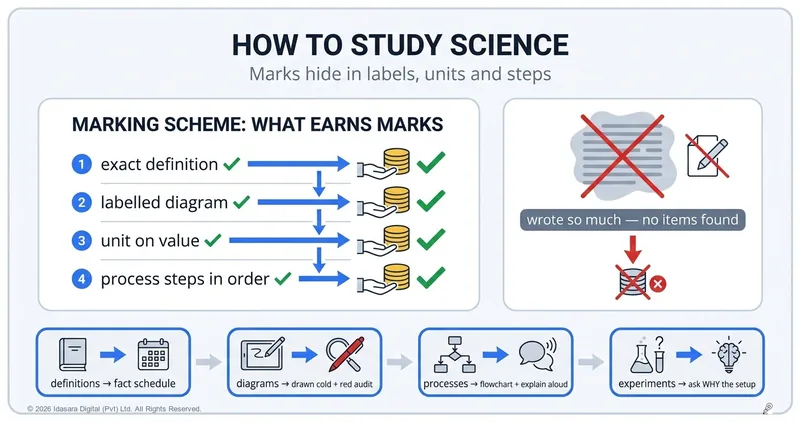
O/L Science looks like a reading subject and marks like a precision subject — its marks live in exact definitions, labelled diagrams, correct units, and the steps of processes. This chapter of Learn to Learn is the science playbook: what the scheme actually pays, the four kinds of science knowledge and the right tool for each, and why your diagram-drawing hand is worth more than your highlighter ever was.
Two students walk out of the same Science paper. One says "it went well — I wrote so much." The other says less and scores more. When the papers come back, the difference isn't knowledge. It's that one of them knew what Science marks are made of.
Science feels like a story subject — chapters full of explanations you read and "understand." But open any Science marking scheme (the shopping chapter taught you how to read one) and look at what's actually listed: the exact definition, with the syllabus's wording. The diagram, with these labels. The unit on the value. The steps of the process, in order. The one-word term for the phenomenon. Science schemes pay for precision items — and the student who "wrote so much" delivered paragraphs the scheme couldn't find items in.
So the science playbook is the book's engine pointed at four targets.
The four kinds of science knowledge — and the right tool for each
1. Definitions and terms → exact wording, on the fact schedule. Science definitions are paired facts (term ↔ precise wording), and the memorising chapter's rules run them: small batches, produce-don't-recognise, spaced ladder, both directions. The trap to kill: paraphrasing. "Photosynthesis is how plants make food" feels right and drops the scheme's keywords; your red-ink audit — marking your gaps in red — against the official wording (the textbook's, always) is where those marks get locked in.
2. Diagrams → drawn from memory, labels and all. This is Science's signature currency — the pictures chapter's exam-angle at full strength. Every syllabus diagram (the cell, the circuit, the flower, the eye) is a practised performance: draw it cold, label it cold, audit in red, repeat on the spaced schedule. The figure-walk chapter gives you the weekly refresh for the whole diagram set. A student with fifteen cold-drawable diagrams walks into the paper holding banked marks.
3. Processes → flowcharts, then explained aloud. Digestion, the water cycle, reflex arcs, electrolysis — processes are ordered chains, and the scheme pays the links: what happens, in order, because of what. Build each as a from-memory flowchart (boxes, arrows, one verb per arrow), then run the deepest science check there is: explain it aloud, alone, as if teaching — where your explanation stumbles is exactly where the chain has a weak link.
4. Applications and experiments → the "why" behind the setup. Papers love the practical: why this apparatus, why the control, what varies, what's measured, what conclusion follows. Don't memorise experiments as photographs — interrogate them with the question-log habit — a running list of your own whys: why the water bath? what would break if we skipped it? The exam's "suggest why" questions are testing whether you ever asked.
Underneath all four: the loop unchanged. Textbook first (Science schemes are written beside its wording), short notes from memory, exercises paper-first, errors banked by species, past papers in season. Science just tells you what to aim each move at.
What does a good science week look like?
- Per topic: short note from memory plus its diagram/flowchart from memory — the note-and-picture pair the dual-coding chapter promised.
- Daily fact-dose (10 min): the definition batches on their spaced ladder.
- Weekly: figure-walk the finished chapters; explain one process aloud; one timed set of structured questions, checked against the scheme with the shopping eye — did my answer contain the listed items?
- The precision sweep habit: units and labels are Science's cheap-mark species; your ten-second check (unit on every value, label on every part) belongs at the end of every answer, every time.
Do this tonight
- Pick your current Science topic. Write its key definition from memory, then audit word-by-word against the textbook. Feel the gap between "my version" and "the scheme's version" — that gap is where Science marks die.
- Draw the topic's diagram cold, label it cold, red-ink the misses.
- If it's a process topic: flowchart it, then explain it aloud to the wall. Mark where you stumbled — that's tomorrow's first ten minutes.
At a glance
- Science marks are precision items: exact definitions · labelled diagrams · units · ordered process steps · one-word terms. Paragraphs the scheme can't find items in earn little.
- Four knowledge types, four tools: definitions → fact schedule, exact wording · diagrams → drawn cold + red audit · processes → flowcharts + explain aloud · experiments → interrogate the why.
- The note-and-picture pair per topic is Science's version of the short note.
- Units and labels are the cheapest marks on the paper — install the ten-second sweep.
- The loop unchanged underneath: textbook wording first, paper-first practice, errors banked, papers in season.
One step further with Idasara Academy
Science's playbook runs on mirrors and reps, and both are built in: short notes — free to start — carry the syllabus-standard definitions and diagrams for the red-ink audit (which label did your hand forget?), micro-quizzes drive the daily fact-dose with slips banked automatically, and on the paid tiers Exam Paper Marking checks your structured answers the scheme's way — keywords verified, diagram labels read from your photograph. Precision, audited weekly instead of mourned in December.
Start Free — Create Your Account →
FAQ
Science has so much to memorise — is it just a memory subject? It's a precision subject: memory for the fact layer (definitions, labels), understanding for the processes and applications — and papers test both. The split matters because each half has its own tool; treating it all as "memorise the chapter" is why the workload feels impossible.
Do spelling and exact wording really matter in answers? Key terms, yes — the scheme lists them, and a mangled term the marker can't credit is a lost item. That's precisely why definitions live on the produce-and-audit schedule, not the read-and-nod one.
How do I study for practicals/experiment questions if my school rarely does experiments? The paper tests the reasoning, which the textbook's experiment descriptions carry fully: setup → why each part → what's measured → conclusion. Interrogate them with the question log; where school labs exist, they make it vivid — where they don't, the why-chain still earns the marks. (Rural students: this is one of the most equalising facts in the syllabus.)
Biology-heavy vs physics-heavy sections feel completely different. Same method? Same four-type sort, different mix: bio-flavoured sections lean definitions/diagrams/processes; physics-flavoured sections add the maths playbook's rules (worked examples covered-and-attempted, full working shown). Sort each topic into its types and the method assigns itself.
Further reading
Keyword rubrics, labelled diagrams, and the marking engine behind them: Part 3 — The Grade Progression Ladder & Paper Marking.
Sources
- The Learning Scientists: Dual Coding · Spaced Practice
- Wammes, J. et al. (2016) — the drawing effect, ScienceDaily (why drawn-cold diagrams stick)
- Educational Publications Department — edupub.gov.lk (the wording schemes are written beside)
- The Idasara Method: Part 3 — The Grade Progression Ladder & Paper Marking