The Most Underrated Pages in Your Textbook: End-of-Chapter Exercises, Done First, On Paper
The short answer: Yes — end-of-chapter exercises are the official baseline: published by the same national system that sets your exam, at the level the paper's foundational marks are written to. Work every one on paper, with full working, before any help arrives — done that way, they are the cheapest grade-builder in your year.
A chapter of the free book Learn to Learn
Published 2026-08-31 · updated 2026-08-31
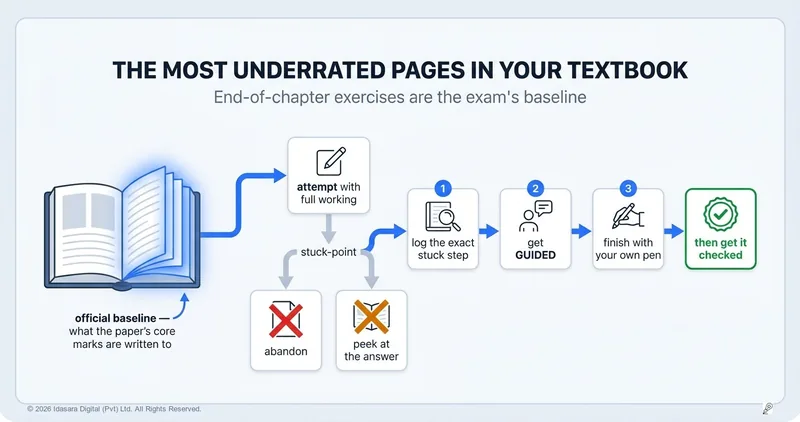
At the end of every official textbook chapter sits a set of exercises most students skip, skim, or "read through" — yet these questions are the national baseline, and working them on paper is the single cheapest grade-builder there is. This chapter of Learn to Learn explains what those pages really are, the paper-first rule, and what to do at the exact moment you get stuck.
Do a quick audit of your own textbook — any subject, any chapter you've "finished."
Turn to the exercises at the chapter's end. Now answer honestly: have you done them — pen, paper, full working, checked? Or have you done what most students do: read a few, thought "yes, I could do that," and turned the page?
That small skipped ritual, multiplied across every chapter of every subject, is one of the largest silent mark-leaks in a student's year. Because those exercise pages are not decoration, and "I could do that" is — as you knew the moment you read it — the illusion of competence wearing its favourite disguise.
Do the exercises really matter for the exam?
Remember who publishes your textbook: the same national system that sets your exam. The end-of-chapter exercises are not a random author's afterthought — they are the official statement of baseline competence for that chapter: the kinds of problems, at the level of difficulty, that the syllabus considers every student should handle. When examiners write the paper's foundational questions — a large share of its marks — this is the standard they write to.
That's why the grade-ladder chapter — the book's step-by-step route from C to A — placed exercises at the very first rung: read the official textbook, do every end-of-chapter exercise, get every attempt checked — and the C-pass foundation is built, exercise by exercise. Not hoped for — built. A student who has genuinely worked every exercise in the book has rehearsed the paper's baseline, chapter by chapter, all year — usually without ever calling it "exam practice."
And the exercises hold one more quiet gift: they are placed correctly in time. Fresh after each chapter, they arrive exactly when retrieval practice pays most — the first effortful "out" pass on new material, right when the forgetting curve is steepest. The book's whole engine — read, note, retrieve, check — has its natural third station sitting printed at every chapter's end, waiting.
The paper-first rule
One rule governs the ritual, and by now you can derive it yourself: every exercise gets attempted on paper, with full working, before any help arrives — before the solution page, before a friend, before AI, before "let me just check the first step."
The reasons stack, all of them from chapters you've read: the attempt is the retrieval (mental rehearsal is recognition; the pen is recall). The working is the exam's own format — method shown, steps ordered, handwriting under way, the production capacity the hall will audit. And the attempt is what makes help effective: you can't ask a surgical question about a problem you haven't located yourself inside.
"Read through the exercises" has none of these. It is highlighting with extra confidence.
What do you do the moment you get stuck?
Question 4(b) refuses to move. Your working reaches a step and dies. This exact moment — repeated hundreds of times a year — is where the exercise ritual either builds you or quietly collapses, and the difference is a fork with three paths:
Path one: abandon. Close the book, "I'll ask someone eventually," move on. The problem joins the invisible pile, and the pile becomes your December.
Path two: peek at the solution. Instantly soothing — "ah, of course." And you know that feeling's name by now. Recognition of someone else's step is not the ability to produce it; the same wall returns in the exam, with no solutions page.
Path three — the trained path: log the exact blockage and get guided, not given. Write down where precisely the working died — "I reach 3x = 12 - y and don't see how to eliminate y" — the question-log skill, applied mid-problem. Then take that surgical location to your helper — teacher, friend, or AI tutor — and ask for the step's logic, not the answer: "Here's my working; where does it diverge, and why?" Then — non-negotiable — finish the problem with your own pen, and later re-attempt it cold.
Path three turns every stuck moment into the most valuable kind of learning event you own: a located gap, repaired at the exact point of failure, sealed by your own production. A chapter's exercises done this way don't just verify the chapter — they complete it.
Checking closes the loop
An attempted exercise is still half-done until something honest checks it — answers compared, working verified against the expected method, errors marked in red and (as the coming mistake-bank chapter will insist) recorded. An unchecked page of working can be confidently wrong in exactly the ways your notes could be, and the audit rule is the same: check while the attempt is fresh, correct in place, keep the marked page. Right-first-time tells you the chapter is secure. Wrong-then-repaired tells you something better: precisely what to re-attempt next week.
Do this tonight
- Take the chapter you most recently "finished" in your hardest subject. Open its end-of-chapter exercises.
- Paper-first: attempt them with full working — no solutions, no help — logging the exact step wherever you stick.
- Then check everything, repair via path three, and mark the stuck ones for a cold re-attempt in a few days.
- Notice the honest news the page just gave you. However it went, you now know — and knowing in week three costs nothing, while knowing in December costs everything.
At a glance
- End-of-chapter exercises are the official baseline standard — the level the paper's foundational marks are written to; working them all is the C-pass rung, mechanically.
- Paper-first rule: full working, before any help — the attempt is the retrieval, the format rehearsal, and the question-sharpener at once.
- At a stuck step, take path three: log the exact blockage → get guided (not given) → finish with your own pen → re-attempt cold later.
- Peeking at solutions is recognition in disguise; abandoning builds the invisible December pile.
- Every attempt gets checked while fresh — red ink, recorded, stuck ones diarised for re-attempt.
One step further with Idasara Academy
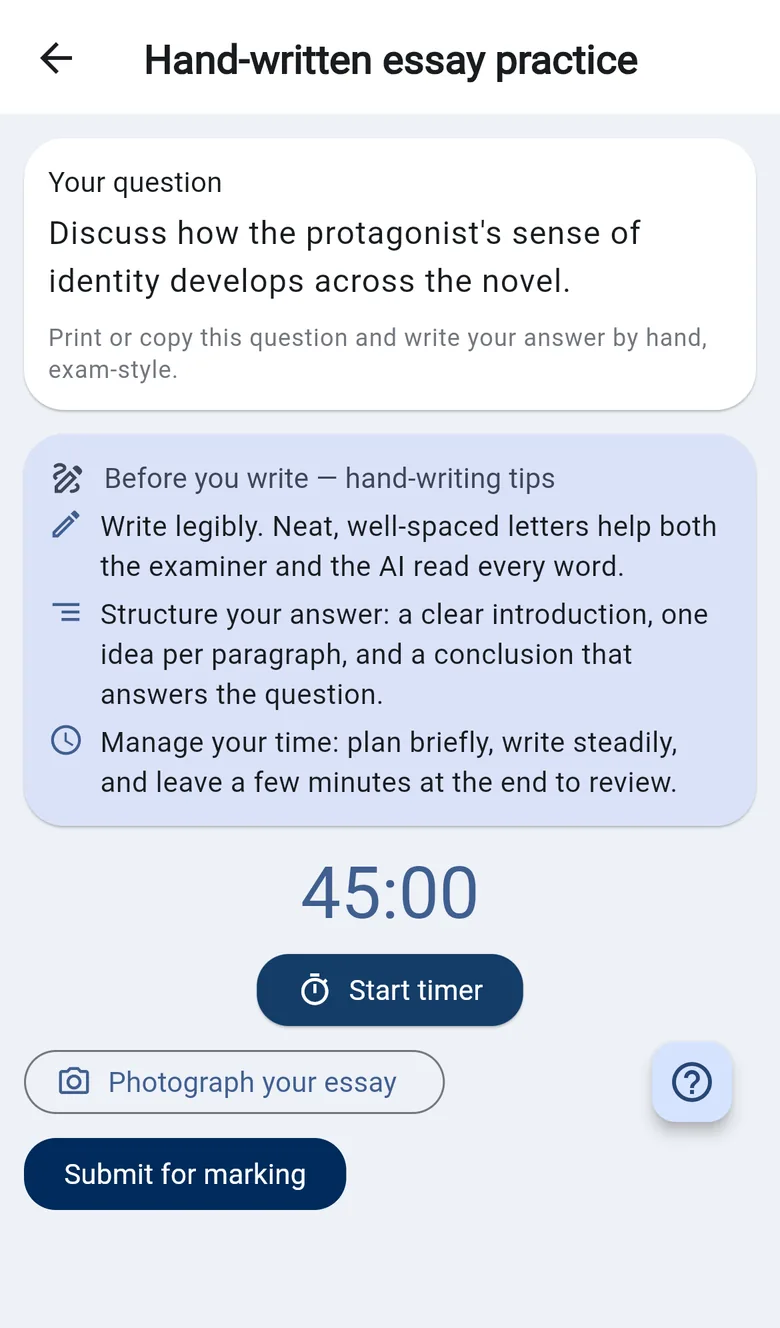
The ritual's two support beams — honest checking and guided unsticking — are exactly what Idasara Academy automates. Free to start: after each chapter's exercises, take the topic's micro-quiz cold to verify the chapter went in. On the paid tiers, photograph your handwritten working and Exam Paper Marking checks it against the official standard step by step; at the stuck moment the AI Study Coach — free to try, 5 messages a day — takes your partial working and plays the Socratic tutor — locating the divergence without handing you the answer. Paper first, always; the tools stand at the two moments paper needs a second pair of eyes.
Start Free — Create Your Account →
FAQ
The exercises look easier than real past-paper questions. Why bother with them? Because the ladder has an order. Exercises secure the baseline the paper's majority marks sit on; past papers then convert that base into exam performance (the coming chapters cover exactly when and how many). Skipping to past papers with unworked exercises is building the B-rung over air.
Do I really need to write full working for the easy ones? For genuinely easy ones, brisk working is fine — the rule is pen produces the solution, not that you suffer. But be honest about "easy": if it's easy, full working costs ninety seconds; if it wasn't, the working just saved you from finding out in the hall.
What about subjects without calculations — history, literature, languages? Same ritual, different shape: the chapter-end and workbook questions there are short-answer and structured-response baselines. Answer them in writing, in full sentences, then check against the text — composition practice and retrieval in one, exactly the pair those subjects' papers demand.
How is this different from doing past papers? Timing and grain. Exercises are per-chapter, done fresh, at baseline level — they build and verify coverage. Past papers are cross-syllabus, done under exam conditions, at full difficulty — they convert coverage into a grade. The method needs both, in that order.
Further reading
The paper-first rule and the C-pass protocol are written up in the Idasara Method: Part 1 — The Human Foundation & Active Recall and Part 3 — The Grade Progression Ladder & Paper Marking.
Sources
- Dunlosky, J. et al. (2013). Improving Students' Learning With Effective Learning Techniques — overview at the Association for Psychological Science (practice testing)
- Educational Publications Department — edupub.gov.lk (the official textbooks whose exercises set the baseline)
- The Idasara Method: Part 3 — The Grade Progression Ladder & Paper Marking