Working Hard Isn't Working — and It's Not Your Fault
The short answer: Your marks are stuck because the usual methods — re-reading, copying notes, highlighting — pour knowledge in, while exams only pay for knowledge you can produce out, from memory, on paper. The fix is not more hours; it is pointing the same effort at methods that train the out direction.
A chapter of the free book Learn to Learn
Published 2026-08-31 · updated 2026-08-31
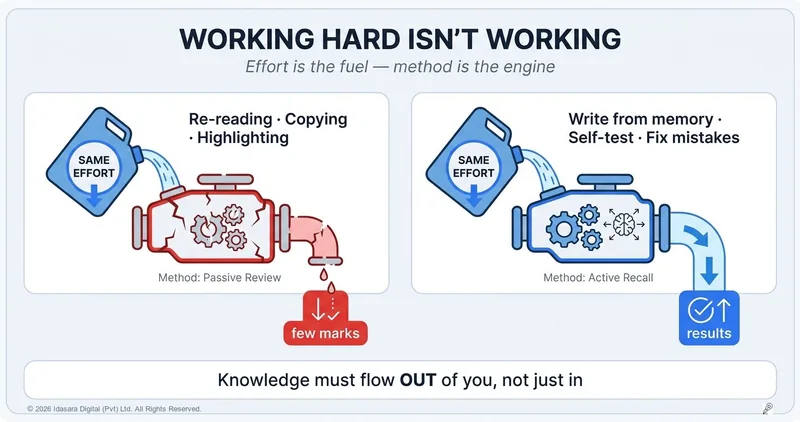
Thousands of students study late into the night and still watch their marks stand still — not because they lack effort or talent, but because common study methods train the wrong skill. This opening chapter of Learn to Learn explains why effort alone stalls, and what "working scientifically" means instead.
You know this student. You may be this student.
The lights are on past midnight. The textbook has been read — twice. The notes have been copied out neatly. Weekends have disappeared into tuition classes. Nobody could call this student lazy; the exhaustion on their face is earned nightly.
And the marks? The marks barely move.
So the student reaches the only conclusion the world has offered them: "I must work even harder." More hours. Less sleep. More of the same — followed by the same results, and a quieter, crueller conclusion forming underneath: "Maybe I'm just not clever enough."
This book begins here, with that student, because both of those conclusions are wrong — and the second one is poison. Let's take them apart.
Effort is the fuel, not the engine
Nobody achieves an A without work — let's establish that immediately, because this book will never sell you shortcuts. Effort is genuinely required. It is the fuel.
But fuel alone moves nothing. Fuel poured into a broken engine produces heat, noise, exhaustion — and no motion. And this is precisely the situation of the hard-working, stuck student: enormous fuel, poured nightly into methods that cannot convert it into marks.
Which methods? The familiar ones. Re-reading chapters until they feel known. Copying notes until the page looks full. Highlighting until the book glows. Watching lesson after lesson, feeling every one make sense. These techniques share two properties: they feel like studying, and they have been examined — repeatedly, at scale — by learning researchers, who keep reaching the same verdict: they rank among the least effective things a student can do with an evening. Not zero. But a terrible return on your hours.
Why do they fail? One sentence: they all involve knowledge flowing into you, while the exam only pays for knowledge flowing out of you — out through your pen, onto a blank page, from memory, under time. Reading in. Copying in. Watching in. Then exam day arrives and demands out — a direction you never once practised. The marks were never measuring your effort. They were measuring your training in that one direction.
There is even a scientific reason the trap stays hidden: material you've re-read feels mastered, because it looks familiar — while most of what flowed passively in drains away within days. The feeling of knowing and the ability to produce are two different things, and cheap methods give you the feeling without the ability. (That trap has a name, and the next chapter is devoted to it.)
What does "working scientifically" mean?
Now the good news — and it is genuinely good.
If the engine is the problem, then the engine can be replaced, and the same fuel — your effort, already proven, already abundant — starts producing motion. Students who make this switch often do less total work than before, and improve anyway. Not because they found a trick, but because their hours stopped leaking.
The scientific engine is not complicated. Its principles fit in a breath: make knowledge flow out of you, daily. Write from memory instead of re-reading. Test yourself instead of watching. Turn confusions into questions instead of carrying them. Get every attempt honestly checked, and study your mistakes instead of your comforts. Space the work across the syllabus instead of binging one subject.
Every one of those moves has decades of evidence behind it — retrieval, self-testing, and spaced practice sit at the very top of the effectiveness tables that re-reading and highlighting sit at the bottom of. And every one is learnable by any student. No talent is required at the door. That is the entire message of this book, and it is worth saying plainly:
The students you call "naturally bright" are, almost always, students running better methods — usually without knowing it. Method looks like talent from the outside. It always has.
What this book will do
Learn to Learn is that engine, delivered in small parts. Each chapter takes one piece — how to take a short note that teaches you, what to do when a paragraph makes no sense, how a timer beats willpower, how marks are actually awarded, how to climb from an S to a C to a B to an A — and hands it to you in a form you can use tonight, with a pen, paper, and your textbook. No chapter requires any app. No chapter requires talent. Every chapter requires your effort — the one resource you have already proven you have.
The chapters are short on purpose. Read one, use it the same evening, come back for the next. By the end, you won't just have better grades on the way — you'll own something that outlasts every exam: the knowledge of how you learn. That skill transfers to A/L, to university, to every career that will exist in your lifetime. School never quite gets around to teaching it. That's this book's job.
Do this tonight
Just one thing, and it's a diagnosis, not a technique.
Tonight, as you study — whatever you study — keep a scrap of paper beside you. Every few minutes, ask: right now, is knowledge flowing IN (reading, watching, copying), or OUT (writing from memory, answering, solving unaided)? Mark a tally for each.
Most students discover their evening is nearly all IN. Don't fix it yet — the next chapters will show you how. Tonight, just see it. The moment you see where the hours leak is the moment "I'm not clever enough" dies, and its replacement is the truest sentence in this book: my effort was never the problem.
At a glance
- Hard-working students stall because common methods — re-reading, copying, highlighting, passive watching — rank among the least effective known, despite feeling productive.
- The one-line diagnosis: those methods train knowledge flowing in, while exams only pay for knowledge flowing out — produced from memory, on paper, under time.
- Passive familiarity fades within days and imitates mastery while it lasts.
- "Working scientifically" = daily outflow: write from memory, self-test, question, get checked, space the work. All learnable; no talent gate.
- "Naturally bright" students are usually students with better methods. Method looks like talent from the outside.
One step further with Idasara Academy
Everything in this book can be run with paper and discipline alone. What Idasara Academy adds is the engine's automation — and its front door is free: sign up tonight and Today's Plan hands you tomorrow's short list of small tasks, already aimed at where your marks swing, with micro-quizzes that pull knowledge out of you after every topic. The paid tiers add the deeper engine — honest marking of your handwriting, and an AI coach that works on what the free Mistake Bank — your running record of lost marks — collects (try the coach free: 5 messages a day). The method is free either way; the app just makes it run daily without willpower.
Start Free — Create Your Account →
FAQ
Are you saying I should study less? Not less effort — less waste. Keep your work ethic; change what the hours do. Many students do end up studying fewer total hours with better results, but that's the by-product, never the goal.
Isn't this just "study smart, not hard"? That slogan usually sells shortcuts. This is the opposite: the scientific methods feel harder in the moment — writing from memory is more effortful than re-reading. Smart here means harder-per-minute, fewer minutes wasted.
I've believed I'm "not a studies person" for years. Can this really change? That belief was built on evidence — years of effort not paying. But the evidence was measuring your methods, not your mind. Change the engine, and watch what the same effort produces before you re-judge yourself.
Where do I start? The next chapter — the illusion of competence — explains the trap underneath everything. Then the reading and short-notes chapters give you the first tools. One chapter, one evening, one habit at a time.
Further reading
The full scientific framing — working hard versus working scientifically, and the complete learning architecture built on it — is in the Idasara Method: Part 1 — The Human Foundation & Active Recall.
Sources
- Dunlosky, J. et al. (2013). Improving Students' Learning With Effective Learning Techniques — overview at the Association for Psychological Science
- Murre, J. & Dros, J. (2015). Replication and Analysis of Ebbinghaus' Forgetting Curve, PLOS ONE
- UCLA Bjork Learning and Forgetting Lab — research overview on desirable difficulties
- The Idasara Method: Part 1 — The Human Foundation & Active Recall