AI Is a Tutor, Not an Answer Machine — and the Difference Decides Your Grade
The short answer: Pasting the question and copying the answer is cheating in the sense that matters — it cheats you, and the exam's three unassisted hours audit it. Attempting first, asking the AI for the why or the where, and finishing the problem yourself is not cheating; it is studying, with a better-available tutor.
A chapter of the free book Learn to Learn
Published 2026-08-31 · updated 2026-08-31
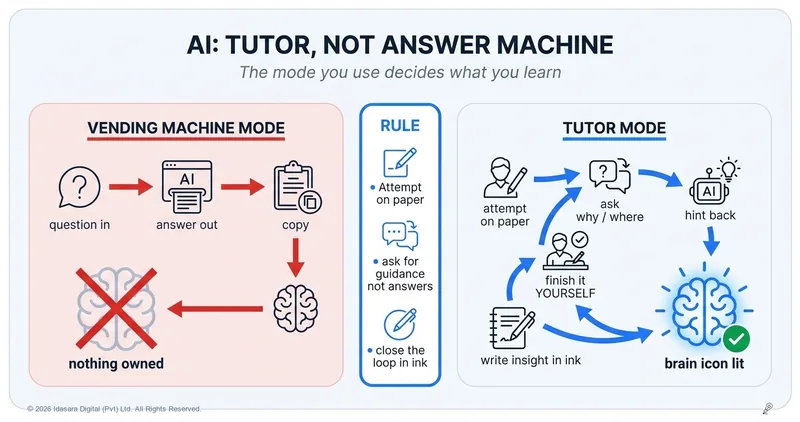
The same AI that can quietly do your homework can also be the best tutor you've ever had — the outcome depends entirely on which of two modes you use it in. This chapter of Learn to Learn draws the line between them, answers the cheating question honestly, and gives you the three rules that keep AI on the teaching side of the line.
Every student now has the same new companion, and every student is quietly deciding — mostly without noticing — which of two relationships to have with it.
The first relationship: it's 9 p.m., the homework is due, you paste the question into an AI, and a perfect answer appears. You copy it down. Homework complete. Nothing learned. Repeat for a year.
The second relationship: it's 9 p.m., you're stuck on the same question, and you ask the AI "here's my working — I get lost at the third step; why does the substitution fail here?" Two minutes later you understand something you didn't, you finish the problem yourself, and you write the insight into your notes.
Same technology, same evening — two opposite results, and the difference compounds every night it repeats. Let's name it precisely.
Vending machine or tutor
Mode one treats AI as a vending machine: question in, answer out, transaction complete. It feels like help. It is actually outsourcing — the cognitive work that would have become your knowledge was done elsewhere, and what you received was the receipt. You've met this pattern throughout the book: knowledge flowed impressively, and none of it flowed through you. The exam hall — where the machine doesn't enter — eventually audits the difference.
Mode two treats AI as a tutor: you bring your work, your located confusion, your precise question, and the AI supplies the missing link — a reason, an error's location, a worked pattern — which you then use to complete the thinking yourself. Here the cognitive work stays yours; the AI just removed the roadblock that would once have cost you a lost evening or a wait until Friday's class.
Notice something important: the great tutors have always worked in mode two. A good teacher, asked for an answer, responds with a guiding question. This is the old Socratic insight — understanding must be built by the learner, not delivered to them — and it's why the best use of the newest technology in education turns out to be the oldest teaching method in history, running at midnight, in your language. Even UNESCO's global guidance points the same way: AI in education should support human thinking, never replace it.
So — is it cheating?
The question every student, parent, and teacher is asking deserves a straight answer, and the two modes give us one.
Mode one is cheating in the only sense that finally matters: it cheats you. Whether or not a school's rules catch a copy-pasted answer, the exam certainly will — a national paper is three unassisted hours, and every answer you outsourced during the year is a skill you don't own when it's demanded back. The person defrauded was never the teacher.
Mode two is not cheating; it's what studying has always been — with a better-available tutor. Asking why, showing your working, requesting a hint rather than a solution, checking your understanding: no honest definition of learning excludes these because the answerer is a machine. The student in mode two is doing more thinking than the student with no help at all, not less — because their stuck evenings become resolved evenings.
The line, one sentence: if the AI's output replaces your thinking, it's mode one; if it feeds your thinking, it's mode two.
How do you stay in tutor mode at 9 p.m.?
The line is clear; staying on the right side of it at 9 p.m. under deadline pressure needs rules, not intentions.
Rule 1 — Attempt first, always. Never bring a question to AI that your own pen hasn't attempted on paper. The attempt does two things: it makes your question surgical (you now know where you're stuck, per the previous chapter), and it guarantees the AI is repairing your thinking rather than replacing it. Blocked at step 3 is a tutoring situation; blank page is an outsourcing one.
Rule 2 — Ask for the why or the where, not the answer. Phrase requests so the useful response is guidance: "Why does this rule apply here?" — "Here's my working; where did it diverge?" — "Give me a hint, not the solution." Then finish the problem yourself, by hand. If an answer arrives anyway, the discipline is not to transcribe it: read it, close it, and reproduce the reasoning on your own page.
Rule 3 — Close the loop in ink. An explanation read on a screen is recognition — you know by now how little that's worth. When the AI unlocks something, pick up your pen and write the insight into your notes beside the original question, in your own words. Thirty seconds. That's the step that converts a good explanation into your knowledge — and it's the step the vending-machine student never performs.
Do this tonight
- Recall your last three AI interactions honestly. Mode one or mode two? No guilt either way — just an audit; most students discover a mix.
- Tonight, run one deliberate mode-two session: attempt a hard problem on paper until genuinely stuck, then ask the AI for the where or the why — not the answer — and finish the problem yourself.
- Close the loop: the insight goes into your notebook, handwritten, beside the question that needed it.
At a glance
- Two modes with one technology: vending machine (answer replaces your thinking) vs tutor (guidance feeds your thinking).
- The cheating question, answered: mode one cheats you — the exam hall audits it in three unassisted hours. Mode two is studying, with a better-available tutor.
- Rule 1: attempt first — no AI before your pen has tried.
- Rule 2: ask for the why/where/hint, never the answer; finish the problem yourself.
- Rule 3: close the loop in ink — the insight goes into your notebook, handwritten, in your own words.
One step further with Idasara Academy
Mode two works with any AI if your discipline holds — but it works better with a tutor built for it. Idasara Academy's AI Study Coach (Ask AI) — free to try with 5 messages a day; the paid tiers remove the cap — is designed around the tutoring relationship: grounded in the national curriculum so explanations match your syllabus and marking scheme, and built to guide your working step-by-step rather than hand over finished answers. Want to feel the difference free first? The Prompt Packs run tutor-mode interactions for your exact topics. Bring your attempt and your located confusion — and let the tool do what the best tutors do: remove the roadblock, leave the thinking to you.
Start Free — Create Your Account →
FAQ
My whole class copies AI answers for homework. Am I falling behind by not doing it? You're watching the illusion of competence scale up to a whole classroom. Homework was never the product — the ability it builds is. Come exam season, the gap between the copiers and the mode-two students becomes public — stay on the side of it you'd want printed.
Sometimes I genuinely need to see a full worked solution. Is that mode one? Studying a worked solution is a legitimate, old technique — the mode question is what happens next. Read it, close it, and reproduce it from memory on paper; then attempt a similar problem cold. Solution-as-teacher is mode two. Solution-as-submission is mode one.
How do I know the AI's explanation is even correct? A sharp question — vague or generic AIs do err, especially against a specific national syllabus (the next chapters take this on directly). Two protections: use tools grounded in your curriculum, and keep your textbook in the loop — an explanation that contradicts the official book loses, every time.
As a parent, how do I tell which mode my child is in? (for parents) Ask them to explain, with the screen off, something AI helped them with this week. Mode two explains it — the understanding lives in them. Mode one can't — it lived in the chat window. The check takes two minutes and teaches the child what you value.
Further reading
Targeted AI clarification, Socratic guidance on exercises, and the closed-loop annotation protocol are moves 4–6 of the learning loop: Part 1 — The Human Foundation & Active Recall and Part 2 — The Plan.
Sources
- UNESCO — Artificial intelligence in education: a human-centred approach (the human-centred approach to AI in education)
- The Learning Scientists: Learn How to Study Using… Retrieval Practice (why explanations must be reproduced, not just read)
- The Idasara Method: Part 1 — The Human Foundation & Active Recall