Why You Must Take Your Own Short Notes (Borrowed Notes Won't Save You)
The short answer: Yes — write your own. The value of a short note is created during the writing — choosing, compressing, retrieving in your own words — so borrowed notes carry the ink but not the learning; keep them only for checking yours afterwards.
A chapter of the free book Learn to Learn
Published 2026-08-31 · updated 2026-08-31
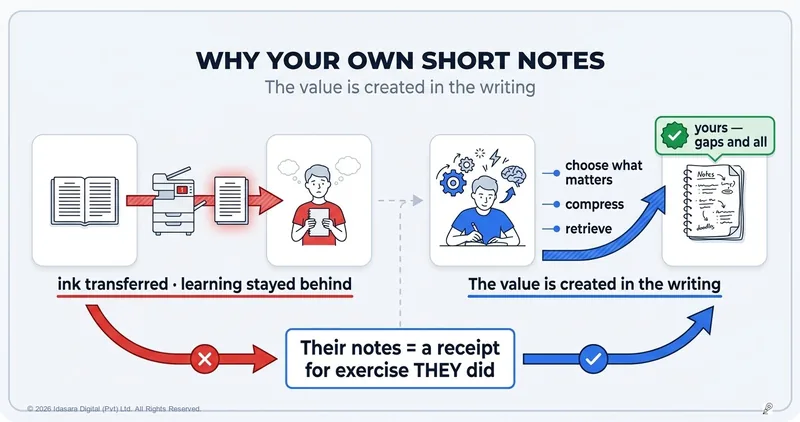
Notes written by someone else — a tuition teacher, a topper, a friend — can be read, but the learning they contain was already collected by the person who wrote them. This chapter of Learn to Learn explains why the value of a short note is created during the writing, and what borrowed notes are actually good for.
In every class there is one student whose short notes are famous. Beautiful handwriting, perfect structure, every topic in its place. Before the term test, those notes get photographed and passed around like treasure.
Here is the strange thing. Have you noticed who scores highest on that test?
Almost always: the student who wrote the notes. Rarely: the students who borrowed them. The same pages, the same content — completely different results.
Why? Because everyone is sharing the wrong thing. The pages were never the treasure.
Where did the learning actually happen?
Think about what the note-writer did on the night those famous notes were made.
They read the textbook section. They wrestled with it. They decided — actively, personally — what mattered and what could be dropped. They searched for their own words to say it shorter. They drew the diagram from memory and checked it. Every one of those small struggles forced knowledge through their mind and out onto the page.
That process — deciding, compressing, retrieving, expressing — is the learning. Research on note-taking shows exactly this: the benefit comes from the mental processing, the selecting and summarising in your own words, not from possessing the result. And research on memory adds the second half: what you retrieve and produce yourself is what stays retrievable later.
So when the notes are photocopied, what transfers? The ink. What doesn't transfer? Everything that mattered. In simple terms: borrowing notes is borrowing the receipt for exercise someone else did.
"But their notes are better than mine"
Of course they are. Theirs are neater, more complete, more confident. Yours — especially at first — will be messier, patchier, full of gaps.
And yours will still teach you more. This is the counterintuitive part, so let's say it plainly: a flawed note you produced beats a perfect note you consumed. The gaps in your note are not defects — they are discoveries. Each one marks a spot where your understanding ran out, found now, at your desk, instead of later, in the hall. A borrowed note can never give you that map, because it has no gaps: it shows the writer's understanding, and quietly hides the state of yours.
There is an exam-day reason too. In the hall you must generate answers in your own words, under time pressure, in your own handwriting. A year of writing your own notes is a year of daily rehearsal for exactly that act. A year of reading someone else's is a year of rehearsing… reading.
What are borrowed notes actually good for?
None of this makes other people's notes worthless. It makes them a checking tool instead of a learning tool.
Used at the right moment — after you have written your own note from memory — a good borrowed note becomes a mirror: Did they include a formula you forgot? A condition you dropped? A cleaner structure than yours? Compare, correct your own note in red, and hand theirs back. Their strength has now been added to yours, without replacing your effort.
Used at the wrong moment — instead of writing your own — the same pages quietly replace your training with their ink.
The order is everything. Produce first. Compare second.
Do this tonight
- Take the topic where you most depend on someone else's notes.
- Don't open their notes. Open the textbook, read the section, close it.
- Write your own short note from memory — messy is fine, gaps are welcome.
- Now open the borrowed notes and compare. Fix your note in red ink.
- Notice how differently their notes read now — no longer a script to memorise, but a checklist you are auditing. That shift is what ownership feels like.
Do this for one topic per evening, and by the end of term you will own a set of notes with a property no famous notebook can offer: every line in them passed through you.
At a glance
- The value of a short note is created during the writing — deciding, compressing, and retrieving in your own words.
- Photocopying notes transfers the ink, not the learning: it's the receipt for someone else's exercise.
- Your imperfect note beats their perfect one, because its gaps are a map of your understanding.
- Borrowed notes have one good use: a mirror for checking, after you've produced your own.
- The order is everything: produce first, compare second.
One step further with Idasara Academy
The compare step needs a trustworthy mirror. Idasara Academy's short notes — free to start — and Lesson Notes packs (a one-time purchase per subject) give you a curriculum-checked summary of every topic in your grade to hold your handwritten note against, so the corrections you make in red come from the syllabus standard itself, not from whoever happened to sit beside you. Tonight's version: write your note, open the matching topic, compare, correct.
Start Free — Create Your Account →
FAQ
My tuition class gives printed short notes. Should I ignore them? Keep them — as the mirror. Write your own note from the textbook first, then use the class notes to audit yours. If you only ever read the printed notes, the class has done the learning and you have done the reading.
I'm slow at making notes. Isn't copying a good one faster? Faster at filling pages, yes. But the goal was never filled pages — it's the ability to produce answers in the hall. There are no shortcuts to that ability that skip the producing.
What should my own short note actually look like? Two or three dense handwritten pages per chapter, written from memory after reading — the full method is in this book's chapter How to Take a Good Short Note.
Is it bad to share my notes with friends? Share generously — teaching and comparing helps you both. Just tell them the truth you now know: your pages will help them check their learning, not do it for them.
Further reading
The full write-up of handwritten notes, forced synthesis, and the self-comparison protocol is in the Idasara Method: Part 1 — The Human Foundation & Active Recall.
Sources
- Mueller, P. & Oppenheimer, D. (2014). The Pen Is Mightier Than the Keyboard — summarised by the Association for Psychological Science: Take Notes by Hand for Better Long-Term Comprehension
- The Learning Scientists: Learn How to Study Using… Retrieval Practice
- Dunlosky, J. et al. (2013). Improving Students' Learning With Effective Learning Techniques — overview at the Association for Psychological Science
- The Idasara Method: Part 1 — The Human Foundation & Active Recall