How to Study O/L English: The Subject You Learn by Producing
The short answer: You pass O/L English by producing it daily: ten handwritten lines a day, ten minutes of real reading, your own recurring errors found and fixed, and the paper's fixed formats — comprehension, letters, essays — practised one by one with past papers. English is a skill you perform, so small daily production beats years of grammar tables.
A chapter of the free book Learn to Learn
Published 2026-08-31 · updated 2026-08-31
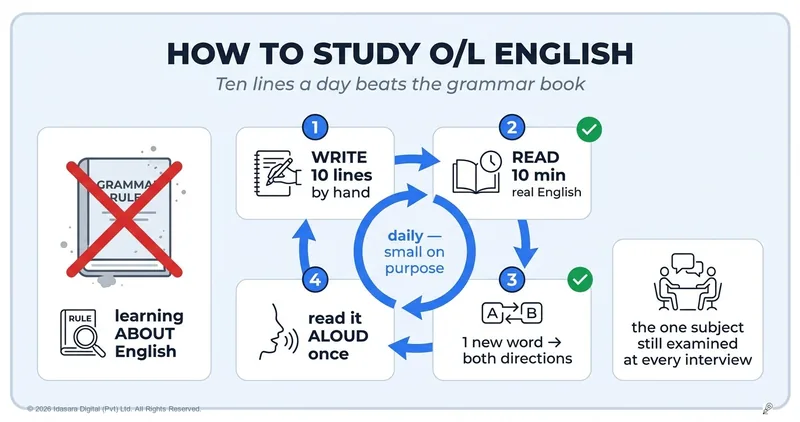
English is the O/L subject most studied backwards — years of grammar rules memorised, and still the essay box stays empty. This chapter of Learn to Learn is the English playbook: why the paper is a production exam, the daily ten-line habit that beats any grammar book, and why this one subject quietly follows you into every job interview of your life.
Here is the strange thing about how English is usually studied. A student spends years learning about English — tense tables, grammar rules, lists of words — the way you'd study History. Then the paper arrives and asks them to do English: read a passage and answer, write a letter, produce an essay. And all those years of rules stand there, useless — like someone who studied swimming from a book, standing at the edge of the pool.
You've met this trap in every playbook so far, and English is its purest case: a language is a skill, not a content subject. The paper tests comprehension you perform, writing you produce, language you use — and skills are built the one way this book keeps finding: daily production, honestly checked. (If your fear is studying other subjects in English, that's the second-language chapter's job. This one is about English as the examined subject itself.)
One more reason to take it seriously, said plainly because parents ask: of all nine subjects, English is the one that keeps being examined after school ends — in every interview, every workplace, every opportunity the AI-age chapter described. The O/L English paper is the cheapest English course your child will ever get. Use it.
The playbook: produce daily, check honestly
Rule 1 — Ten lines a day, in English, no excuses. The core habit, and it's humble: every day, write ten lines of English by hand. A diary entry, a description of today, a letter never sent, an opinion on anything. Not corrected yet, not beautiful — written. Within weeks, sentences start coming to you whole instead of being built word by word. Skills grow on daily practice, and ten lines is a practice anyone can keep.
Rule 2 — Read something real, daily, small. Ten minutes a day of any real English — the textbook passages, a news story, a simple storybook — builds the words and sentence patterns your own writing will reuse. Read actively: one new word per day goes into your fact schedule, both directions (English↔your language), the way the memorising chapter taught.
Rule 3 — Learn grammar through your own errors, not through tables. Grammar rules studied in the abstract evaporate; grammar corrected in your own sentences sticks. So the loop: produce (Rule 1) → get checked (teacher, capable friend, or AI in tutor mode) → collect your recurring errors in the mistake bank ("I drop 'the'", "past tense slips in long sentences") → drill exactly those. Three personal error-species fixed beats thirty rules memorised — and every student's top three are different, which is why the tables never worked.
Rule 4 — Practise the paper's formats, one by one. The O/L paper asks for specific things — comprehension answers, guided writing, letters, essays, grammar questions. Each has a fixed shape, and shapes are learned by doing each one repeatedly with past papers: comprehension answered from the passage's own lines (find it in the text, don't imagine it); letters with their fixed layout — address, date, greeting, closing; essays planned first (three points, then write — the writing chapters' habit). This is where "average English" students collect easy marks: the formats never change, and a format you've practised ten times survives exam nerves.
Rule 5 — Speak what you write. Reading your ten lines aloud daily costs one minute and builds the ear that catches errors your eye misses — and quietly builds the spoken confidence the interview years will demand. No audience needed. The wall is patient.
What does a good English week look like?
- Daily: ten written lines + ten reading minutes + one vocabulary pair on the schedule + one minute reading aloud.
- Weekly: one full format rehearsal (rotate: comprehension set, letter, essay) under time, checked honestly; errors banked by species.
- In season: past papers on the ladder — the staged practice climb — with the format rotation ensuring no paper section is met for the first time in the hall.
That's ~15 minutes daily plus one weekly session — deliberately small, because the enemy of English study isn't difficulty, it's abandonment. English rewards the consistent far beyond the intense.
Do this tonight
- Write tonight's first ten lines — about today, in English, by hand. Ugly is expected and irrelevant.
- Read them aloud once. Circle anything that sounded wrong — your ear caught your first error-species.
- Put one new word from today's reading into your fact deck, both directions. That's the whole system, day one, done.
At a glance
- English is a doing exam: you read, you write, you produce — years of learning about grammar can't fill the essay box.
- The core habit: ten handwritten lines daily + ten reading minutes + one vocabulary pair — small on purpose; daily beats heroic.
- Grammar sticks when corrected in your own sentences: write → get checked → find your top three repeated errors → fix exactly those.
- The paper's formats (comprehension, letters, essays, guided writing) never change — practise each one repeatedly; a practised format survives nerves.
- This is the one subject still being examined in every interview a decade from now.
One step further with Idasara Academy
The playbook's bottleneck is honest checking at daily volume, and that's what the system carries: micro-quizzes — free to start — drill vocabulary and grammar-in-context with slips banked automatically, the writing practice sessions (paid tiers) give your ten-lines habit real prompts and structure, and your handwritten letters and essays go to Exam Paper Marking for format-and-language feedback the way the paper will judge them. Your pen does the ten lines; the system does the red ink.
Start Free — Create Your Account →
FAQ
My English is too weak even to write ten lines. Where do I start? Start at five lines, and let them be simple: "Today I woke at six. I went to school." Simple correct sentences are the real foundation — complexity grows from volume, not from ambition. (And read the slow-reading chapter in Hard Mode — the book's catch-up chapters — if reading itself is the wall — there's an on-ramp, no shame attached.)
Should I memorise essays, like many students do? No — one unexpected topic and the memorised essay is useless, and examiners can tell a memorised essay from a written one. Memorise formats and your own best phrases instead: the plan-three-points habit plus your daily ten lines can handle any topic the paper invents.
Is it okay to think in Sinhala/Tamil and translate as I write? It's the natural starting state, and the daily production is exactly what dissolves it — translation shrinks as sentence-shapes become automatic. The second-language chapter's rule applies here in miniature: never plan to translate in the exam; train until the pen runs in English.
We speak no English at home and there's no one to practise with. (rural readers especially) The playbook was built for exactly you: the textbook, ten daily lines, reading aloud to the wall, and the checking tools need no English-speaking household. Many strong English results come from homes where the student is the family's first English speaker — the daily habit is the whole secret.
Further reading
Production-first training and the writing disciplines behind it: Part 3 — The Grade Progression Ladder & Paper Marking — and the sibling chapter for studying other subjects in English: Studying in a Second Language.
Sources
- Rayner, K. et al. (2016) — reading fluency through exposure, APS
- The Learning Scientists: Retrieval Practice · Spaced Practice (vocabulary scheduling)
- UNESCO — Languages in education
- The Idasara Method: Part 3 — The Grade Progression Ladder & Paper Marking