You Lose Most of Today's Studying by Tomorrow — Unless You Do This
The short answer: You beat the forgetting curve by retrieving each topic from memory — notes closed, blank page — the next day, about a week later, and about a month later, ten minutes each time. Retrieval is the only signal that tells your brain a memory is worth keeping; re-reading doesn't send it.
A chapter of the free book Learn to Learn
Published 2026-08-31 · updated 2026-08-31
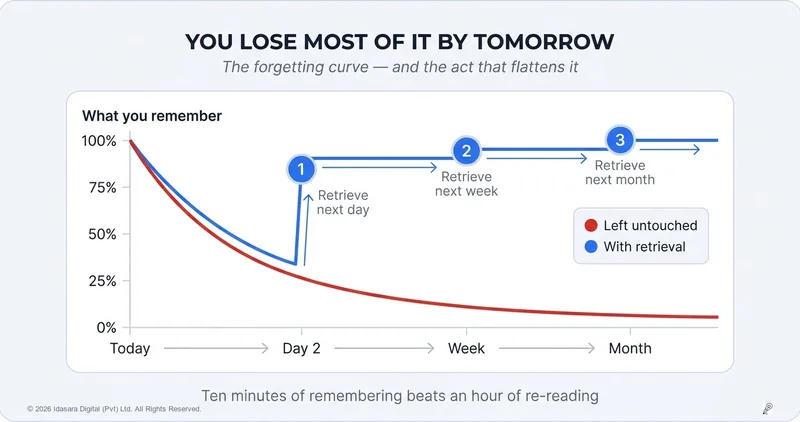
Memory research has measured it for over a century: the majority of newly learned material drains away within a day or two if it is left untouched. This chapter of Learn to Learn explains the forgetting curve, why it isn't your fault, and the small, scheduled act of remembering that flattens it.
Here is an experiment you have already run, many times, without meaning to.
Monday evening: you study a topic properly. It goes well. By the end, the ideas are clear, the steps make sense — the topic feels installed.
Friday: the teacher asks a question from Monday's topic. And you reach for it… and grasp fog. Four days. That's all it took. Where did it go?
Most students answer that question by blaming themselves: bad memory, careless, should have concentrated harder. The real answer is more interesting — and far more useful.
The leak was measured in 1885
In the 1880s, a German researcher named Hermann Ebbinghaus performed one of the most patient experiments in the history of psychology — memorising lists of meaningless syllables, then testing himself at intervals from twenty minutes to a month, charting exactly how memory drains.
The result is now called the forgetting curve, and its shape is brutal: the steepest loss happens immediately. Within a day or two, without review, the majority of newly learned material — commonly more than half, often around 70% — has slipped away. In 2015, researchers repeated the whole gruelling experiment with modern methods and found essentially the same curve. A hundred and thirty years apart, one conclusion: rapid forgetting is not a defect of your brain. It is a specification of every brain.
And it makes sense, if you think about what your brain is for. It meets thousands of impressions a day; keeping everything would drown it. So it runs a ruthless filter with one simple rule: whatever is not used again soon was probably not important. Your Monday topic wasn't stolen. It was filed as unimportant — because nothing after Monday told your brain otherwise.
Which points directly at the cure.
What signal stops the leak?
How do you tell your brain a memory matters? Not by wishing. Not even by enjoying the lesson. Only one signal counts: retrieving it.
Every time you pull a memory back out — recall the formula without looking, rebuild the diagram from nothing, answer a question on Wednesday about Monday's topic — you overrule the filter: this one is used; keep it. The curve restarts, but flatter. Retrieve again a few days later, and it flattens further. A handful of well-timed retrievals, and the material stops draining — it has been promoted to knowledge your brain treats as permanent equipment.
Two details make this practical, and both are counterintuitive:
The retrieval must be effortful to count. Re-reading Monday's notes on Wednesday feels like review, but it's the page remembering, not you. Close the notes and produce the material — that strain you feel is precisely the signal being sent. Memory researchers call these effortful conditions "desirable difficulties" for a reason.
A little forgetting first is good. It feels wrong to let material fade slightly before reviewing — but retrieving something that has begun to slip strengthens it far more than repeating something still fresh. This is why spacing your practice across days beats repeating a topic five times tonight: tonight's four extra repetitions are cheap, because nothing has faded yet. The same repetitions, spread across the week, each do real work.
In simple terms: cramming fills a leaking bucket faster; spacing seals the bucket.
What schedule can you actually keep?
You don't need software or a complicated system — you need roughly three touches after every first study:
- Touch 1 — next day (ten minutes): before new studying begins, blank page: write what you remember of yesterday's topic. Check, patch the gaps, done. This single habit catches the curve at its steepest.
- Touch 2 — about a week later (ten minutes): same act — retrieve, check, patch. Answering the end-of-chapter questions cold works beautifully here.
- Touch 3 — about a month later: one more retrieval, ideally as exam-style questions. After this, the topic typically needs only rare maintenance.
That is perhaps thirty minutes, spread over a month, per topic — and it changes exam season completely. The crammer meets the syllabus in exam month as a stranger, re-learning everything at maximum panic. The spacer meets it as an old friend, revising material that never fully left. Same total hours. Utterly different exam seasons.
(You may notice this is the same principle behind the weekly honesty test from the illusion-of-competence chapter, and the "no subject sleeps" rule from the time-management chapter. It is. The forgetting curve is the reason both of those rules exist.)
Do this tonight
- Before starting anything new, take a blank page and spend ten minutes retrieving yesterday's topic — from memory, notes closed.
- Check and patch in red.
- At the top of tomorrow's plan, write the first line of your new study ritual: "First ten minutes: yesterday, from memory."
One habit. Ten minutes. It rescues more marks per minute than any other act in this book — because it stops paying the 70% tax on everything else you do.
At a glance
- The forgetting curve (measured in 1885, replicated in 2015): most untouched new material drains within a day or two. It's a property of all brains, not a personal flaw.
- The brain keeps what gets retrieved — used memories are marked important; unused ones are filed away.
- Retrieval must be effortful: notes closed, produced from memory. Re-reading doesn't send the signal.
- Slight forgetting before review is good — spaced retrieval strengthens more than immediate repetition.
- The working schedule: retrieve next day → next week → next month, ten minutes each.
One step further with Idasara Academy
The hard part of spacing isn't understanding it — it's remembering to remember, across every topic of every subject, on the right days. That scheduling is exactly what Idasara Academy automates: flash cards built for spaced recall (on the paid tiers) bring facts back at the right intervals, revision questions return whole topics as retrieval practice, and topics you struggle with return sooner. The forgetting curve gets managed for you, so your effort goes into the remembering itself.
Start Free — Create Your Account →
FAQ
Is my memory just worse than other students'? Almost certainly not. The curve is universal — what differs between students is how many retrievals their habits happen to generate. The classmate who "never forgets" is being retrieved-from constantly: they self-test, they answer in class, they explain to friends.
Does cramming ever work? For tomorrow's small test — partially, at a miserable exchange rate, paid for with sleep (which is itself when memory consolidates). For a national exam covering two years of syllabus, the leak makes cramming mathematically hopeless: you cannot re-fill two years in three weeks.
I don't have time to revise old topics AND study new ones. The ten-minute retrieval isn't extra time — it's insurance on all the other hours. Ten minutes protecting yesterday's ninety is the best exchange rate on your schedule. Studying only new material is how students cover the syllabus once and own none of it.
Should I use flashcard apps for spacing? They implement the principle well for fact-heavy material. But they aren't required — a blank page, your syllabus list, and the next-day/next-week/next-month rhythm deliver the same effect for free.
Further reading
The forgetting curve and the cognitive-effort principle sit under the whole method — the full write-up is in the Idasara Method: Part 1 — The Human Foundation & Active Recall.
Sources
- Murre, J. & Dros, J. (2015). Replication and Analysis of Ebbinghaus' Forgetting Curve, PLOS ONE
- The Learning Scientists: Learn How to Study Using… Spaced Practice
- UCLA Bjork Learning and Forgetting Lab — research overview on spacing and desirable difficulties
- The Idasara Method: Part 1 — The Human Foundation & Active Recall