The Question Log: Turn "I Don't Get It" Into Your Sharpest Study Tool
The short answer: A question log is a margin column beside your notes where every confusion that survives a section is written down as one precise question — then answered, in your own words, and struck through. It works because a feeling ("I don't get it") cannot be answered, but a question about one exact sentence can, in minutes.
A chapter of the free book Learn to Learn
Published 2026-08-31 · updated 2026-08-31
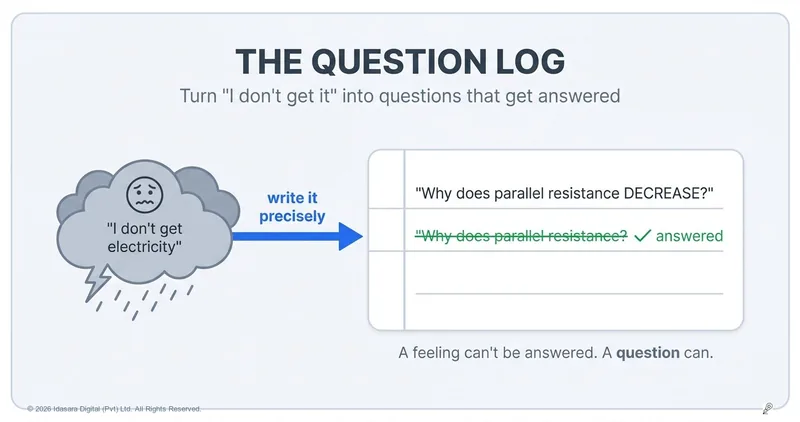
A question log is a running list, kept beside your notes, where every confusion is written down as a precise question instead of carried as a vague feeling. This chapter of Learn to Learn shows how one small margin column converts frustration into progress — and turns you into the student whose questions get answered.
Two students hit the same wall on the same evening: a paragraph about electric circuits that refuses to make sense.
The first student feels the familiar heaviness — "I don't get electricity" — carries it around for the rest of the evening, and brings it, still vague and still heavy, all the way to the exam.
The second student takes thirty seconds and writes one line in the margin of their notebook: "Why does adding a resistor in parallel DECREASE total resistance?" — and keeps reading.
Same wall, same confusion, same evening. But watch what those thirty seconds set in motion.
A feeling can't be answered. A question can.
"I don't get it" has a strange property: nobody on earth can help you with it. Not your teacher — what don't you get? Not your friend. Not the best tutor money could buy. It is a fog, and fog cannot be attacked.
But "why does the potential difference stay the same across parallel branches?" — that can be answered in four minutes by anyone competent. The entire art is in the conversion: from a feeling about a subject to a question about a sentence.
Something quietly powerful happens inside you at the moment of writing, too. An unwritten confusion sits in the mind as a threat — proof, whispers the doubt, that you're weak at this subject. A written question is different: it has edges, it has a place, it is one item on a list that shrinks. Students who keep a log consistently report the same shift — panic gives way to something almost like appetite. You are no longer a person who "doesn't get physics." You are a person with three open questions in physics, two of which will be closed by Friday.
Learning science recognises the deeper mechanism here: asking how and why questions about material — and then hunting the answers — is itself one of the well-supported study strategies, because forming the question forces you to locate the exact edge of your understanding. The log doesn't just store your confusions. Writing it sharpens them into learning.
How do you keep the log?
No new notebook needed — the log lives beside the notes you already write.
- Give it a margin. Rule off a column on the page of your short notes, or keep the facing page. Confusions get logged next to the material that caused them.
- Log at the end of the section — not mid-paragraph. As the reading chapter of this book explains, textbooks often clear their own fog a page later. Keep reading to the section's end; whatever confusion survives has earned a line in the log.
- Write it as a real question, aimed at something small. Not "confused about Chapter 4" — instead, name the exact sentence, step, or claim: "What are the three specific terms of the Colebrooke–Cameron reforms?", "Why does the inequality sign flip when we multiply both sides by minus one?" The test: could someone answer it without asking you what you mean?
- Close questions visibly. When a question gets answered — by a teacher, a friend, further reading — write the answer beside it, in your own words, and strike the line through. A log full of struck-through, answered questions is a scoreboard; a log that only grows is a warning sign.
How does the log change your classes?
Here is where the compounding begins. The student with a log walks into school or tuition armed.
Everyone else's "any questions?" moment is a blank-minded silence — confusion never written down cannot be recalled on demand. You, meanwhile, open your notebook and read out a precise, pre-formed question about yesterday's exact sticking point. Teachers answer these brilliantly, because precise questions are answerable — and, truthfully, because they reveal a student who has actually done the work.
The same log upgrades every other resource. Asking a friend? You'll get four minutes of targeted help instead of "let me explain the whole chapter." Searching online? A precise query finds precise answers. The log turns every helper around you — human or otherwise — from someone giving a general lecture into someone answering your exact question.
Do this tonight
- Rule a question column into tonight's study pages.
- Read one full section of your hardest current topic, to the end, no stopping.
- Convert whatever confusion survived into one or two written, precise questions.
- Tomorrow, spend those questions: one on a teacher, one on a friend or your own further reading. Strike through what you close.
- Notice, after a week, what the log has quietly proved: your confusions were never infinite. They were finite, listable, and killable.
At a glance
- A question log converts confusion-as-feeling into confusion-as-precise-question — and only questions can be answered.
- Log at the end of a section, not mid-paragraph; the next page often clears the fog for free.
- Write questions aimed at something small and specific; strike them through, with the answer, when they die.
- Forming how/why questions is itself a proven learning strategy — writing the log sharpens the understanding it records.
- The log makes every helper efficient: teachers, friends, searches, and AI all answer precise questions best.
One step further with Idasara Academy
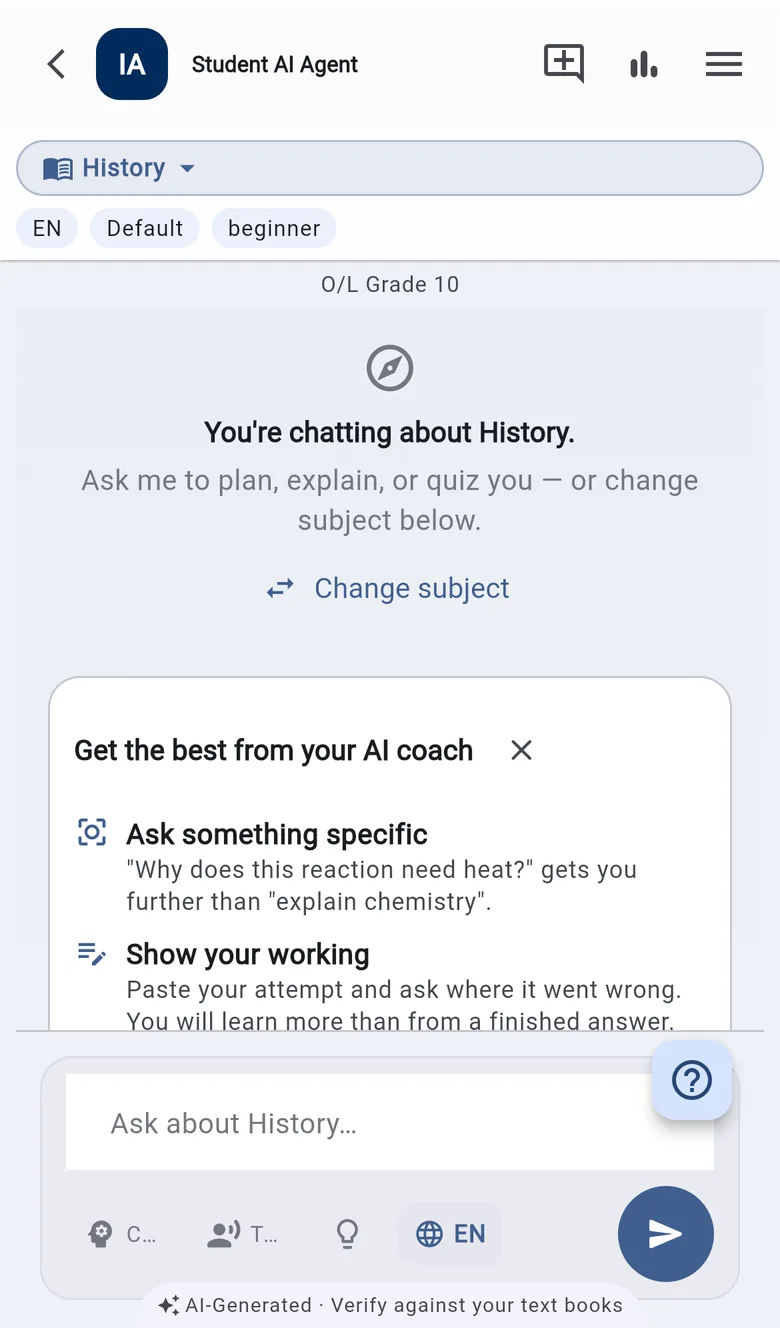
Some questions shouldn't wait for Friday's class. Idasara Academy's AI Study Coach (Ask AI) — free to try with 5 messages a day; the paid tiers remove the cap — takes the exact question from your log at 9 p.m., in your language, and answers it grounded in the national curriculum, so the explanation matches your syllabus and marking scheme. The free Prompt Packs are the on-ramp: pre-built question frames for your topic that teach you what a well-aimed ask looks like. Either way, write the key of the answer back beside your question, in your own words, and strike the line through.
Start Free — Create Your Account →
FAQ
Won't I look weak walking around with a list of things I don't understand? Look again at who keeps logs: researchers, doctors, engineers — precision about the edge of one's knowledge is the mark of strong minds. And the strongest students in any class are usually the ones asking the most precise questions.
What if I can't even form a question — I'm just totally lost? "Totally lost" almost always means a missing foundation from earlier. Ask the locating question instead: "Which earlier idea does this section assume that I might not have?" — then step back one topic. That single question converts even total fog into a next move.
How many questions should a section produce? Often zero — most sections clear themselves by the end, and that's success, not failure. A hard section might yield two or three. Twenty questions from one section means you're logging mid-paragraph; finish the section first.
Paper log or phone note? Paper, beside the notes that caused the question — context matters when you revisit, and the strike-through ritual is worth more than it looks. Your notebook is also welcome in places your phone shouldn't be: the study desk at 10 p.m.
Further reading
The question log is move 3 of the method's learning loop — between the reading discipline and targeted clarification. The full write-up is in the Idasara Method: Part 1 — The Human Foundation & Active Recall.
Sources
- The Learning Scientists: Learn How to Study Using… Elaboration (elaborative interrogation — how/why questions)
- UCLA Bjork Learning and Forgetting Lab — research overview on generation and effortful learning
- The Idasara Method: Part 1 — The Human Foundation & Active Recall