Subjects You Hate: Interest Is Built, Not Found
The short answer: Stop waiting to feel interested — interest follows competence, not the other way around. Find where the subject stopped making sense, repair that first, and give it twenty minutes a day of small visible wins; a few weeks of real progress cools most hate into workable neutrality.
A chapter of the free book Learn to Learn
Published 2026-08-31 · updated 2026-08-31
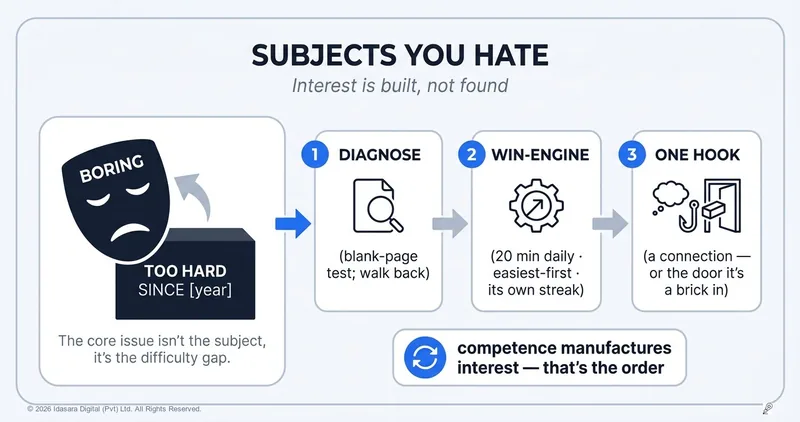
Every timetable contains one: the subject that makes the evening feel longer just by sitting there — boring, pointless, endured. Students wait to feel interested the way they wait to feel motivated, and the waiting costs a grade a year. This chapter of Learn to Learn closes the habits arc with its most counterintuitive finding: boredom is usually difficulty wearing a disguise, and interest is manufactured the same way everything else in this book is — by the machinery, in a specific order.
Ask a student why history bores them, and press past the first answer ("it just does"). Dig honestly and you almost always find the same layer underneath: somewhere back, the subject stopped making sense — a bad year, a missed foundation, a teacher who lost them — and the mind did what minds do with material it can't grip: it filed the discomfort as boredom. "Boring" is so often the polite name for "I can't hold onto this, and holding hurts" that the two are worth treating as one until proven otherwise.
Which flips the standard advice on its head. "Make it interesting first, then you'll study it" waits for a feeling that follows competence — the motivation chapter's error, re-worn. The working order is the reverse, and it's one of psychology's better-kept secrets: competence manufactures interest. Things become interesting when we get good enough at them to see their machinery — ask anyone about the hobby they once found dull. The hated subject isn't waiting for your interest. It's waiting for your first rung.
How do you fix a subject you hate?
Step 1 — Diagnose the disguise. Run the honest check: is this boredom, or buried difficulty? The instruments know: can you actually do the subject's current work cold (the blank-page test, applied)? Where did your marks in it turn — and does that date match a syllabus tower-floor (the debt chapter's walk-backwards)? Most "boring" subjects fail this exam: the boredom started where the understanding stopped. In that case the treatment is the comeback machinery, small-scale — placement, the ground floor, twenty daily minutes — and the interest question shelves itself: subjects under repair stop being boring remarkably fast, because progress is interesting even when content isn't yet.
Step 2 — Engineer early wins in it. Genuine-boredom cases (the diagnosis sometimes does come back clean) and repair cases alike respond to the same next move: make the subject the site of visible, frequent, small wins. Give it the launch chapter's treatment — short daily doses (twenty minutes; the hated subject never gets the marathon that deepens the hate), the easiest-first entry each session (competence's warm-up), quiz-scores and streak-ticks made visible for this subject specifically. The feeling tracks the graph: give the hated subject a few weeks of engineered wins and the hate has a way of cooling into neutrality — and neutrality is all the machinery ever needed.
Step 3 — Give it one honest hook. Interest also has a content lever, used after the machinery is running (not instead of it): every subject connects to something you already care about, and one deliberate hour of hook-hunting pays a year of easier sessions. The history-hater who cares about films finds the war-film's real events; the commerce-hater who wants a phone finds what the business chapter says about the companies that make them; the plant-bored bio student meets the chapter through the crops their family grows. And the careers-backwards walk supplies the blunt hook when charm fails: this subject is a named brick in a door I want — purpose is a good-enough substitute for love, and often grows into it.
And the honest floor, when all three steps have run: some subjects will end at professional neutrality — studied well, passed solidly, never loved. That's a success, not a failure: the portfolio chapters showed why the slip needs all nine grades, and adult life is full of competently-done necessary things. The exam doesn't award marks for enjoyment; it awards them for the machinery — which works, this book's whole length has shown, entirely without your affection.
Do this fortnight
- Run the diagnosis on your most-hated subject: blank-page its current work; walk back to where the marks turned. Name what you find — repair-case or genuine-boredom.
- Start its win-engine: twenty minutes daily, easiest-first, its own visible streak. Fortnight minimum before you re-judge the feeling.
- Spend one hour hook-hunting — or, failing charm, write the door this subject is a brick in, and tape it inside the book's cover.
At a glance
- "Boring" is usually difficulty in disguise — the mind files what it can't grip as dull. Diagnose before treating: blank-page test + walk back to where the marks turned.
- The order is reversed from the folk advice: competence manufactures interest — not the other way around. Progress is interesting even when content isn't yet.
- The treatment: repair the buried floor if found → engineer small visible wins (short daily doses, easiest-first, its own streak) → add one honest hook (a connection, or the door it's a brick in).
- The hated subject never gets marathons — they deepen the hate. Twenty minutes, daily, wins showing.
- The honest floor: professional neutrality is a success — the exam pays machinery, not affection.
One step further with Idasara Academy
The win-engine is the free tier working exactly as designed: micro-quizzes supply the hated subject's small frequent wins (easiest-first ladders included), the per-subject streak and progress view makes its graph visible on its own — separate from the subjects you love — and Today's Plan doses it daily so the twenty minutes happen without the nightly negotiation with your own reluctance. The feeling follows the graph; the graph follows the plan.
Start Free — Create Your Account →
FAQ
I genuinely understand the subject fine — it's just deadly dull. Now what? Then you're the rarer clean case: skip to steps 2 and 3 — the win-engine still works on clean boredom (visible progress is its own pleasure), and the hook-hunt matters more for you. Also check one sneaky variant: subjects can be too easy to be interesting — in which case the stretch material (harder problems, the prompt-pack extensions) is the cure, not the lighter dose.
My hatred is really about the teacher, not the subject. Common, and worth separating out loud: the subject didn't choose its messenger. The self-study machinery (textbook-first, the loop — learn, recall, check, daily — outside explanations) can carry a subject past a bad teacher-year — and the flip chapter's prepared-student approach sometimes even repairs the classroom relationship, since prepared students meet different teaching. Don't let one adult's classroom cost you a grade you'll carry for life.
Should I just drop/de-prioritise the subject I hate? Where it's genuinely optional and the doors-check clears it — the elective chapters' machinery decides, calmly. But run the diagnosis first: students regularly drop repair-cases that six weeks of machinery would have turned, and the dropped subject's real lesson — that difficulty can hide behind dislike — follows them to the next subject they can't drop.
As a parent, how do I handle "I hate maths" at the dinner table? (for parents) Hear it as data, not defiance: "hate" usually marks the spot where understanding stopped (this chapter's whole diagnosis). The response that helps: curiosity about where it stopped ("when did it start feeling like this?"), then the machinery — never the lecture about importance, which the child can recite already. The maths-from-zero chapter was written for exactly this dinner.
Further reading
The machinery this chapter aims: The First 30 Days (the win-engine) · Maths From Zero (the deepest repair-case) · Motivation That Survives Monday (why feelings follow action). The doors, when deciding: Choosing Your O/L Electives.
Sources
- UCLA Bjork Lab — research overview (difficulty, effort and engagement)
- Dunlosky, J. et al. (2013) — overview at APS (machinery works without affection)
- The Idasara Method: Part 4 — Time Management & Flipped Learning (never abandon a subject; the dosing rules)