Find Your Mentor: One Adult Changes a Study Year
The short answer: Look at the adults already around you — teachers first, then the quiet capable relatives and your school's past pupils — and make one small, bounded ask: fifteen minutes, once a month, to show your progress chart and ask two or three questions. Almost no adult declines an ask that small, and the relationship grows from the kept promise.
A chapter of the free book Learn to Learn
Published 2026-08-31 · updated 2026-08-31
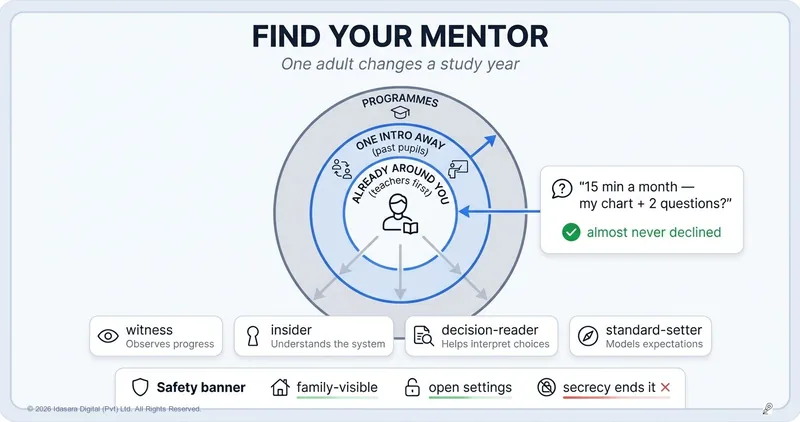
Threaded through this whole book, one figure keeps appearing at the edges — the witness for the self-study year, the insider for the career walk, the outside adult who says what a family can't hear from its own child. This chapter of Learn to Learn gives that figure their name and their finding-method: what a mentor actually is (smaller than the movies claim), who around you already qualifies, and the ask that gets a yes — because the students who "get lucky" with mentors are almost always the students who asked.
Notice something about the students who seem carried by fortune: behind most of them stands an adult who isn't a parent — the teacher who took an interest, the engineer uncle who explains things, the past pupil who checks in. The culture calls this luck. Look closer and it's rarely luck at all: mentors mostly attach to students who made themselves attachable — who asked precise questions, showed up with evidence, reported back. The mentor economy runs on invitation, and invitations can be learned.
First, shrink the word to its working size. A mentor is not a guru, a sponsor, or a second parent. For a student, a mentor is one consenting adult who knows something you need and agrees to a small, regular connection — fifteen minutes a fortnight, a message thread, a monthly look at your instruments. That's the whole machine. Its smallness is why it's findable — and its regularity is why it works.
What does a mentor actually do?
The roles this book kept assigning, now unified in one person (or two — mentors can be single-purpose):
- The witness (the self-study and launch chapters' missing piece): someone outside the household who sees the tracker — your progress chart — monthly — pacing survives on visibility to someone, and a mentor's steady "show me this month's chart" has kept more comebacks alive than any surge of willpower.
- The insider (the career-walk's telephone call, made renewable): the adult inside a field you're curious about, answering the ordinary-Tuesday questions as they evolve.
- The door-opener at decision seasons: streams, combinations, the five doors — an experienced outsider reads your evidence without the family's fears attached, and (the delicate one) sometimes says to a family what a child can't — the working-and-caring chapter promised this figure; here's where they come from.
- The standard-setter: simply knowing a competent adult expects your monthly chart raises the chart. Accountability to someone chosen is a different chemical than accountability to someone assigned.
Where do you find a mentor, and how do you ask?
Circle one — already around you: teachers (the single richest source — a teacher asked outside class-time for a small regular thing is startlingly often honoured by it), the extended family's quiet competents (not the loud advice-givers; the aunt who actually runs something), religious and community figures, employers of the working teen. Circle two — one introduction away: your school's past pupils (teachers hold this network; "is there a past student in engineering I could ask three questions?" is a normal request), parents' colleagues, the village's professionals. Circle three — structured programmes where they exist, including digital mentorship with consent and safety rails (of which more below).
The ask is where students fail, by asking for too much ("will you be my mentor?" — heavy, vague, easy to decline) instead of too little. The working ask is small, specific, and bounded — the question-craft chapters, aimed at a person: "I'm preparing for O/L using a system — could I show you my progress chart once a month and ask you two or three questions? Fifteen minutes, I'll come to you." Almost no adult declines that — it's flattering, bounded, and evidence-backed — and the relationship that grows from a kept small promise grows itself. Then the maintenance, which is just integrity: come with the chart and written questions (their time honoured by your preparation), report back on what you did with last time's advice (the single behaviour mentors cite as what keeps them invested), and say thank you in results season, whatever the results.
And the safety paragraph, plainly, for students and parents both: real mentorship is visible to your family — parents know who, when, and where; meetings are in open settings; and any adult who wants the connection secret, moves it toward private channels, or makes you uneasy in ways you can't name is not a mentor and the connection ends, no explanation owed. Consent-gating and family visibility aren't bureaucracy; they're the difference between the figure this chapter celebrates and the one every parent rightly fears.
Do this fortnight
- Draw the three circles and shortlist three candidates — competence and steadiness over status; the quiet aunt over the loud uncle.
- Make one small ask, scripted as above, to the top candidate. (The teacher version can happen tomorrow.)
- Book the first fifteen minutes: chart, two questions, and the report-back promise. Then keep it — the kept promise is the mentorship.
At a glance
- Mentor, working size: one consenting adult + a small regular connection (15 minutes a fortnight; a monthly chart-look). Smallness is findability.
- The unified roles: witness (pacing survives on visibility) · insider (the renewable Tuesday-questions) · decision-season reader · standard-setter.
- Three circles: already-around-you (teachers first) → one-introduction-away (past pupils via teachers) → structured programmes.
- The ask is small or it fails: specific, bounded, evidence-backed — then maintained by preparation, report-backs, and thanks.
- Safety, non-negotiable: family-visible, open settings, consent-gated — secrecy ends it, instantly, no explanation owed.
One step further with Idasara Academy
The machinery is built in, safety-first: the mentor invite — free — lets a student bring a trusted adult into the system with consent-gated visibility (the mentor sees progress the student chooses to share; parents see the connection exists), giving the monthly chart-look a real instrument and the mentor's encouragement a place to land (endorsements on real achievements, not vague cheerleading). The witness role, formalised — with the safety rails this chapter insists on, engineered rather than hoped.
Start Free — Create Your Account →
FAQ
I'm shy — the ask feels impossible. Use the gradient: the written version (a note or message to a teacher) counts fully, and the night-before-class chapter already proved you can ask precise questions of adults when they're prepared in advance. Script it, send it, and let the smallness carry it — you're offering fifteen bounded minutes, not requesting adoption.
Nobody in my circles has education or professions — we're farming people. (rural readers) The witness and standard-setter roles need steadiness, not degrees — a respected farmer who looks at your chart monthly is a complete mentor for the pacing job. For the insider role, circle two stretches further than it looks (the school's past pupils reach everywhere), and the structured/digital third circle exists for exactly this gap. Split the roles; fill what's fillable.
What do mentors get out of it? I feel like a burden. Ask any adult who's been one: the report-back — watching advice become action in a serious young person — is among the most satisfying things available to a working life. The bounded ask with kept promises isn't a burden; it's a gift most adults never receive. (And one day the ledger balances: the lifelong-learning chapter's graduates become this chapter's adults.)
My mentor gives advice that contradicts this book's methods. Weigh it the way this book weighs everything — by evidence and mechanism, not authority (including this book's own; the textbook-outranks rule generalises). Most contradictions dissolve on inspection into context differences; where one survives, run both honestly and let the instruments referee. A good mentor enjoys that answer. A poor one reveals themselves by hating it.
Further reading
The roles this figure unifies: No Tuition in My Area (the witness) · Pick the Career, Then Walk Backwards (the insider hour) · Studying While Working or Caring (the outside adult's household role). The ask-craft: How to Ask a Good Question.
Sources
- Idasara Academy — Trust & data safety (consent-gated mentor visibility)
- The Learning Scientists — Elaboration (the question-craft the mentorship runs on)
- The Idasara Method: Part 1 — The Human Foundation & Active Recall