The Red-Ink Audit: How to Catch Your Notes Being Confidently Wrong
The short answer: Right after you finish a note, compare it item by item against the textbook — formula against formula, wording against wording, label against label — and fix every slip in red ink on the page. Memory writes errors as confidently as truths, so checked beats sure.
A chapter of the free book Learn to Learn
Published 2026-08-31 · updated 2026-08-31
Notes written from memory are the best learning tool there is — and they arrive containing errors you can't feel. This chapter of Learn to Learn teaches the audit that completes the method: comparing your notes against a trusted source and correcting in red, so every mistake dies at your desk instead of surviving until results day.
Here is a danger this book created — and now has to solve.
The earlier chapters convinced you (I hope) to write your own short notes, from memory, in your own words. Excellent: that act builds more learning than anything else you can do at a desk. But it delivers its product with a hidden defect: memory writes errors with exactly the same confident handwriting as truths.
The formula missing its condition. The definition that swapped a precise word for a nearly-right one. The diagram missing one label. When you revise from those notes next month — trusting them, as you should trust your own work — you will study the errors as faithfully as the truths, stamping each one deeper with every pass.
There is a name for the result: confidently wrong — the only kind of wrong that doesn't feel like anything. Ordinary ignorance announces itself; you feel the gap. Confident error feels identical to knowledge, right up until the marking scheme disagrees. Ask anyone who has argued with a returned test paper: "but I was sure…"
Sure was never the question. Checked is the question.
The audit
The fix is a ritual, five to ten minutes long, run right after you finish a note. It needs your handwritten note, a trusted source (the textbook you just read, or a curriculum-checked summary), and one pen in a colour you never write notes in. Red, traditionally — for the honest reason that it screams against blue and black.
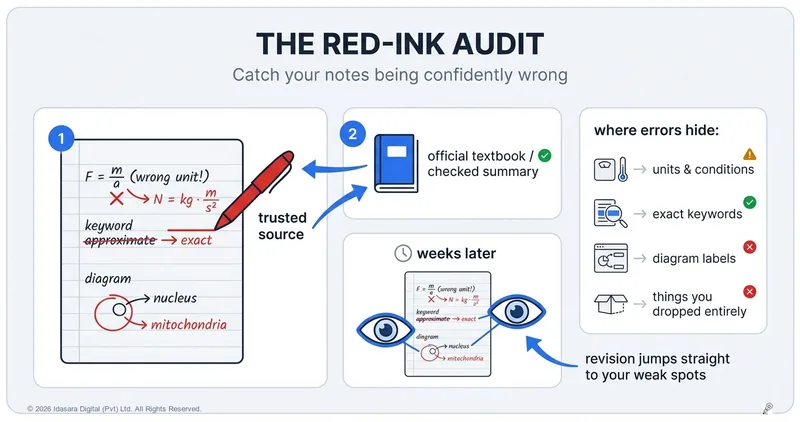
1. Compare item by item — not vibe by vibe. Don't "look over" the note (looking-over is highlighting's cousin: comfortable and blind). Go claim by claim: this formula against theirs, this definition's wording against theirs, this diagram's labels against theirs.
2. Hunt in the four burrows where errors hide. Marking-scheme experience says your slips cluster here: - Units and conditions — the formula is right; the "only when…" beside it vanished. - Precise wording — you kept the meaning, lost the syllabus keyword the scheme pays for. - Diagram labels — the shape survived memory; one label didn't. - Missing items entirely — the fourth cause, the second exception. Memory doesn't flag what it dropped, which is why the comparison must be against the source's list, not your recollection of it.
3. Correct in red, ON the note — never rewrite the page. Fix the error where it lives: the missing unit inserted, the wrong word struck and replaced, the absent label added. A rewritten clean page destroys the evidence; the corrected page is the treasure — and here's why.
Why red ink is a machine, not a decoration
Weeks later, in revision, you open that page — and the red does something no clean page can: it pre-sorts your attention. The black ink is what your memory produced correctly; it needs a glance. The red is the precise archive of where your particular memory failed on this particular topic — and revision time flows straight to it.
Think about what you're holding. Not just notes — a personalised error map no bookshop, no tuition class, no topper's photocopied masterpiece could ever sell you, because it's a map of you. Two students with identical black ink will carry different red: hers marking dropped units, yours marking swapped keywords. Each is revising their actual weaknesses. This is the same principle the exam chapters of this book build into a full system — the A-student's habit of studying their mistakes rather than their comforts — running here in miniature, at the notes level, for the price of a red pen.
And one more quiet payoff: the audit trains the auditor. After a month of red-ink sessions, you'll notice yourself writing notes differently — pausing at a formula: "there was a condition here, wasn't there?" The repeated experience of being caught teaches your memory where it drops things. The check strengthens the writing it checks.
What should you check your notes against?
An audit is only as good as the standard it audits against. The mirror must outrank your memory and match your syllabus:
- First choice: the official textbook or resource book itself — the exact source the exam is built from, as the textbook chapter of this book established.
- A curriculum-checked digital summary works when it's genuinely curriculum-checked — matched to your grade and national syllabus, not a foreign curriculum's phrasing of the topic.
- Last resort: a friend's strong notes — memory checking memory, usable when nothing better is at hand, with the textbook confirming anything that surprises you. Never: a random internet summary (whose own errors and foreign terminology you would be inking into your notes, in red, with total confidence).
Do this tonight
- Take the most recent short note you've written — ideally one a few days old, so you've stopped remembering what you meant and can only read what you wrote.
- Run the audit against the textbook: item by item, four burrows, red corrections in place.
- Count the red marks. Two or three is a normal, healthy harvest from an honest note. Zero usually means the comparison was a look-over — go again, claim by claim.
- Notice the feeling when you catch one — the small jolt of "I was sure of that." Learn to love that jolt. Every one is a mark that just moved from the exam's side of the table to yours.
At a glance
- Notes written from memory are the best learning tool — and arrive confidently wrong in places you cannot feel.
- The audit: right after writing, compare item by item against a trusted source; correct in red, on the page — never rewrite clean.
- Errors cluster in four burrows: units/conditions, precise keywords, diagram labels, silently dropped items.
- The red is a machine: it pre-sorts revision attention to your personal failure points — an error map of you.
- The mirror must outrank memory and match the syllabus: official textbook first; curriculum-checked summaries second; friends' notes only when nothing better is at hand.
One step further with Idasara Academy
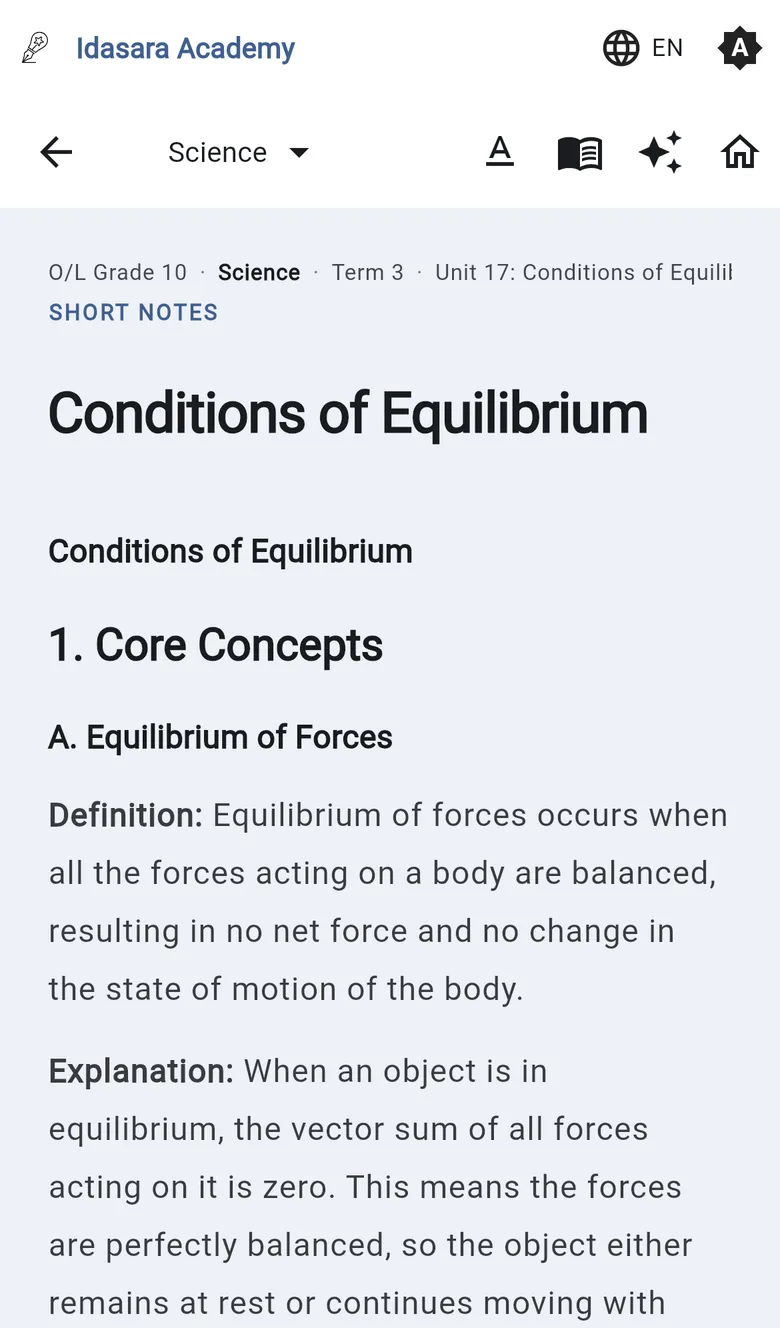
The audit's bottleneck is the mirror. Idasara Academy's short notes — free to start — exist to be exactly that: a curriculum-checked summary of every topic in your grade, aligned to the national syllabus's own wording — the standard your red pen checks against, one screen beside your notebook. Your note stays handwritten, your corrections stay yours; the mirror just guarantees the standard you're correcting toward is the one the exam will use.
Start Free — Create Your Account →
FAQ
Doesn't checking right after writing defeat the memory test? No — the retrieval already happened when you wrote the note with the book closed. The audit is the feedback step, and retrieval-practice research is explicit that checking your output against the source completes the technique. Unchecked retrieval practises errors too.
My note is so red it's embarrassing. Should I rewrite it? Heavy red on early notes is the method working, not failing — and no, keep the page: heavily-corrected notes are your highest-value revision documents precisely because they hold the most captured errors. The embarrassment fades; watch instead how the red thins over the weeks. That thinning is measurable progress.
Can I audit with the app's summary instead of the textbook? For the regular rhythm, a curriculum-checked summary is built for exactly this and faster to navigate. Keep the textbook in the loop for full re-reads and for anything the summary compresses — the audit standard and the reading source can share the job.
How is this different from the mistake bank the exam chapters describe? Same philosophy, different altitude. The red-ink audit catches errors in your notes, minutes after they're born. The mistake bank catches errors in your answers, across quizzes and papers, and manages them over months. Together they close the loop at both ends: nothing wrong survives in what you study from, and nothing wrong survives in what you produce.
Further reading
The self-comparison protocol — and why red-ink annotation turns note-taking from transcription into self-audit — is written up in the Idasara Method: Part 1 — The Human Foundation & Active Recall.
Sources
- The Learning Scientists: Learn How to Study Using… Retrieval Practice (checking retrieved output against source)
- Dunlosky, J. et al. (2013). Improving Students' Learning With Effective Learning Techniques — overview at the Association for Psychological Science
- The Idasara Method: Part 1 — The Human Foundation & Active Recall