One Hour, Two Skills: How Revision Time Can Also Teach You AI
The short answer: You learn AI skilfully by using it on the syllabus you must revise anyway: attempt the topic on paper first, then run a structured prompt on it and read the response as an examiner — complete? syllabus-worded? steps verified? One hour banks the revision and a genuine rep of AI literacy at the same time.
A chapter of the free book Learn to Learn
Published 2026-08-31 · updated 2026-08-31
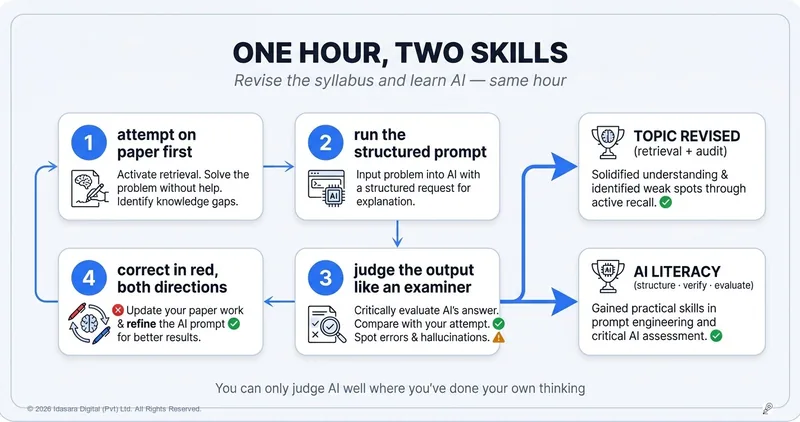
Most students will need two educations: their syllabus, and the ability to work skilfully with AI — and almost nobody has time for a second curriculum. This chapter of Learn to Learn shows how the two can be the same hour: structured prompting practice, run on your own syllabus topics, that revises the material while training the century's newest professional skill.
Here are two facts about your future that sit awkwardly side by side.
Fact one: in the next few years, your life runs through a syllabus and a paper-based exam — that is where your time must go, and this book has been unapologetic about it.
Fact two: in the decades after, an enormous share of skilled work will involve directing AI systems — asking precisely, structuring requests, judging outputs. UNESCO has gone as far as publishing AI competency frameworks for students worldwide; the working world is not waiting for anyone's exam calendar.
So when, exactly, is a Sri Lankan student supposed to learn the second thing? There's no room in the timetable for a second curriculum — and the honest answer is that there doesn't need to be. Used a particular way, the same hour teaches both. This chapter is about that way.
What is a prompt pack?
You've been writing your own AI questions since the question-log chapters — surgical, single-target queries aimed at your own confusions. That's the foundational skill, and nothing replaces it.
A prompt pack is the next level up: a pre-structured, topic-aligned prompt framework — think of it as a worked example of expert prompting, attached to a syllabus topic. Where your surgical query asks one thing ("why does the potential difference stay equal across parallel branches?"), a pack orchestrates a whole interaction: "break down the four stages of mitosis with diagram labels", "generate a past-paper-style projectile motion problem and guide me through it step by step", "analyse the economic causes of this period from three perspectives."
Reading a well-built pack teaches you, by example, what your own one-line questions don't yet show: how experts structure multi-part requests, how they demand step-by-step verification rather than raw answers, how they constrain an AI to a syllabus, a format, a role. It's the difference between asking for directions and studying how routes are planned.
The workflow — paper first, always
The packs only deliver their double value inside a workflow, and by now you can predict its first rule:
- Pick the pack for the topic you're revising anyway. This is revision, not a detour — the pack's content is your syllabus.
- Attempt on paper before triggering anything. The pack asks for mitosis's four stages? Close the book, draw and label them from memory first. This is the retrieval step — skip it and the session degrades into watching an AI be clever, which you know by now teaches nothing.
- Run the pack and read the response as an examiner. Not "is this impressive?" but: is it complete against my syllabus? Does the terminology match my textbook's? Did it verify its steps? You've just practised the third pillar of AI literacy — critical evaluation — on material you can actually judge, because you attempted it first. That last clause is the secret of the whole method: you can only evaluate an AI's answer well in territory where you've done your own thinking. Your paper attempt is what makes your judgement real.
- Compare, correct, close the loop in ink. Differences between your attempt and the response go into your notes in red — whichever direction the correction runs. Sometimes you were incomplete; occasionally you'll catch the response being off-syllabus, and that catch is the most valuable AI lesson of the week.
Run that loop and count what one hour produced: a topic retrieved, audited, and corrected (revision, fully banked) — plus one rep each of expert prompt structure, output evaluation, and verification discipline (AI literacy, fully banked). No second curriculum. Same hour.
Why not learn prompting separately?
There's a version of AI-literacy education that's all abstractions — courses about prompting, disconnected from anything the learner actually knows. It produces students who can recite prompt tips and can't tell a good output from a fluent-wrong one.
The pack workflow inverts it: your syllabus knowledge and your AI judgement grow against each other. The chemistry you retrieved this morning is what lets you catch the response's dodgy step this evening; the evaluation habit you built this evening is what deepens tomorrow's chemistry. This is also why the skill transfers: the person who spent two years attempting-then-evaluating on hard material walks into university — and work — already fluent in the actual professional posture with AI: direct it precisely, verify it ruthlessly, own the result. That posture, not any tool trick, is the durable skill. Tools will change every year of your career. The posture won't.
Do this tonight
- Take tonight's revision topic. Before any screen: blank page, five minutes, produce what you know — the diagram, the stages, the derivation.
- Then run a structured prompt on that topic — a pack if you have access to one, or build your own using the pack pattern: role + syllabus constraint + multi-part request + "verify each step" + format demand. Building one by hand is itself excellent training.
- Read the response as an examiner: complete? syllabus-worded? steps verified? Corrections — in either direction — go into your notes in red.
At a glance
- Students need two educations — syllabus and AI fluency — and the pack workflow makes them the same hour.
- A prompt pack = a worked example of expert prompting, attached to a syllabus topic: structure, constraints, step-verification, format.
- The rule that unlocks everything: attempt on paper first — you can only evaluate AI output well in territory where you've done your own thinking.
- Read every response as an examiner: completeness, syllabus terminology, verified steps; corrections in red, both directions.
- The durable skill is the posture — direct precisely, verify ruthlessly, own the result — and it transfers to every tool you'll ever meet.
One step further with Idasara Academy
Idasara Academy ships Prompt Packs — and they're free: curated, syllabus-aligned frameworks for exactly this workflow, sequenced to your topics. They're the doorway into the curriculum-grounded AI coach (free for 5 messages a day; the paid tiers remove the cap), where the responses stay syllabus-faithful while you practise evaluating them. Tap one on tonight's revision topic — after your paper attempt — and the double-value hour starts. No detour, no second curriculum, and every session leaves both ledgers richer.
Start Free — Create Your Account →
FAQ
Isn't "prompt engineering" going to be obsolete as AI gets smarter? The tips-and-tricks layer, probably. The posture layer — decomposing what you want, constraining it precisely, evaluating what comes back — is just clear thinking made external, and it gets more valuable as AI gets stronger, because stronger tools amplify direction quality in both directions.
Can't I skip the paper attempt and just study the AI's answer? Then the hour posts to the rented-knowledge column you met two chapters ago — and your "evaluation" becomes nodding at fluency, since you've done no thinking to judge against. The attempt is not a warm-up; it's the load-bearing step of both skills.
I don't have access to curated packs. Can I still do this? Yes — build prompts using the pack pattern in this chapter, on your own topics. You'll make clumsy ones at first; that's the training. The curated versions mainly buy you expert structure and curriculum grounding from day one.
Is this appropriate for O/L students, or only A/L? The workflow scales down naturally: simpler topics, simpler packs, same posture. An O/L student who spends two years attempting-first and evaluating-always arrives at A/L with both curricula compounding.
Further reading
Prompt packs, the paper-first workflow, and the AI-literacy case are written up in the Idasara Method: Part 1 — The Human Foundation & Active Recall and Part 2 — The Plan.
Sources
- UNESCO — Artificial intelligence in education: a human-centred approach (AI competency frameworks for students)
- The Learning Scientists: Learn How to Study Using… Retrieval Practice (why the paper attempt comes first)
- The Idasara Method: Part 2 — The Plan