Parenting From Abroad: The Exam Year Across an Ocean
The short answer: Retire the "are you studying?" call and run the year on shared evidence: a caregiver at home guards the routine, you read the progress trends from abroad and join the big decisions by call, and the weekly fifteen minutes carries one specific praise and one thread that isn't the exam. On instruments, distance parenting works — often better than doorway guessing ever did.
A chapter of the free book Learn to Learn
Published 2026-08-31 · updated 2026-08-31
Across the island, an enormous number of children are studying for national exams while a parent works in another country — the remittances funding the very education the distance complicates. Nobody writes for these families; the culture offers them only guilt. This chapter of Learn to Learn does better: how distance parenting runs well on shared instruments, the caregiver triangle that makes it work, and what the money should and shouldn't be asked to say.
The Friday call, familiar to half the island: a parent in Dubai or Doha or Milan, tired after a shift, asks the only question distance seems to allow — "putha, are you studying?" — and gets the only answer the question ever earns: "yes." Both hang up unsatisfied. The parent, no wiser, sends the guilt the distance manufactures. The child carries a weekly reminder that the family's sacrifice is riding on them — pressure without support, the worst combination this book knows.
Say the true thing first, because these families rarely hear it: working abroad for a child's education is an act of provision, not abandonment — and the distance-parent's real disadvantage isn't love or commitment; it's information. The doorway-parent guesses badly from ten feet (the blame-cycle chapter proved it); the abroad-parent guesses from ten thousand kilometres. Which means the fix is the same fix, amplified: replace the guessing with instruments — and suddenly distance matters far less than anyone believed.
The triangle: parent abroad, caregiver at home, student
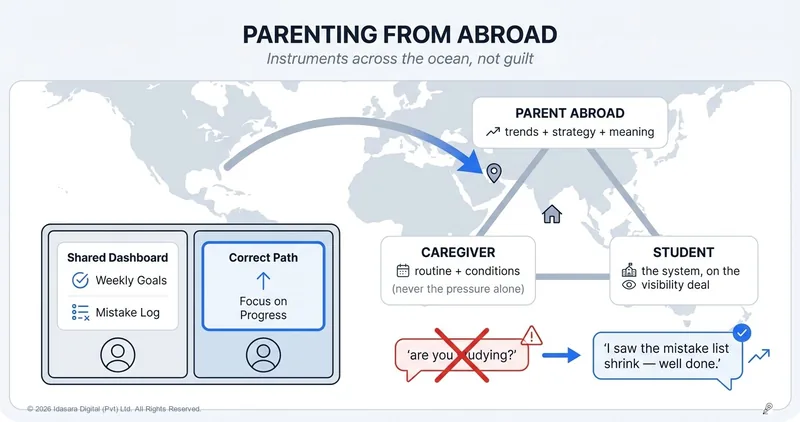
Distance families run on a triangle, and naming each corner's actual job prevents the classic failures (the caregiver reduced to a cook; the abroad-parent reduced to a wallet-with-guilt; the student answering to nobody or to everybody):
The caregiver at home — grandmother, aunt, the remaining parent — holds the local jobs from the parents' chapters: the routine guarded (sleep, meals, the anchor times), the conditions protected (the quiet arrangements, the phone geometry), the presence at the school gate. What the caregiver should never be asked to carry alone: the strategy, the pressure, the monitoring — grandmothers cannot read tuition audits, and shouldn't have to.
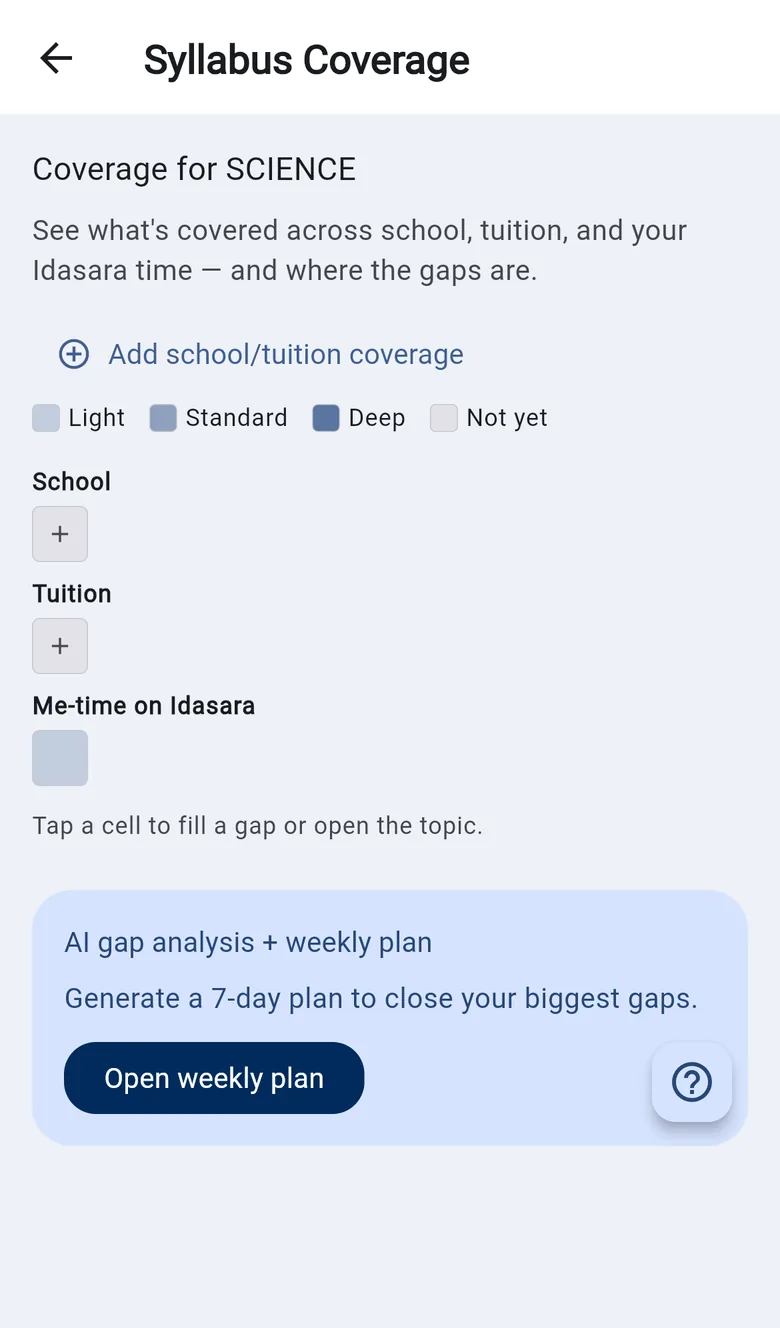
The parent abroad holds what distance actually permits, and it's more than the Friday interrogation: the trend-reading (the dashboard reads identically in Colombo and Kuwait — coverage, traffic lights, the marked-paper trajectory: the informed monthly conversation the A/L chapter described, run over a video call with the instruments open on both screens), the strategy seat (the elective evenings, the stream decisions, the tuition audits — joined by call, decided jointly; distance excuses none of Part 10's homework), and the meaning-making — of which more below.
The student holds the system itself — and gains, properly framed, something valuable: the visibility deal (the blame-cycle trade) works better across distance, because the instruments replace an interrogation the child resented with a dashboard the child controls. More than one abroad-family reports the strange upgrade: the parent overseas, on instruments, became better informed than they'd ever been at home on guesses.
What should the weekly call sound like?
Retire "are you studying?" — it measures nothing, from any distance. The redesigned weekly call, fifteen minutes: open the instruments together (the week's tracker — the coverage chart — one number that moved — evidence gives the call a shared object, which is what the old call never had), one process-praise, specific (the parents' chapters' machinery survives transmission perfectly: "I saw the mistake list shrink — that fortnight of maths shows"), one real-life thread that isn't the exam (the exam-free channel matters more over distance — a parent who only calls about studying becomes, in the child's phone, the studying), and the logistics sweep with the caregiver (separately, briefly — the triangle's other edge maintained). Guilt sends pressure; instruments send partnership. The child can feel which one arrived before hello finishes.
What should you tell your child about the money?
The remittance economy's silent script — we suffer abroad so you must succeed — is usually meant as love and lands as debt, compounding weekly (the fear-fuel this book keeps pricing). It deserves one deliberate replacement, said once and then lived: "the money buys you the chance; your job is the honest work, not the guarantee." Pair it with the widened map (Part 10's doors — spoken from abroad, where many parents have seen exactly how many roads the world actually holds), and the sacrifice converts from a weight on the child into a floor under them. The families that thrive at distance all seem to have had some version of this conversation; the ones that fracture usually never did.
Do this month
- Build the triangle explicitly: one call with all three corners where the jobs are named — caregiver's local guardianship, parent's trends-and-strategy, student's system. Write the weekly rhythm down.
- Install the shared instruments: dashboard access abroad, the WhatsApp digest for the caregiver, the wall-tracker at home. Retire the interrogation call the same week.
- Have the money-meaning conversation — prepared, calm, once. Then let the Friday calls be about trends, praise, and cricket.
At a glance
- Working abroad for education is provision, not abandonment — and the real handicap is information, which instruments fix better than guilt ever did.
- The triangle: caregiver = routine & conditions (never strategy alone) · abroad-parent = trend-reading + the strategy seat + meaning-making · student = the system, on the visibility deal.
- The call, redesigned: instruments open together · one specific process-praise · one non-exam thread · caregiver logistics separately. Fifteen minutes; no interrogation.
- The money's meaning, said once: it buys the chance, not the debt — paired with the widened map, sacrifice becomes floor, not weight.
- On instruments, distance-parenting can beat doorway-parenting. Many families discover it already has.
One step further with Idasara Academy
This family's shape was in the design: the parent dashboard reads identically from any country (trends, traffic lights, the shared screen for the redesigned call), the WhatsApp digest meets the caregiver where they already are — in their language, no app skills demanded — and the mentor invite can add a trusted local adult (an uncle, a past teacher) to the triangle with consent-gated visibility. The ocean stays; the guessing goes.
Start Free — Create Your Account →
FAQ
I'm the caregiver — a grandmother — and all of this technology talk isn't me. Your corner never needed the technology: routine, meals, the quiet half-hour, the school gate — the oldest jobs, done your way. The digest arrives as an ordinary message you can read or have read to you; everything else is the abroad-parent's corner. What the triangle asks of you is what you already know how to give — and permission not to carry the pressure the distance tempts everyone to route through you.
My child performs studying for the camera on calls, and I can't tell what's real. That's the doorway problem over video — and the answer is the same: stop reading the performance, read the instruments (they don't perform). The screen-off explain-back check works on calls too: "teach me the thing you studied this week" survives any distance and no theatre survives it.
The time difference means I'm asleep during homework hours and awake during school. When do I even parent? Trend-parenting is asynchronous by design — the dashboard's week reads the same whenever you wake, the praise lands by message as well as by call, and the weekly fifteen minutes needs only one workable overlap (weekend mornings island-time fit most Gulf and European shifts). You're not needed at homework hour; you're needed at the month's altitude — which distance serves fine.
I'm a mother working as a housemaid — my phone time is not my own. One short call a week, sometimes less, on someone else's schedule. The redesigned call above assumes freedoms I don't have. It does, and you deserve the version built for your actual week. When contact is scarce, spend it entirely on the two things only a mother can send: one specific praise and one non-exam thread — the trend-reading corner of the triangle moves to the caregiver or a trusted adult (the mentor invite exists for this), and the digest can wait on your phone for whenever you're allowed to read it, because trends don't expire the way calls do. Two more truths for your situation: a five-minute call that lands as love outweighs an hour that lands as interrogation, so scarcity is not the handicap it feels like; and the money-meaning conversation matters most in your family's shape — say it once, in a letter or a voice note if the calls won't fit it, and let it stand.
Since I left, my eldest daughter has become the household's second mother — and her own studying is disappearing under it. Name it, this month, before another term absorbs her. A daughter who inherits the kitchen, the younger children, and the caregiver's exhaustion is doing invisible full-time work, and no study method survives a day with no hours left in it — the working-student chapter is her chapter now, and its first rule applies: her anchor study time is a household decision, protected out loud, not something she must defend nightly against everyone else's needs. This is a triangle job that belongs to you, not to her: one call where you say to the household — not to her — "her hour is fixed; the house works around it." She cannot win that negotiation alone, and she shouldn't have to.
Should I come home for the exam period? If it's possible, the highest-value windows are decision seasons and the exam fortnights (support-crew season — the playbook chapters show what those days need). If it isn't possible — and for most it isn't — the redesigned system is the presence: steady, informed, un-guilty. Children remember the years' texture, not the December geography; make the texture partnership.
Further reading
The machinery this chapter transmits: "I Never See You Studying" (the visibility deal) · The O/L-Year and A/L playbooks (the seasons, run remotely) · Results Day at Home (next — plan it before you need it).
Sources
- The Idasara Method: Part 3 — readiness instruments (what the shared screen shows)
- Idasara Academy — Trust & data safety (family access, consent-gated)
- NHS — pressure and support (why guilt-fuel fails)