Describe, Explain, Evaluate: Read the Verb Before You Write a Word
The short answer: Command words — describe, explain, compare, derive, evaluate — tell you what kind of answer earns the marks: a picture in words, reasons, both side by side, every step, a judgement with evidence. Circle the verb before you write, because a correct answer to the wrong verb scores almost nothing.
A chapter of the free book Learn to Learn
Published 2026-08-31 · updated 2026-08-31
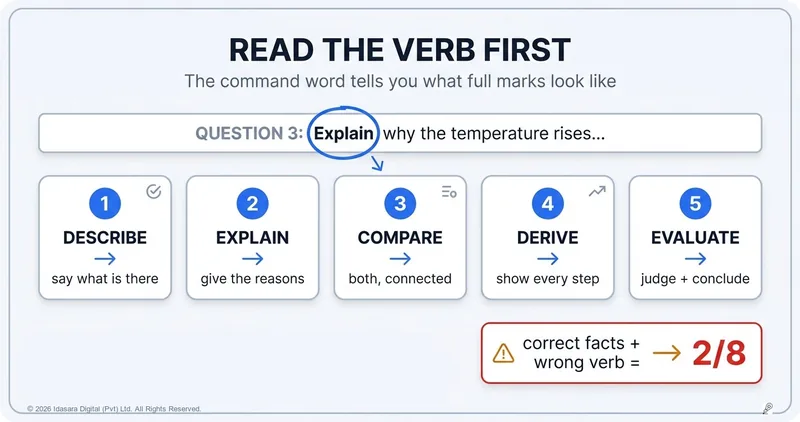
Every exam question contains one small word that decides what a full-mark answer looks like — the command verb — and answering with the wrong verb loses marks on topics you knew perfectly. This chapter of Learn to Learn decodes the verbs your papers use, and builds the two-second habit that stops the silent mark leak.
Here is one of the most painful experiences in a student's life — precisely because no one can see it happening.
The question is on a topic you know cold. You fill half a page, writing everything true and relevant. You walk out satisfied. And when the marks come, that question paid you 3 out of 8.
But everything I wrote was correct! — yes. Correct, and not what was asked. The question said explain why; you described what. Every sentence was true; almost none touched the marks, because the marks were attached to reasons, and you supplied features.
The difference between those answers was one small word near the start of the question. Let's learn to read it first.
What does each command verb actually ask for?
Command verbs — describe, explain, compare, derive, evaluate — are instructions about what kind of thinking the examiner wants back. Same topic, different verb, completely different full-mark answer. Watch one topic transform:
- Describe the structure of the human heart → say what is there: four chambers, valves, vessels — a picture in words. No reasons required.
- Explain why the left ventricle wall is thicker than the right → give reasons: because it pumps blood around the whole body against greater resistance. Description without the because earns almost nothing here.
- Compare the pulmonary and systemic circuits → put both side by side: similarities AND differences, explicitly connected. Writing two separate descriptions and hoping the examiner links them is the classic half-mark answer.
- Derive an expression (in maths and physics) → show the journey: every logical step from starting principles to result. The final formula alone — even correct — misses the point entirely, because the derivation is what's being marked.
- Evaluate whether a treatment is worthwhile → judge with evidence: strengths, weaknesses, and — the part most students omit — an actual conclusion. An evaluation that never commits to a judgement is a list, and it's marked as one.
Examination boards publish these meanings deliberately — Cambridge, for instance, maintains a public list of its command words and states plainly that they "tell you how to answer a specific exam question." The verbs aren't decoration or formality. They are the marking scheme, announced in advance.
Why did I lose marks on a question I knew?
This mark leak has a cruel property: it's invisible from inside the exam hall.
When you don't know a topic, you feel it — the discomfort tells you where you stand. But when you know the topic and answer the wrong verb, everything feels right: the pen moves, true statements flow, confidence is high. The failure is only visible from the marker's chair, where a scheme says "1 mark per reason" and your answer contains beautiful descriptions and no reasons.
This is also why the leak survives years of studying. Students revise content endlessly and verbs never — so the same student loses the same marks the same way, paper after paper, and concludes the problem is nerves, or luck, or harsh marking. It was one unread word, every time.
There's a deeper habit underneath, and you've met it in this book already: the panic-skim. Under time pressure, the eye grabs the topic of the question — "heart! I know the heart!" — and the hand starts unloading everything about the topic. Reading the verb is the antidote in miniature: it forces the question to be read as an instruction, not as a topic prompt.
The two-second habit
The fix costs two seconds per question, and it's mechanical enough to survive exam-hall panic:
Circle the verb. Say what it demands. Then write.
- Circle the command verb before anything else — physically, with your pen. Describe. Explain. Compare. Derive. Evaluate. Outline. State. Justify.
- Translate it into a demand in your head, one line: reasons (explain), picture in words (describe), both, connected (compare), every step (derive), judgement with evidence (evaluate).
- Let the verb shape the skeleton. An "explain" answer is built of because-sentences. A "compare" answer holds both items in every line. An "evaluate" answer ends in a verdict. If your planned first sentence doesn't fit the verb's shape, you've caught a wrong answer before writing it.
And one upgrade for your daily studying: when you practise questions from this day on, mark yourself on the verb too. The question said explain — did your answer actually contain reasons? This single check, applied to your own practice answers, teaches more exam technique in a month than years of unexamined practice.
Do this tonight
- Take five past-paper questions from one subject — don't answer them. Just circle each verb and write the one-line demand beside it. Two minutes.
- Now find one of your old practice answers (or a test script you got back). Circle the verb in its question, then reread your answer asking one question only: did I answer this verb? Most students find at least one perfect wrong-verb answer — and seeing your own is worth ten warnings from a book.
- From tonight, no practice answer begins until its verb is circled. Two seconds. For life.
At a glance
- The command verb (describe, explain, compare, derive, evaluate…) announces what a full-mark answer must be — it is the marking scheme in one word.
- Same topic + different verb = different answer: what's there ≠ why ≠ both side by side ≠ every step ≠ judgement with evidence.
- Wrong-verb answers feel perfect while losing marks — the leak is invisible from inside the hall.
- The habit: circle the verb → state its demand → let it shape the skeleton → then write.
- Mark your own practice answers on the verb, not just the content.
One step further with Idasara Academy
The verb check works best with a marker who never gets tired of applying it. When you upload a handwritten answer to Idasara Academy's Exam Paper Marking (paid tiers), it's marked against the official scheme — and the feedback shows exactly where marks went missing, including the classic pattern this chapter is about: correct content that didn't serve the question asked. Seeing "you described; the question asked you to explain" on your own answer, in week three instead of on results day, is the whole game.
Start Free — Create Your Account →
FAQ
Where do I find what each verb means for MY exam? Your best sources are official past papers with their marking schemes: read scheme against question and the verb's demands become concrete for your subject. Boards also publish command-word lists — Cambridge's public list is a good model of the genre — and your teachers know your local board's dialect precisely; it's an excellent question-log question.
What if a question has two verbs — "describe and explain"? Then it has two jobs, and the marks are split between them. Answer both, ideally in order: the picture first, the reasons second. Circling both verbs is exactly how you avoid serving only the comfortable one.
Does this really matter in mathematics? Fully — maths just uses its own dialect: derive, show that, hence, verify, solve. "Show that" means the destination is given and every step to it is the answer. "Hence" commands you to use the previous part — solving from scratch ignores the instruction and often the allocated method marks — the marks paid for your working.
Isn't this just exam trickery rather than real learning? It's the opposite of trickery — the verbs are the exam speaking plainly about what it wants. And the skill transfers: knowing whether a situation demands description, explanation, comparison, or judgement is precisely what good thinking and good writing require everywhere, from university essays to workplace reports.
Further reading
Comprehending directional verbs is part of the "universal examination contract" — independent reading, comprehension, and composition under time — written up in the Idasara Method: Part 3 — The Grade Progression Ladder & Paper Marking.
Sources
- Cambridge International Education — Command words and what they ask of candidates
- The Idasara Method: Part 3 — The Grade Progression Ladder & Paper Marking